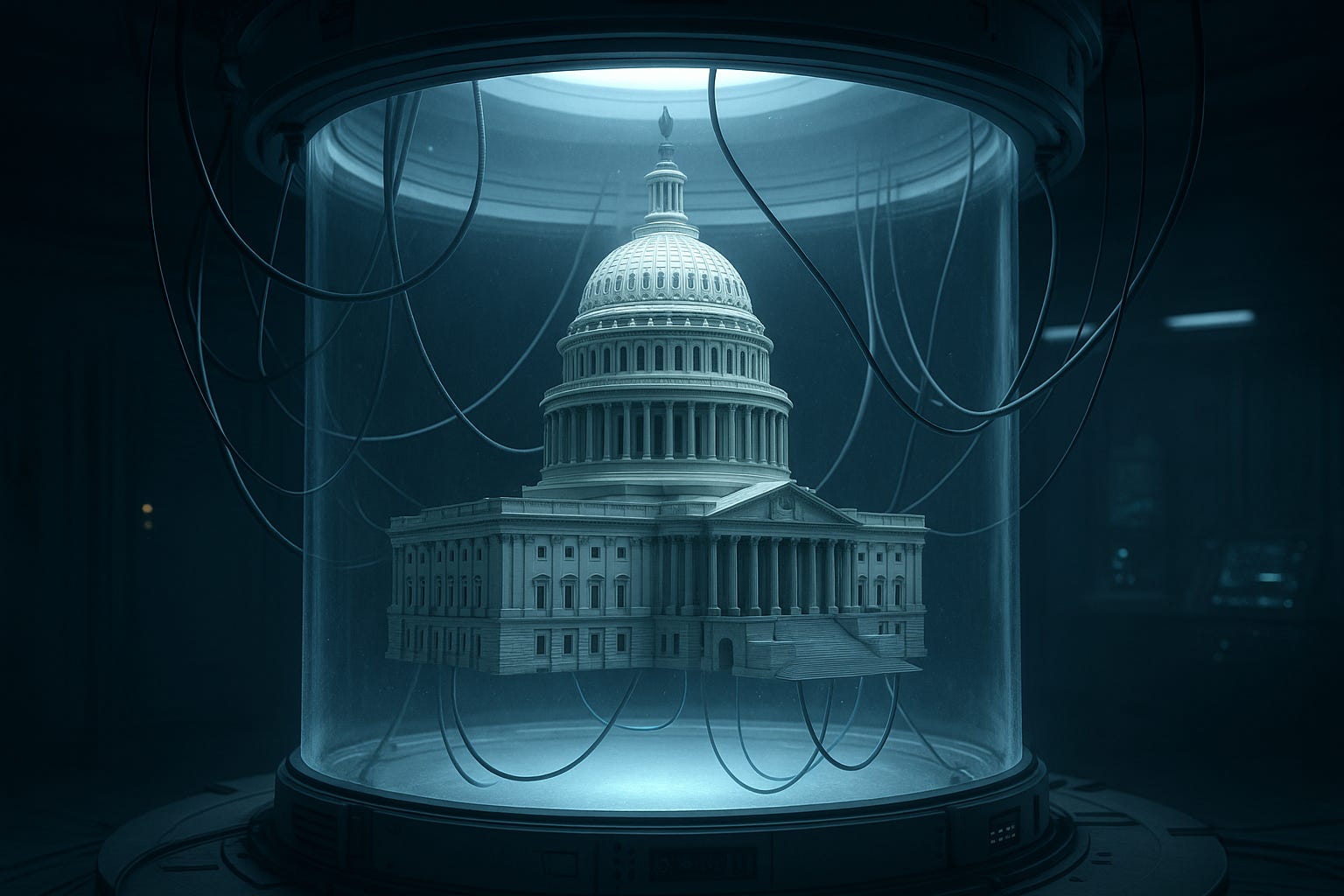
House Speaker Mike Johnson has functionally dissolved Congress, deepening the damage to what’s left of the constitutional order with each passing day. By taking the advice of the likes of Newt Gingrich to keep his fragile, tiny majority together by keeping it physically apart, Johnson has only further aggrandized Donald Trump. “I’m the speaker and the president,” Trump reportedly jokes at the White House. Johnson’s decision to shutter the House strengthens his CR strategy, which tacitly ratifies the shift of spending power to the White House.
The shutdown is accelerating what University of Maryland public policy professors Donald Kettl and Philip Joyce recently described as “the single biggest expansion of presidential power in American history,” created by “the single largest shift in the constitutional balance of powers ever.” Trump’s congressional and court allies are collapsing their power into his hands.
Former OMB official Bobby Kogan worries that we’re only at the lower levels of how egregiously the White House may co-opt the power of the purse, articulating a five level framework for evaluating the infringement on Congress’s authority. “Once a president has decided that he is unbounded by the Constitution, the Antideficiency Act, or the purpose statute, any of these levels is possible,” Kogan notes. “The only barriers left are self-imposed restrictions.”
Congressional expert Matt Glassman highlighted the administration’s rerouting of military R&D dollars to pay service members, writing “for the legislature to say ‘you can spend $8B for the next two years on weapons research’ and for the executive to take that money and proudly spend it on soldiers instead is a pure attack on Congress, and consequently, on the rule of law. It reduces Congress to a single, negative power: the right to not appropriate any money.”
Trump already is pursuing creative work-arounds for self-enrichment as well as enriching his political allies. We may be witnessing the creation of a personal cash machine, as Trump presses the Justice Department for $230 million as a settlement for the investigations he faced under the Biden Administration. Officials at the Justice Department, including his former defense attorneys, would have to sign off.
As the material and political conditions of the shutdown cause major deterioration beyond the capital region, such as the collapse of air travel, exploding health insurance costs, and food insecurity, elected representatives may rediscover their personal political agency. We also may see public demonstrations grow beyond the 7 million Americans who rallied for the ‘No Kings’ protest.
Accountability (or lack thereof)
As the president suggested some of his former legal team, now installed at the Department of Justice, should fulfill his $230 million damages claim against the department, his unraveling of the government accountability apparatus continued under the radar. Trump has fired 18 inspectors general during his term, with the latest let go last week at the Export-Import Bank. The White House has provided no justification for any of the firings, which Sen. Chuck Grassley complained violated statutory requirements.
Replacement IGs, meanwhile, are reaching confirmation hearings in the Senate. HSGAC ranking member Gary Peters asked specifically whether Trump violated the law by providing no “substantive rationale” to Congress required for their predecessors’ dismissal. None answered.
Nevertheless, some nominations are moving forward. Sen. Lisa Murkowski cast the deciding vote to approve the nomination of former Rep. Anthony D’Esposito as Department of Labor IG, despite allegations he violated House rules by employing his mistress and his fiancee’s daughter. (The sole point in D’Esposito’s favor is they are not the same person.)
Senate Republicans did draw a line this week with Trump’s choice to replace the head of the Office of Special Counsel he fired in February. Paul Ingrassia, White House liaison to the Department of Homeland Security, had his nomination withdrawn after HSGAC members signaled it would fail after Politico published a variety of racist text messages he sent to other Republicans. He also admitted to having a “Nazi streak.” Ingrassia also has been accused of sexual harassment by a colleague. Trump fired the previous head of the independent OSC, which protects whistleblowers, without stating a reason – under federal law, the only valid bases for removal are “inefficiency, neglect of duty, or malfeasance in office.”
The Republican majority on the Committee on House Administration announced it will block plans by House Oversight Democrats to create a website tracking ICE raids, leveraging the committee’s oversight of the Office of the Chief Administrative Officer. Chair Bryan Steil rejected the idea that the House would maintain such a website, claiming it would “dox” ICE agents. The idea of the House Administration Committee policing statements and publications by members of Congress seems unorthodox to us. If it is to be done, wouldn’t that be properly done by the Ethics Committee, which also is divided evenly between members of both parties? Moreover, publishing information about government activities is the purpose of the oversight committee.
In response to the Supreme Court’s accelerating use of the “shadow docket” to provide emergency decisions, the Brennan Center has launched a new application tracker.
Secret law
One of the many pernicious ways the Executive Branch undermines Congress is through the Office of Legal Counsel in the Department of Justice. The attorneys who work in this office are charged with interpreting the U.S. Constitution and federal law to provide legal guidance to the Executive Branch, which includes advising on whether actions are constitutional and/or legal as well as addressing disputes among agencies. The OLC is supposed to say what the law is based upon how a federal court would most likely rule.
If it were only this, it would not be a problem. These attorneys do not work as neutral arbiters, however, and instead lean their opinions in favor of what the White House wants to do, contorting the Constitution and federal law in the process. When they decide that an action is lawful, the Justice Department will not prosecute violations of the law that they have blessed, thereby circumventing the judicial review process. The result is effectively a get-out-of-jail free card for the Executive Branch.
Many opinions do not deal with criminal matters but those regarding separation of powers. In those cases, it is Congress and the American public that get the short end of the stick. How would Congress know when the Justice Department decides to ignore duly enacted laws that the DOJ has concluded would impinge on a fanciful interpretation of the president’s constitutional powers?
An unknown number of opinions are kept secret from Congress and the public. There is no public count of how many opinions exist. We have been advocating for public disclosure of the total number of opinions and their subject matter for decades. A 2016 update to FOIA prevented the administration from arguing executive privilege protected opinions older than 25-years could be withheld under FOIA, resulting in the release of a huge trove of opinions and revealing significant shenanigans. Our testimony on OLC opinions is a great primer to get up to date on the issues involved. It is our view that the OLC practice should include the presumption of timely disclosure for opinions, not the dark mirror reverse proposition of withhold except in rare circumstances.
Unfortunately, legal efforts to obtain more recent opinions have not been successful. The DC U.S. Court of Appeals just rejected a suit by the Campaign for Accountability for access to several categories of Office of Legal Counsel opinions under the Freedom of Information Act. The appellate court reversed a lower court’s finding that some of the opinions should be disclosed under FOIA’s reading room provision. This is an instance of the DOJ having it both ways – the opinions are sufficiently binding inside the Executive Branch, but not binding enough for the courts. Many federal judges, including those on the Supreme Court, got their start at the Justice Department, including in the Office of Legal Counsel
To underscore the salience of OLC opinions, the Knight First Amendment Institute’s Jameel Jaffer points to the strikes by U.S. forces on the boats in the Caribbean and the Pacific, explaining that the OLC has deemed the strikes lawful, but of course the analysis hasn’t been disclosed. He points to the Bush administration’s issuance of secret torture opinions – opinions that were withdrawn after they were pried out of the Justice Department’s hands through litigation. (One attorney who authorized the torture became a federal judge, another serves as a law professor at UC Berkeley. Both should have been disbarred.)
Security
An insurrectionist who entered the Senate chamber on January 6 was arrested October 19 for threatening to kill House Minority Leader Hakeem Jeffries. Christopher Moynihan had texted others that he was planning to attack Jeffries Monday when he made a speech in New York City.
Moynihan’s 21-month prison sentence for participating in the attack on the Capitol was voided when President Trump pardoned him and all other defendants in January. He is the first pardoned January 6 criminal to be arrested for threatening a member of Congress. According to CREW, “at least 10 January 6th insurrectionists pardoned by President Trump have already been rearrested, charged or sentenced for other crimes,” including plotting to murder FBI agents, child sexual assault, possession of child sexual abuse material, and more.
Bottlenecks
All communications by Department of Defense personnel with Congress will have to be conducted through the Pentagon’s main legislative affairs office under a new memo issued by DoD leadership. The policy is a major change as the branches of the military, combat commands, and DoD agencies all have their own relationships on Capitol Hill, including their own legislative affairs teams.
The move comes as bicameral negotiations for the NDAA are starting, a process that requires constant, rapid communication between congressional staff and various military and civilian officials. One congressional aide told Breaking Defense routing everything through the main leg affairs office may keep needed language out of the bill. Not just that – Congress should empower the entities it creates to be able to speak clearly and directly to legislators so that it can engage in better lawmaking.
The policy shift also affects constituent relations, as notice that a service member has contacted a representative office is routed by military commands to their leg affairs office. The new policy creates a bottleneck for responses to congressional follow-up.
Some in Congress, meanwhile, seem content to remain in the dark about what the Administration is doing with military force in the Caribbean. Asked about the Navy sinking civilian boats suspected of drug running, Sen. Cynthia Lummis told Semafor “we ought to just keep shooting them out of the water.” Colombian-born Sen. Bernie Moreno endorsed the potential deployment of ground forces to Venezuela.
Odds & ends
Seating Grijalva: The State of Arizona is suing the House of Representatives for failing to swear member-elect Adelita Grijalva in to represent the 7th District, noting that the Constitution makes no specification of who must administer the oath of office. Speaker Mike Johnson swore in Reps. Randy Fine and Jimmy Patronis in a pro forma session in April.
Nuking shutdowns: Mark Strand and his former boss Sen. Jim Talent argue that the Senate should eliminate filibuster rules for continuing resolutions that are short, maintain current spending levels, and include no riders.
Loper Bright and modernization: Writing for a symposium in the Yale Journal of Regulation, the Bipartisan Policy Center’s J.D. Rackey and Michael Thorning argue that Congress needs to modernize itself and adopt collaborative learning approaches with federal agencies in the wake of the Loper Bright decision and the end of Chevron deference.
Congressional term limits: Every time it’s proposed, we feel obligated to just say no.
The First Branch Forecast is published by the American Governance Institute. It’s written by Chris Nehls and edited by Daniel Schuman.
Assuming there will be future elections in the US in which the outcome is adverse to the party presently in power, you have to wonder how credibility and accountability of government to the people will ever be restored. This, of course, further assumes accountability ever truly existed.