The Government Publishing Office grabbed the spotlight at the final Congressional Data Task Force meeting of 2025 last Wednesday by announcing that it is launching a Model Context Protocol server for artificial intelligence tools to access official GPO publication information. The MCP server lets AI tools like ChatGPT and Gemini pull in official GPO documents, allowing them to rely on current, authoritative information when answering questions.
Here’s why this matters. Large Language Models are trained on large collections of text, but that training is fixed at a point in time and can become outdated. As a result, an AI may not know about recent events or changes and may even give confident but incorrect answers.
Technologies like an MCP server address this problem by allowing an AI system to consult trusted, up-to-date sources when it needs them. When a question requires current or authoritative information, the AI can request that information from the MCP server, which returns official data—such as publications from the Government Publishing Office—that the AI can then use in its response. Most importantly, the design of an MCP server allows for machine-to-machine access, helping ensure responses are grounded in authoritative sources rather than generated guesses.
Adding MCP creates another mechanism for the public to access GPO publications, alongside search, APIs, and bulk data access. It is a good example of the legislative branch racing ahead to meet the public need for authoritative, machine-readable information.
GPO’s Mark Caudill said his office implemented the MCP both to respond to growing demand for AI-accessible data and to avoid having to choose the “best” AI agent. This is in line with GPO’s mission of being a trusted repository of the official record of the federal government. With a wide range of AI tools in use, from general use ones like ChatGPT and Gemini to more specific ones geared toward legal research, GPO’s adoption of MCP allows it to be agnostic across that ecosystem.
A user would configure the LLM of their choice to connect to GovInfo’s MCP, allowing it to draw data from GPO publications rather than being limited to its training data. How well the model interprets those publications and returns quality answers to users is beyond GPO’s control.
GPO also has expanded access to data in ways that don’t involve AI, including expansion of its customizable RSS feeds for users interested in specific types of documents or the latest data from specific federal offices or courts.
Building off the public launch of the legislative branch data map at the most recent Congressional Hackathon, House Digital Service’s Steve Dwyer and our very own Daniel Schuman demonstrated a prototype interface that contained more than 130 data sets. The data map, which is essentially a giant spreadsheet, describes the source of data, what it contained, its format, its provenance, and more. When launched, the data map interface will allow users to search, download, and provide feedback on the holdings. It is their hope that all stakeholders, inside and outside the government, will be able to contribute datasets. They hope to release the interface publicly in early 2026.
I also presented on a project I recently completed to provide more information about members of Congress. Over the last few months I built a dataset that connected representatives’ membership in the 10 major ideological factions in the House to their member bioguide data. In other words, I identified each member of Congress and the major ideological caucuses to which they belong, such as the New Democrats, Freedom Caucus, and so on. Most caucuses publish their rosters on their websites, but that information is not included in the Clerk’s public-facing official member data. Using the Wayback Machine and some secondary source websites, I was able to fill in members’ caucus membership going back to the 117th Congress.
As I explained on the Congressional Data Coalition blog, we have made this data available to GovTrack and hope researchers can utilize it there to reveal things like the density of caucus membership on specific committees, how caucuses are represented on bill co-sponsorships, and how members of caucuses voted on bills and amendments to better understand chamber political dynamics like caucus discipline, cross-caucus collaboration, and issue overlap. The data can be downloaded at this link.
The Office of the House Clerk is days away from launching its committee portal pilot project, which when complete will allow committee staff a central place to manage much of their work. The pilot will include tracking bill referrals to committees, committee votes, and provide vote information to the House Clerk. Eventually, this will be a mechanism for the public to submit their written testimony and truth-in-testimony forms, for the Clerk to publish aggregate vote and witness data, request Official Reporters, and so on. The committee portal has been a long time coming, with Appropriators originally expressing an interest in some aspects going back to FY 2021. The Clerk provided a major public update in the middle of last year.
The Clerk’s Office and the Office of the Secretary of the Senate also discussed their progress on a pilot for making the House’s comparative print suite platform available in the Senate, which has gathered positive user feedback so far. We hope to someday see the results of the comparative print suite—comparing introduced legislation against changes to the U.S. code—included on Congress.gov.
The Secretary of the Senate has finalized a report on how to move forward with its portion of the Congressional Video Project. House and Senate partners are still working out a uniform way to publicly host floor video that will be easy to maintain. Both chambers and the Library of Congress have committed to providing historical floor proceedings on a player that can be embedded in Congress.gov, with video hosting and preservation issues coming into play. We have also encouraged the inclusion of additional House and Senate committee videos on Congress.gov.
The Library of Congress discussed its ongoing user experience research project for Congress.gov, which it will use to improve the site. Those wanting to be interviewed for the project can email user-research-info@loc.gov to volunteer. This project builds off the Library’s public forum on Congress.gov in September. It will announce its 2026 public forum early in the new year and will share the annual report from the Congress.gov team around the same time.
The annual report from the Congress.gov team is a big deal and we are very pleased to see the Library willing to preliminarily discuss the report in public at this meeting. The Library detailed breaking out projects by efforts in progress, those it’s deferring for data partners, and those to explore “resource permitting.” We’d strongly encourage the Library, for its efforts in progress, to provide a rough timeline for completion, even if it is short term, medium term, and long term. We’d also encourage the Library, for those requested projects it is looking to data partners to fulfill, to explore what steps the Library could take to clean up already-existing data generated by data partners or to draw from where civil society has already implemented a solution.
There is much more to cover, from the House CAO’s publishing of a new taxonomy for CaseCompass to an update on the modernized lobby disclosure system to the ongoing legislative drafting study, but that will have to wait until we write our recap of the meeting on the Congressional Data Coalition website. The video and slides for the event are available on the Legislative Branch Innovation Hub.
GAO Succession
GAO Chief Operating Officer Orice Williams Brown will take over as acting comptroller general when Gene Dodaro’s 15-year term expires on December 30. She has served in the agency for more than 30 years, including as its head of congressional relations, and would be the first female comptroller general.
Under current law, a bipartisan group of lawmakers will propose candidates for President Trump to select for nomination to the position for a full term. The group will include HSGAC chair Rand Paul and ranking member Gary Peters, House Oversight chair James Comer and ranking member Robert Garcia, the majority and minority leaders of the House and Senate, Speaker Johnson, and Senate pro tempore president Chuck Grassley. Dodaro was acting CG when he was nominated in 2010. (He reflected on his 50+ year tenure at GAO with GovExec last week.) House Oversight Chair Comer expressed gratitude for Dodaro’s service in a floor speech this past week.
The selection process has a history of strong interbranch collaboration and sensitivity to partisanship in the selection process. As the National Taxpayers Union and the Project on Government Oversight note in their guide on the comptroller general selection process, the committee and White House typically eschew ideological candidates for those who are acceptable to all, usually those with extensive relevant professional experience. As a result, it can take some time. Dodaro was acting comptroller general for two years before his nomination for the full 15-year term.
The White House, however, has taken adversarial interest in GAO as we’ve been charting this entire year. GAO fended off a DOGE landing team, while OMB director Russell Vought has repeatedly claimed the agency has no constitutional legitimacy under his view of unitary executive power.
Last week, we discussed who runs the legislative branch agencies, focusing on a legislative proposal that only addressed the appointment process for the Librarian of Congress and director of the Government Publishing Office. Now, Rep. Ed Case has introduced a bill to remove the president from the comptroller general selection process, which takes on renewed importance given White House pressure on the agency.
In light of the threat of the White House using Dodaro’s retirement to hollow out the agency, former Senate Government Affairs Committee counsel Steven Katz called on congressional leadership to back such a measure. The last 45 years of congressional commission selection, he notes, has not involved a professional search process, lacked an official professional description of the position, and left behind no records of commission proceedings.
Constituent engagement
The Committee on House Administration’s Modernization Subcommittee will hold a hearing on the future of constituent engagement on Wednesday, at 10:00AM in Longworth 1310. Because the witness testimony is available, we can provide a bit of a preview.
Michael Neblo from Ohio State’s Institute for Democratic Engagement and Accountability reminds the subcommittee that more than 70 percent of Americans are willing to engage with members of Congress, but find authentic two-way communication to be the most satisfying. Technology like AI can be layered onto deliberative engagement models like those his center has developed to make them more effective.
Beth Noveck, director of the Governance Lab and the Chief AI Strategist of the State of New Jersey focuses on how AI can help the subcommittee implement two recommendations from the House Modernization Committee – developing options for a constituent feedback platform for pending legislation and for a platform committees can use to solicit public comment and evidence. A public input system for committee hearings, she says, is one of the “most achievable, low-risk, and high-impact places for Congress” to begin using AI.
[Congress has used AI for years, for example, in the comparative print project, and that GAO has its own LLM. But we take the point especially as it comes to soliciting public comment and evidence, something Congress has experimented with—see, e.g., Citizen Cosponsor—but not put into effect in a lasting way.]
It could take Brazil’s e-Cidadania portal as one example to build from, which invites targeted constituencies and organizes questions for similarity, unique perspectives, and relevance. She also provides examples of AI-enabled engagement tools used by American municipalities to process constituent questions and comments.
Beyond specific pilot projects she describes, she also calls on Congress to create a small, permanent team that is modeled on the innovation labs of the Brazilian and Chilean legislatures that can sustain public engagement experimentation. She also calls for Congress to create its own AI model trained on legislative data that could be optimized for legislative functions.
House Digital Service Senior Director Ken Ward notes that the approval process for vendors providing computing applications to the House involves rigorous security requirements and a substantial set of product and provider standards because of disruptions caused by past vendors’ technical and financial failures. As a result, a small pool of vendors control most constituent data within their proprietary systems, limiting innovation for others.
Ward suggests addressing this consolidation challenge with a “data lake,” or a data environment the House itself controls that can be accessed by various vendor applications that members can select. A data lake also could support faster development of internal projects like the CaseCompass casework aggregator pilot by creating a common constituent data standard and support greater interoperability between House applications.
POPVOX Foundation’s Aubrey Wilson provides the subcommittee with several case studies from foreign legislatures that could be a model for congressional innovation. Estonia, for example, has deployed chatbots to assist citizens in finding details about legislation and for interacting with various government agencies. She also highlights a tool the Brazilian Chamber of Deputies uses to perform constituent sentiment analysis on legislative proposals.
Wilson recommends organizational changes to spur innovation in constituent engagement, like reforms and greater transparency for House IT procurement processes, the streamlining of cybersecurity reviews, and the selection of a new CAO that maintains a focus on experimentation.
We welcome the public attention to this issue. We joined an excellent invitation-only conference hosted by Brazil-based Bússola Tech and the Organization of American States this past May at the House of Representatives focused on improving the quality of the lawmaking process that had a specific focus on AI. It contained high level presentations from many of the parliaments leading in AI as to the technologies they use.
The second conference built upon the first, where we were introduced to an International Parliamentary Union report identifying 45 use cases for AI in parliaments. In addition, we would be remiss if we didn’t point you to the excellent book released by Bússola Tech entitled Artificial Intelligence In Legislative Services: Principles for Effective Implementation, which contains the best set of use cases with descriptions of implementation challenges by the people responsible for designing those tools.
Member Pay
Thursday, the Senate Rules Committee advanced an amended version of Senator John Kennedy’s resolution that would halt the payment of senators during future government shutdowns. Ranking member Alex Padilla potentially interrupted its progress, pointing to prudential and constitutional issues, noting congressional pay must be set by law, which the resolution is not. Daniel was in the room, and it was clear that the bill and the failed efforts to amend it had all been worked out in advance. He thinks this is a terrible idea whose political moment may nevertheless have arrived.
AGI opposes S. Res. 526 for several reasons. As the last shutdown demonstrated, House rules allow the Speaker to hold the chamber out of session, denying the Senate a negotiating partner and holding senators hostage. Although many senators are wealthy, some do rely on their congressional pay as their primary means of income. Denying pay during a shutdown therefore erects another barrier for people of lesser means to run for representative office, which diminishes the representative nature of the Senate and the Congress.
Minority rule
There have been 13 discharge petitions filed now in the 119th Congress. Brookings’ Molly Reynolds notes that members have started to anticipate needing discharge petitions and in response have begun introducing bills with broad jurisdiction that can serve as platforms for such a purpose, including Rep. Josh Gottheimer’s recent effort to advance a two-year extension of Affordable Care Act tax credits.
Last week even saw five House Republicans join with Democrats to advance Rep. Jared Golden’s bill reversing a presidential executive order stripping a million federal employees of unionization rights to the House floor, where it subsequently passed by a healthy majority.
A ban on members’ stock trading may further build discharge petition momentum this month, Leader Hakeem Jeffries, however, continues to throw up roadblocks by insisting the White House be covered in such a bill. Former Speaker Nancy Pelosi used a similar rationale to explain something she just fundamentally didn’t want to do.
We are tracking member frustration with leadership control of the legislative process as part of this explosion of discharge petition use – and success where it has previously been rare. With a few more working days left before her resignation, Rep. Marjorie Taylor Greene has decided to sign on to every filed discharge petition whether or not she supports the underlying bill because “I believe my colleagues should have the ability to bring legislation to the floor for a vote.”
Given that two potential discharge petition victories come in direct opposition to White House positions, the coordination between Speaker Johnson and the executive branch in controlling the floor agenda will be all the more complicated next year as vulnerable Republicans seek to carve out their own policy space to save their skins. Punchbowl pointed to under-the-radar comment from OMB’s Russ Vought that Congress might use the reconciliation process in 2026 to increase defense spending, which received strong pushback from senators of both parties.
Because these dynamics invariably become stories about Johnson’s status as Speaker and his control of the conference, we recommend Matthew Green’s context-rich take.
Even a broken clock
The following stood out from retiring Rep. Nancy Mace’s editorial on the state of the House:
A small number of lawmakers negotiate major legislation behind closed doors and spring it on members with little notice or opportunity for input. Leadership promises members their provisions will be in a bill, then strips them out in final drafts. Every must-pass bill is loaded with thousands of pages of unrelated policies, presented as take-it-or-leave-it. The House has abdicated control of appropriations, which the Constitution says must originate here, to the Senate.
And
the frustrations of being a rank-and-file House member are compounded as certain individuals or groups remain marginalized within the party, getting little say. Women will never be taken seriously until leadership decides to take us seriously, and I’m no longer holding my breath. Since 2013, the Republican conference chair position has gone to a woman. It’s the token slot, the designated leadership role for the top woman in the conference, while the real power lies in other offices.
Quid Pro Quo
President Trump left little doubt in a screed last week that his pardon of Rep. Henry Cuellar for his indictment on federal bribery charges was an attempt to get the congressman to switch parties. It was a clear misread by the White House as Democratic leadership in the House consistently has backed Cuellar, despite his indictment and frequent breaks with Democratic policy positions. Cuellar fits their preferred mold: an incumbent capable of holding a swing district by drawing no fire from opponents of progressive policies.
House Democratic Caucus rule 24 requires chairs of subcommittees indicted for felonies with sentences of two or more years to step aside from their post for the remainder of the Congress. The rule restores a chair if during the same Congress, “the charges are dismissed or reduced.” Democratic leadership interpreted this rule to make the president’s loaded pardon the equivalent of prosecutors dropping Cuellar’s case.
Caucus leadership allowed members of the Appropriations Committee to trigger a vote of approval for Cuellar’s restoration upon their objection. At least one did, but the committee voted to return Cuellar to his chair on Thursday.
The caucus can point to the established process being followed in this case, but prosecutors never got their chance to pursue their case against Cuellar to a legal conclusion. The outcome does little to dispel the notion that corruption is tolerable in the service of political expedience.
Now we wait to see whether the Ethics Committee, which had started an investigation into Cuellar only to pause it, takes any kind of action. Our fear is that the equally-balanced committee will forego making progress on investigations into Democrats and Republicans as neither party has any desire for such investigations to reach a result before the election.
Odds and ends
The Office of Congressional Workplace Rights is hosting an in-person bystander training designed to prevent misconduct and maintain a professional workplace environment on Monday, Dec. 15 from noon-1:30 PM in Room LM-621 of the Madison Building at the Library of Congress. Registration is required.
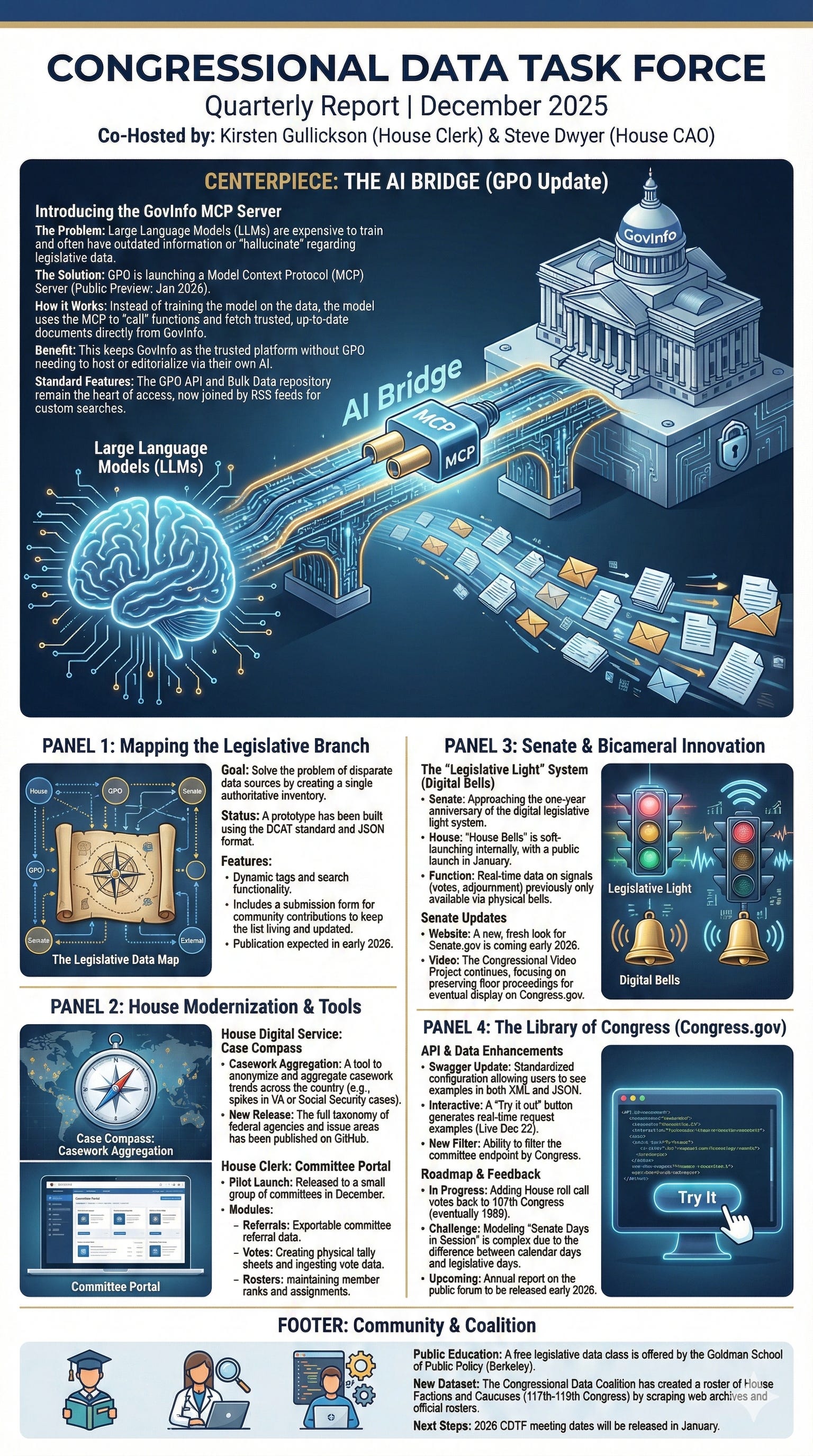
The GDELT Project, a massive internet monitoring project, has started experimenting with Gemini 3 Pro and Nano Banana Pro to create detailed infographics based on enormous bills like the NDAA, CRS reports, and congressional briefings broadcast on C-SPAN. It also has created a proof-of-concept “agentic legislative assistant” to monitor C-SPAN broadcasts for mention of specific topics.
We followed their example and used the recent Congressional Data Task Force meeting as the source for our own infographic. Take a look and let us know what you think.
The European Commission has published the outcomes of a study of using AI in legal drafting for the EU parliament, completed by the University of Bologna. The study developed four proof-of concept pilots using a combination of AI and the Akoma Ntoso XML legislative data schema to illustrate how AI tools could be used to support decision making, support the rule of law and adherence to legal principles, iron out inconsistencies and errors in legislative language, simplifying language in legislative text, and detecting similar language in different parts of legislation.
Our friends at TechCongress highlight five 2025 congressional innovation fellows who recently have found legislative staff positions on the Hill.
The University of Michigan’s Don Moynihan performs an exhaustive review of why transitioning civil servants to at-will positions and removing independent commission heads is bad news for American governance.
The Inter-Parliamentary Union’s Committee on Human Rights of Parliamentarians recorded more than 1,000 instances of alleged violations against lawmakers in 58 countries in 2025.