

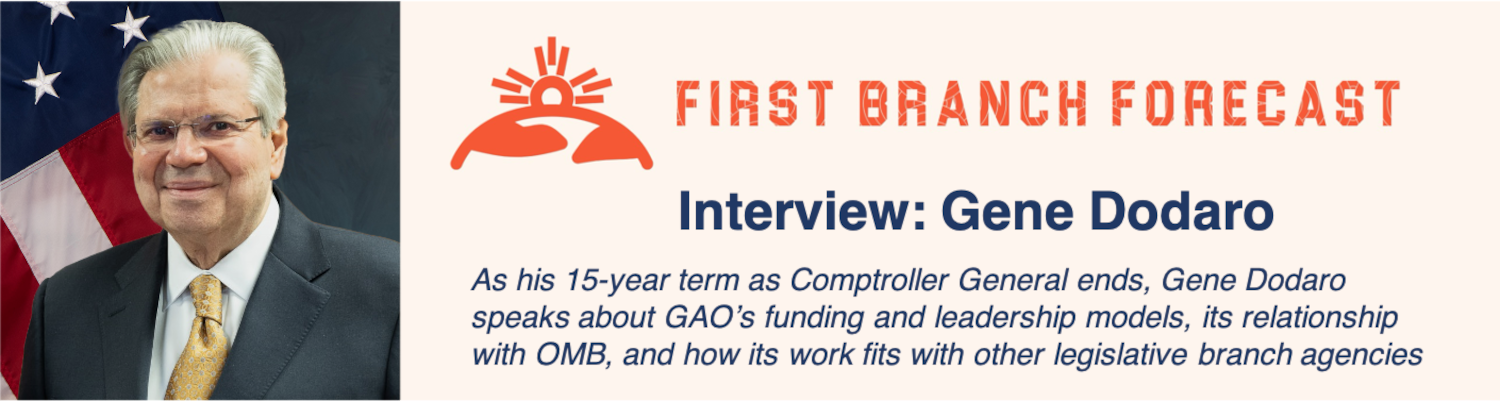
Before his term in office ended, we interviewed Comptroller General Gene Dodaro, who first joined GAO fresh out of college 52 years ago. He had held a number of leadership roles at the agency, including nine as its chief operating officer. In that role, he led the development of strategic plans for GAO.
We spoke to Dodaro about
The impact of 1990’s era budget cuts, which have been sustained ever since, on GAO operations and whether its funding model should change.
The mechanisms by which GAO interacts with other legislative branch agencies.
The selection process for the next comptroller general
The agency’s relationship with the White House’s Office of Management and Budget.
A full transcript of our conversation is below. We are discussing making past and future interviews available as podcasts, so if this is something you find useful or you have suggestions, please drop us a note or leave a comment.
Daniel Schuman: Today, we’re speaking with Gene Dodaro, the Comptroller General of the United States, who will be retiring in a few weeks. He has served as Congress’s watchdog at the Government Accountability Office for 52 years, and for the last 17 years as its head. He literally has testified hundreds of times before Congress. Thank you so much for joining us.
Gene Dodaro: It’s a pleasure to be with you, Daniel.
Schuman: You’ve been using the occasion of your retirement to help educate the public in Congress about the Government Accountability Office, including in a series of exit interviews. We hope to ask you some questions about your tenure that have not been asked elsewhere that focus on the role of Congress as a law making body. Now, you started at what was then the General Accounting Office in 1973 as Congress was beginning to expand the agency’s mission and its authorities. About 20 years into your tenure, Congress made significant cuts to GAO’s funding and staffing levels. The agency went from around, I think, 4,300 employees in 1995 to 3,500 just two years later. Can you talk a little bit about the arc of change at GAO and how that change has interacted with its mission?
Dodaro: Absolutely. We went from about 5,300, Daniel, during that period of time down to around 32, 3,300 people. It was a 40% reduction that was done over a two year period. One of the changes that was most impactful was responding to requests from individual members of Congress.
You know, we have three priorities. One is to respond to statutory requirements in law or in a committee or conference report accompanying a law like the NDAA every year, usually a hundred or so requirements for GAO studies. And then priority two are requests from chairs or ranking members. Since we’re nonpartisan, we treat both the same as a matter of policy and a set of congressional protocols. But third are requests from individual members. It’s still in our protocols, but we haven’t had the resources necessary to do that. So that was a direct consequence of the downsizing of GAO during that period of time.
It also led, though, to some efficiencies. When I became chief operating officer in around 2000, Dave Walker was comptroller general. We completely reorganized GAO, eliminated management layers, set up our teams, did our first strategic plan for GAO as a whole, and the Congress as a whole. Previously, we had plans for transportation and defense health care. There were 36 of those issue plans, but this required us to look back more strategically.
It also caused us to prepare written congressional protocols in consultation with key members of Congress – the ten members that are on the congressional commission to select the Comptroller General. A lot of these things were, I think, perceptions that were there because of not good communications. Dave came in with that mindset, and I thought that was a very astute observation, because we thought we were being consistent in treating people fairly across chambers, across aisles, but obviously some people didn’t believe that.
Now, part of it also wasn’t GAO specific. The Office of Technology Assessment was defunded completely. There were reductions in Congress’s own staff during a period of time. There was a general belief that the legislative branch needed to be more streamlined. But we took it to heart.
And one of the lessons I took from it was when I do outreach to whoever’s in the majority and the minority at the same time. You don’t want to go visit people only when they’re in the majority. That’s not how we operate. It’s important to make sure people know that we care about what everybody thinks in the Congress. We’re there to serve the institution of the Congress and to do it as consistently as we can, even if the political climate is ever changing, ever becoming more complex. We need to stay the same and be consistent. And if anybody asks us a question, whether they’re a Republican or Democrat, they get the same answer because our job is to be professional, objective, fact based, non-partisan, non-ideological, fair and balanced in how we carry out our work.
So that event had important lessons to be learned, and I’ve applied those lessons to help us build more support. We’ve built back a little bit of resources.But I’ve also built very good bipartisan support for GAO over a period of time. And that that clearly was one of the key lessons. Part of it is that change was a real watershed political event where the Republicans came into power as a majority party after being in the minority party I think for like 40 years beforehand. So there was a lot of pent up frustration, I think was part of that, and we were kind of swept up along with a lot of other parties.
Schuman: We saw committee staff slashed by a third; personal office staff the same you had mentioned. Of course, the defunding of the Office of Technology Assessment; the Library of Congress also was reduced significantly. There was not just a change in the size of the legislative branch, but also a change that reflected some of the changes in the power structure that when you first started, GAO committees were very strong and over the 80s and 90s that changed where committees became less powerful and leadership became more powerful. Leadership nowadays is even more powerful still. You talked about how GAO adjusted to that in terms of personnel, but were there things that you were doing that you stopped doing? Have there been new things that you’ve sort of picked up as a consequence of the changing structure and emphasis from Congress?
Dodaro: Yeah, one of the things that I’ve purposely done that’s different from my predecessor is I’ve encouraged us to work more to help shape mandates for GAO’s work, because if you have a mandate, if it’s in a law or committee or conference report, that’s the broadest expression of congressional interest. You also then have an ability to work with both parties while you’re doing the work. It’s much more transparent. The reports that we produce through these mandates are released to the entire Congress. At the same time, they’re also made available to the public. So there’s a lot more transparency while we’re doing the work and after. So most of our work now – which is very different – is done under these mandates.
Then we’ve also worked for the other part of the portfolio which is our requests from committees chair rankings. A third of those are bipartisan. So we try to make sure that we’re working as much as possible: that way we’re efficient, and what we do is meeting the broadest interests of the Congress as an institution. That’s really where we need to be. We need to be there.
Also, these strategic plans that we have are focused more on making sure our resources are allocated to the greatest areas of national interest. The most important national issues are where we’re focusing on now. Previously, there’d be requests that we’d get that were obvious requests shaped by an individual constituent or something from a congressional member. Well, everything’s important to these members since they represent the American people. Not everything’s as broad based and as strategic, so we’ve become much more aligned with trying to figure out what I call a shared agenda. These are things where we think they’re important. We do a lot of strategic planning and provide Congress with ideas of what we think would be a good use of our resources. They [members] are very good because they’re representing the American people, and the American people are expressing their concerns about government to their elected representatives, whether it’s individuals or whether it’s corporations or whatever. They have the perspective of Americans on the ground and what they are concerned about, so we work together and we shape what I call a shared agenda. And we try to allocate our resources to things that we think are important and they think are important.
Then, also, we’ve developed a very good capacity to deal with emerging national issues where there’s extraordinary action that the Congress has to take, whether it’s a global financial crisis – you need $700 billion to unfreeze the credit markets and capitalize our institutions – whether it’s the pandemic recently, where GAO now provides monthly briefings, bi-monthly reports, you’re a reliable partner for the Congress when they have to take these extraordinary measures to deal with national emergencies – that’s very different. This real time auditing concept has made us much more valuable to the Congress.
And we provide that information across a wide variety of committees, because there’s broad-based interest in whatever the congressional response is here. So, shifting more of our resources to working on these mandates where we’re working with multiple committees, usually in both chambers of the Congress, try to encourage as many bipartisan requests as possible and then be as responsive as we can in those areas.
I’ve also worked to strengthen our relationship with the executive branch agencies that we audit – meeting yesterday with the new head of the FAA, for example. And I meet with secretaries as they’re confirmed or their deputies, depending on their availability, and try to make sure we have a good, transparent, constructive engagement with them. I mean, we’re independent, and we are auditing from the legislative branch, but we need to have that relationship. They voluntarily implement most of our recommendations that we have, so it’s important that they know that we’re professional and objective, non-partisan, and that helps us to become more efficient and effective as well. All those things are lessons that you learn over time. I picked up a few tips in 52 years, Daniel. So I try to apply them as much as possible, and they’ve helped a lot. And I’ve tried to make sure that our organizational processes have benefited from the experiences and not just myself – thousands of people that I’ve worked with over the years.
Chris Nehls: That executive legislative branch collaboration is really interesting, and I think something that people pay a lot of attention to. But I’m curious how you work with the other legislative branch agencies, like the Congressional Budget Office or the Library of Congress, who also give expert, non-partisan, non-ideological resource answers to a bunch of other different questions. And how are you guys coordinating on that process?
Dodaro: We do it at several levels. One, I always made a point to get to know the heads of those agencies and departments. Phil Swagel and I meet a number of times, we end up testifying together before the appropriations committees, too, about our request for the next year’s funding. But aside from that there’s the leadership coordination that takes place. We have formal liaisons at the sort of mid-management level that meet on a regular basis to share experiences. And then every audit that we do, we coordinate to make sure we’re not duplicating anything that either CBO or CRS is doing. For example, then oftentimes we’re asked to audit some of their activities. We’ve done audits at the Library of Congress, for example, in the past about their information technology program. And one of the first things I did when I met with Carla Hayden when she came in was talk to her about implementing those recommendations and for us to work with her chief information officer to get that up and running effectively. After January 6th, we audited the response and made a lot of recommendations to the Capitol Police and the sergeants of arms. I’ve met with them on base to implement our recommendations, to strengthen the coordination there among themselves and with the executive branch agencies and law enforcement area and met with the Architect of the Capitol. We’ve audited some of their activities over time. We have very good working relationships. We respect one another’s roles and responsibilities and don’t duplicate, and I’m pleased with that.
For example, when we do our long range fiscal projections, we start with CBO’s numbers for the first ten years and we don’t duplicate it. When I’m asked sometimes to weigh in on what legislation would potentially cost, I said, well, that’s CBO’s role, we don’t do that. We do look at and evaluate things after they’re implemented or as they’re implemented. I try to respect the boundaries. It’s a very good working relationship and I think it’s very collegial and collaborative and professional.
Nehls: Do you ever have discussions between the agencies about the information you deliver from a congressional user’s perspective? Because each of you are getting some feedback on what you’re providing back to Congress. I wonder if there are commonalities that come up or if there’s a platform for you to discuss the experience of the reader of what you’re delivering.
Dodaro: I know in the past, for example, at CRS, a lot of their reports weren’t made public, then they were required to do so. I had conversations with the director of CRS about how we make our reports publicly available. I think this coordination group that I mentioned, they talk about those types of things, what they’re hearing and the feedback. But we have very different missions, so there may be some commonalities, but CRS is much more an extension of the committee staff than GAO is. We’re out gathering information firsthand at installations and facilities around the country for DoD facilities, VA hospitals, we go observe up operations at the borders. There’s just fundamental differences. We do have similar clients, but they expect different things from us.
We also do this as it relates to the inspectors general in the executive branch agencies there. That requires a higher level of coordination because we have similar audit responsibilities, although they’re confined to their individual department agency where we look across the entire federal government. IGs also have more criminal investigators. GAO, since we’re in the leg branch, we don’t have law enforcement authorities, so we coordinate more if we find potential fraud or criminal potential for something – we refer it to the IGs or the FBI, Justice Department, or whatever. But I’m very satisfied.
When I first came into the government the Hill required us to publish these very voluminous books about how we were coordinating with the other leg branch agencies, and it wasn’t very helpful. I know there was a perception that there was a problem, and perhaps before I got into the government or came up the ranks in GAO, there may have been, but I don’t see a problem at all. I’ve met with every CRS director, every CBO director, every Architect of the Capitol, so I think it’s a very good set of relationships.
Schuman: One of the inspirations for that question was when we talked with congressional staff, GAO will have an investigation of an FAA issue. And then, of course, if you go inside CRS, you have the analysts who are experts on that. Then you have the division I worked in where you have the lawyers. Sometimes, we’ve seen the staff have trouble knowing how to put the pieces together because you’ve got different, the investigators and the analysts. Sometimes, you have outside folks like at the National Academies, which are still expert professionals, but it’s a different way of looking at the world as well. The inspiration for the question was thinking through an integrated knowledge environment, so if you’re a staffer and you’ve been there for a year or two years or three years can you find all the same stuff on the same topic, regardless of who it’s from? It’s the user perspective, so that was the thought behind the question.
Dodaro: I know, but you also have to understand the different standards and level of evidence that each of those entities has as you’re putting the pieces together there. The pieces are not developed at the same time or level of evidence at a certain point in time. But this is where we provide selected details upon request to committees from GAO staff. That’s when that happens, that they can integrate those things to help the committees in that process.
Schuman: You’ve testified that GAO returns a significant return on its investments to taxpayers, and also how government shutdowns create significant challenges to GAO in performing its work. In addition, GAO’s overall funding has been constrained to a level below inflation over the last few decades. Do you have a view on whether or how GAO’s funding model should be altered to provide for continuity and be insulated from these political shocks?
Dodaro: Well, I think GAO, like all federal departments and agencies, needs to be held accountable for demonstrating its results and being subject to the oversight process in the Congress, the appropriations process in particular. I think the current model has served us well over the years, particularly the Congress over the past few years has provided us with modest increases to increase our capabilities in the science and technology area. So on one hand, I think we shouldn’t be treated any differently than any other fellow agency that has to justify its use of federal resources. It’s very important to be able to do that.
And on the other hand, as the auditor of the government’s financial statements and advisor to the Congress on financial issues, I’ve issued a report every year for at least the last seven years-plus that the federal government is on an unsustainable fiscal path. There needs to be more discipline in the appropriations process, a plan that has some debt to GDP targets or some other fiscal targets or rules or guidelines. Otherwise, our debt to GDP ratio, which is going to hit the historic high probably in the next two years, is on its way to potentially be 200% of GDP by like 2047. It’s when debt’s rising faster than GDP, you’re on an unsustainable path.
Now, that being said, I think Congress has to take a more discerning approach to the appropriation process where sometimes the approach is more of an across the board kind of approach. I don’t think that that serves well, particularly when you have agencies like GAO that returns on the investment. Unfortunately the return is more broadly to the federal government: It doesn’t return back to the legislative branch appropriation of which we’re in.
I’ve also suggested and advised Congress that they need to make sure that the legislative branch as a whole has enough resources to provide proper oversight over the executive branch agencies. If you want to exercise independent oversight, they need to fund their own operations. The House and the Senate adequately have the right kind of staff to build up the expertise, and they need to provide support to the legislative branch entities.
Now, these are policy decisions. I’ve given them my advice, but I think that they need to take that at heart going forward. I think there’s the attitude that, well, if we’re asking the executive branch to cut their budgeting, narrow their budgeting, we need to do the same thing on the legislative branch. But I think that the proportions are so out of whack that continuing to take that approach just puts Congress at a disadvantage compared to the executive branch.
A lot of the executive branch agencies are increasing because of mandatory spending and there’s only about a third of the total federal budget that goes through the annual appropriation process. So, while Congress is trying to control that piece, overall federal spending keeps growing, particularly health care as the fastest growing part of the budget. Unless you make changes to these mandatory programs, you’re really not reducing federal expenditures other than what they’re trying to do as only about one third of the federal government’s budget. Of course, half of that’s defense, which is very hard to control for national security purposes.
Schuman: I can just jump in there for a second: When I did the analysis, the growth rate for non-defense discretionary spending for all the other agencies outside of the legislative branch was at twice the rate than that for the legislative branch, and that happened every year for the last 30 years. That growth for the legislative branch, it’s not just half the increase as the rest of the government it’s half: it’s compounded and compounded and compounded.
When you look inside the $7 billion for the legislative branch, the only two things that are growing significantly are security: the Capitol Police, which has gone from $150 million to about $900 million in the last 25 years; and the Architect of the Capitol, which also has had a significant increase. The result is that since the share of the pie, the $7 billion that we’re talking about, is not increasing at that greater rate, the money that is available for GAO, for example, is compressed so that if you take your 1993 funding level and inflate it for today, it’d be 1.2 or $1.3 billion – which would be nice, but that is not what you’re receiving.
Given the value that GAO provides, if it’s 130 to 1 return on investment, that ROI comes from saving money for the other 11 appropriation subcommittees. Some countries appropriate their [Comptroller General] in a four year increment or two year increment or something like that. Other places provide the equivalent of some mandatory funding as well as some discretionary so there’s a leveling out effect. I just wonder, given this dynamic and the difficulty of changing it, would you recommend to Congress, or would you encourage Congress to consider a different way of funding GAO so that you don’t get the squeeze, which seems to be constraining your ability to do your job?
Dodaro: Yeah, I, I certainly think and I’m aware of some of these other models because I deal with heads of national audit offices throughout the world. There are a lot of different approaches to how this is handled. Each of them comes with their associated pros and cons, just like most options, so I am not opposed to exploring other models. However, I know that it’s difficult particularly in our government to have different models and have them survive over time. I know there’s this tendency to say, okay, if we’re treating GAO this way in the leg branch, why don’t we treat the Library this way, or why don’t we treat somebody else this way? The Architect: Now, they get multi-year funding because they’re doing capital projects, so there’s a little bit of a difference there, but you could consider different approaches. But you could also recognize the role that the Congress has as a co-equal branch of government and increase the size of the legislative branch appropriation, which would be the easiest thing to do, and then allocate that, respectively, across the entities in the legislative branch to include Congress’s own staff and their operations.
I was told by our congressional relations people that this year 1 in 3 congressional staff have left. This is 33% turnover just in one year, and I know what the turnover has been with members and other staff over the past several years. I’ve been around a long time and that wasn’t the case. Most of the time I’ve been in government, there was much more stability in the legislative branch and build up of knowledge of programs and activities. I know you’re asking me to focus on GAO, Daniel, and I have particular interests and am very fond about GAO, but I’m also fond about the Congress as a whole and how they could carry out their constitutional responsibilities. They should view that differently than the approach that they take for the executive branch agencies, in my humble opinion.
Nehls: Well, there’s a case where there are several models at work in the selection of some of the leg branch leadership going forward. Congress changed the way the Architect of the Capitol is selected last Congress. But GAO and some of the other agencies still have a presidential piece of that to nominate and the Senate can confirm. I wonder, as you are transitioning out of this role, have you thought about how the Comptroller General should be selected and if it should be something that the White House has a piece of, or it should be just a leg branch process?
Dodaro: In our model that we’ve had historically here at GAO, there’s a need to preserve independence because of our role in auditing the executive branch agencies. The independence of auditors is sort of a sacrosanct principle that needs to be preserved. Now, so far, that’s been preserved in our model with a 15 year appointment and only removal by the Congress through impeachment or joint resolution for specific causes. Those two things are meant to guarantee [independence.] It also provides a lot of continuity that virtually no other federal agency has, and that’s beneficial for building a top-flight workforce and retaining people over a period of time and being able to attract people to the government.
The role of the president here is just basically to select from a list that’s created by a ten member congressional commission. Now, there could be other models that are put in place, but whatever other model is used needs to preserve the prerogatives of the Congress. This is a person that represents the Congress. All other presidential nominations typically are to serve on the president’s team. This is somebody that’s on the Congress’s team. You could have a different model, but this approach that’s in law right now starts with the Congress, with the commission that’s bipartisan, bicameral. But it ends with the Congress, too, in that the person has to be confirmed by the Senate.
And of course, Congress, as they did with the Architect of the Capitol, changed the process, so that’s up to them on a policy decision. I definitely think that they need to take their time to select someone who is going to be viewed as nonpartisan and objective. You’re serving for 15 years. During that period of time, there’ll be different parties in the majority and the minority, there’ll be different political parties in the White House, there’ll be constant change in the political dynamics. You need somebody that can lead this agency through all of that in a professional, objective, non-partisan stance that can work with both sides of the aisle and both chambers of Congress and who can stand up and serve the Congress no matter what the political winds are during that period of time. It could be done as it’s been proven under the current model.
Schuman: One of the things that you spoke about is the importance of the independence and integrity of GAO and GAO, of course, is established as by statute. It’s an independent legislative branch agency, it is a different kind of beast. We’ve seen it in recent years, and I think maybe it’s fair to say it has accelerated in recent months – I’m not trying to put words in your mouth, but this is my perception – that OMB has sought to undermine the work of GAO and there have been aspersions cast on GAO by by senior officials over at OMB. There has always been a tussle between the two agencies, although it seems like it is more so than it has been in the past. Given the efforts by OMB with respect to GAO on impoundments, on sending a landing team, calling the agency illegitimate or something to that effect, it raises concerns for me, at least, about the GAO being respected and listened to by the executive branch and also just more problems at the intersection between these two agencies. I just wanted to give you an opportunity. If there’s something that you wish to say to, to give you that chance to say it.
Dodaro: Well, I think OMB’s current posture is kind of ironic since we were both created in the same legislation and Budget and Accounting Act of 1921. And historically, I’ve been here over half a century and we’ve had good relationships with OMB and many of the major management reforms that have lasted have been through good collaboration between GAO and OMB: the Chief Financial Officers Act, the Clinger Cohen Act, the Government Performance Results Act. (Clinger Cohen establishes CIOs in government.) I’ve had good working relationships with OMB over time, including with the deputies for management over at OMB.
Now, the approach taken by this current administration is very dissimilar. I think it’s very unfortunate. I think OMB is missing tremendous opportunities to help improve the performance of our government and to be more efficient and effective. We’ve made recommendations on how to prevent fraud, how to reduce improper payments – all things that are important to people regardless of their political agenda. These are good government management issues, and that’s largely what we’ve worked on over time with OMB.I would say also that they would benefit by being more transparent.
Thirdly, I would say that they’re also missing opportunities by not more constructively engaging with the federal workforce at large to work with them to help implement their agenda. Regardless of your policy agenda, you need a highly-skilled, motivated workforce to implement those policies. Most of the issues I’ve seen where things have fallen down regardless of administration over the years is in the effective execution of their policy agendas. Unless you have the right type of workforce, the right skills and motivation, you’re going to get suboptimal results over time.
I also would say that OMB is a key player, but they’re not the only key player. I’ve reached out to meet with each of the federal departments and agencies in the federal government, to work with the leadership there, as I’ve done with every administration where I’ve been Comptroller General, and I’ve gotten good responses. Of course, some of them are former members of Congress, and they understand GAO’s role and have worked with us in the past. We’re working, as we normally do, throughout the executive branch, so I would hope that OMB would come around. Whether they do or not, GAO needs to continue its important work for the Congress auditing the executive branch agencies throughout government, and we’re committed to do so. My term’s almost up here, but if I was staying, I would be very open if OMB would want to change its posture with regard to GAO, which I think would best serve the country and help further good government and transparency on behalf of the American people. I would hope that that might happen in the future.
Schuman: That’s very helpful. There is some academic criticism of OMB that it’s trying to serve two masters. On one hand, it’s serving the White House; and on the other hand, it’s supposed to serve the needs of the federal government writ large. You see this imbalance of power. You look at the regulatory process, the agencies are supposed to engage in the regulatory process, but the way it goes through OMB, OMB is in effect running aspects of that. You see agencies wanting to communicate with the Congress about their appropriations requests, but that gets routed through the White House process and you can’t have those types of direct conversations. Do you think that OMB’s role needs some reconfiguring, considering the outsized way that it’s playing in our political space now?
Dodaro: There’s always been tension between the agencies and OMB because of their role in reviewing the budget requests from the individual agencies, their role in screening proposals for legislative change, and even approving testimonies by political appointees in their presentations before the Congress, and, of course, in selecting some of the management positions in the individual agencies as well. I think it’s always good to look at how you’re recalibrating these things over time. I think that the agencies always react better to people who give them an opportunity to fairly present their views and to see if they can have a reliable partner in OMB helping them achieve the president’s agenda and their agenda and their respective areas of responsibility. There’s also a lot of areas, and many of these are on high risk lists, where multiple agencies are involved in the same response to something. Let’s take disaster response or food safety: There’s a number of agencies involved in overseeing drug misuse, so OMB has to play a role in helping facilitate cross-agency cooperation. They can either be constructive in that or they can take a hands off role, which is not very helpful in those areas. Each administration needs to see that they’re achieving their objectives and who they’ve assigned and who they’re holding accountable within the executive branch for achieving those objectives. They have a wide variety of tools in order to do this.
You could see this in the initial outreach of the Department of Government Efficiency, where they got involved earlier before some of the people were appointed to come in. The people who were eventually confirmed to run the agency I think have moved to do some modifications to what was done earlier, in part because they’re held accountable. The same thing is true of OMB and the agencies, because the agency heads are going to be held accountable for a lot of these areas. If they don’t have a good working relationship with OMB, that’s going to create a source of tension, which I don’t think is very good for the administration or the country in terms of executing properly on those areas. I don’t have any particular insights to how this is going. I’m talking about it from a generic standpoint of what I’ve seen throughout my tenure and the government that the administration needs to be working like any team, and a good teamwork fashion with respect among all parties. If that’s not there, then you’re going to get less than optimum results.
Schuman: Well, so thank you. I want to be respectful of your time. We could keep going for much longer, but I know you have other things to still attend to. So I just wanted to take a moment to thank you for your time, to thank you for your service. And just to you know, I’ve watched you testify for more than a decade now. And, you know, it’s clear your dedication to public service. And it’s appreciated. And I hope that you enjoy your retirement and pick up the phone when we call, perhaps. And otherwise. Just thanks so much.
Dodaro: Thank you very much, Daniel. Chris, be good to be with you. And I wish you well in your endeavors to try to promote more knowledge about how our government operates and should operate.

