Interview: James Curry
The interplay between congressional leadership and legislative information.


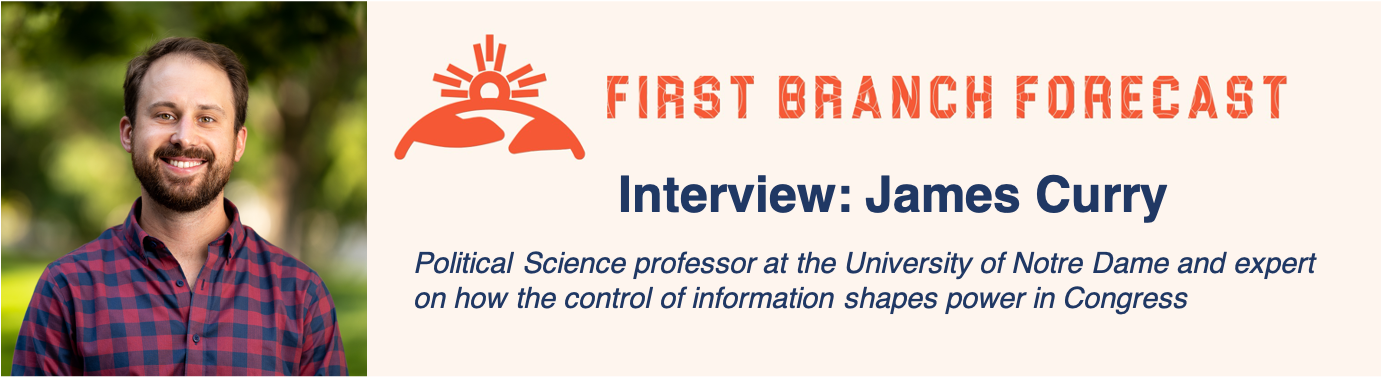
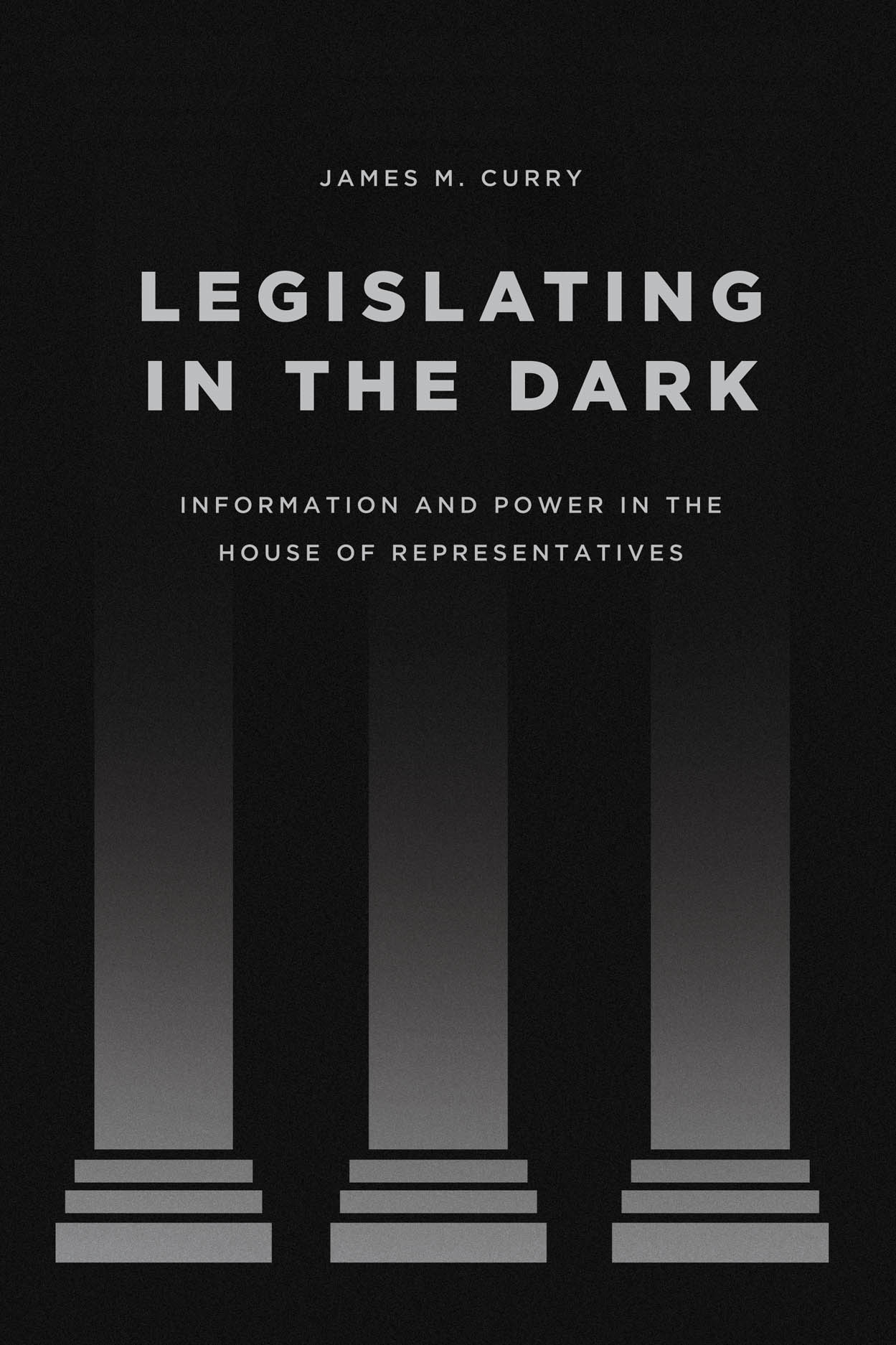
James Curry is Professor of Political Science at the University of Notre Dame specializing in Congress. Among his scholarly works is Legislating in the Dark (2015), which is based partially on his experience working in the offices of the House Appropriations Committee and of Rep. Daniel Lipinski. The book examines how congressional leadership controls information during the legislative process to exercise power. Daniel and Chris spoke with Jim about how leaders limit information that most members have about important bills, why they do it, and what impact it has on the institution.
This interview has been lightly edited for clarity and cut for length
Chris Nehls: One of the things that you’ve written about in your career is the information flow in Congress and how the control of that information is really important, particularly leadership’s control of it. So let’s talk about why leadership would want to control the information that’s available to the rank and file and to committee chairs even while they’re working on issues.
Jim Curry: The goal for controlling information, for restricting information – all these informational or in-the-dark tactics that leaders use – it’s all about trying to get whatever they’re working on across the finish line. They want to avoid the emergence of anything that’s going to potentially sink the effort. To a degree, it’s about control: But it’s also really about the overwhelming desire to achieve the main goal, which is to pass something.
One of the things I learned talking to leadership staff and members in party leadership or committee leadership is that’s actually the overriding focus all the time. It actually took me a while to figure that out. What I didn’t quite get is, in the way that we talk about members of Congress as single-minded seekers of re-election, people who work in leadership are single-minded seekers of passing something. It’s their singular focus all the time. So if this is a tactic that’s going to help them get this bill across the finish line, get it out of committee, get it through the floor, that’s what they’ll do.
Chris: When we talk about information, that’s a broad category of things. How do they do that, and what kind of information are we talking about here?
Jim: What we’re mainly talking about is information about legislative text. There are a handful of tactics that leaders will use to try to control and limit information. It always starts with legislation being actually negotiated and drafted behind the scenes while involving as few other key members or players as possible.
Leadership will loop in who they need to, and they’ll bring in members who they have to involve who are key leaders in a policy area. They’ll negotiate with them first. Then, they’ll bring in stakeholder groups whose support they believe they have to have and who they believe they can get the support of. But they’re very selective in doing so because doing things in this manner, taking it out of committee, doing it at the leadership level, provides all the flexibility to involve who you want and who you don’t want to.
And so you draft the thing behind the scenes, you negotiate behind the scenes, and to the greatest extent possible, you essentially swear everyone to secrecy about what you’re doing. You tell them, no leaks.
The next steps involve limiting, in various ways, how much time members have with legislative text and their ability to process it.
You do that, first and foremost, just by limiting how much time that text is available before members have to act on it. In committee, that often involves only unveiling the text of the chairman’s mark – the chairman’s version of the bill – right before you’re going to have a markup, sometimes in sort of a preposterous way. An example I experienced that people told me was not that uncommon is that they’ll do the draft of the mark, they’ll make it available in a room for people to see for a limited amount of time, and that’s it. You can’t take it with you. In fact, one of my first jobs was guarding the door to make sure nobody’s trying to sneak out with the text of the bill.
It doesn’t always have to be that absurd. It can really literally just be this thing’s only distributed the night before the markup, so there’s limited time to really dig in. And that’s often common with the floor, too, to do what’s called limiting layover time. Under house rules, you’re supposed to have 72 hours between when a bill text is finally revealed – when it’s reported by a committee or otherwise placed on the calendar – and when it is considered on the floor. They routinely waive that requirement using special rules and often will bring things to the floor the night after it’s released or the next day.
Even after they do that, they’ll sometimes make adjustments to the bill at the last second. They’ll announce that a substitute package has been negotiated and we’ll be considering that instead. They’ll announce that fact as the bill’s being brought to the floor, re-scrambling everybody. All this is also often happening on a big, unwieldy bill that has a bunch of different dimensions and a bunch of different parts.
The goal is to make members reliant on the information that’s coming from leadership about what’s in the bill and what’s not and what it does and what it doesn’t do. Once they have members limited in their ability to gather their own information, they aggressively sell the bill. They’ll tell them that it’s the best possible deal that they could have gotten, and that it’s up for the members now to take it or leave it with a strong suggestion that they take it. They tell them what will go terribly wrong if the bill fails. Oftentimes, they’ll wait until there’s a deadline so it’s like, well, this is it, and if we don’t pass it now, the government will shut down or the debt ceiling will implode. They tell them it’s a delicate balance that they’ve struck. It is a very carefully constructed compromise and any change on any point could cause the whole thing to topple so we can’t really negotiate about amendments now.
The evidence I gathered in data suggested that House leaders use one or more of these tactics on at least 50% of bills. The evidence that [Princeton University professor] Frances Lee and I gathered about important laws suggested that this is even more common if you’re looking at the most important things that Congress is doing.
Chris: Maybe we should just take a little step back and explain when you say what you learned inside Congress working there. Why don’t you explain how you wrote the first book, and what your experiences were, and how that shapes the way you think about the way political science approaches Congress.
Jim: The book [Legislating in the Dark] is different from a lot of other work in congressional studies in that it involves a mixed methodological approach of interviews, participant observation, and quantitative data collection. The book emerged from time I spent working on the staff of a House Appropriations Subcommittee where I got to see and participate in the process of bill text being limited to members, which was a surprise to me.
Having this role on an Appropriations subcommittee, the thing that surprised me was we spent all this time drafting this spending bill for that subcommittee and I expected we were going to distribute it to at least the members of the majority on the subcommittee so that they could see it and make sure they’re okay with it. And that’s not what we did. We held it in that room and gave them an hour at lunchtime to come and take notes on it. And that was it. That was the only time they saw the full draft until the markup.
It just surprised me. It’s not something I expected, it’s not something I could have possibly known about, I think, without being there and seeing it in person. It led to lots of questions, and I went and interviewed people and asked them well, how common is this? Why does it happen? And I asked leadership why do you do it this way? And I asked committee leadership, why do you do it this way? And I asked members how does this affect you and I asked member staff when this happens what’s your reaction?
Then I spent more time on the Hill, working in a member office where now I had to live the other side of constantly scrambling and trying to get the information to make recommendations to my boss. Then I collected data on ways that you could try to see this or observe it from the outside. When is the leadership restricting information, when is it not, and what do we see in a macro sense?
That’s a very different way of approaching studying Congress. But, I think for something like this, it’s probably the only way because it’s not the type of thing you can see in the typical publicly available data we see about Congress. It’s stuff that mainly takes place behind the scenes. It’s stuff that’s hard to know to look for until you know what to look for.
Daniel Schuman: Yeah, that’s what made the book really compelling to me, was that it reflected my experience as someone who had worked there, and also as someone who is an outside advocate of trying to engage with the system, particularly with appropriators.
Jim: I’ve spent a lot of time talking about how this withholds information from members. It also withholds information from outside groups, maybe even more so. If the members are scrambling to find out what’s going on, outside groups that are trying to find out if they support or oppose this legislation are also in the dark. It’s harder for them to make recommendations unless they’ve been co-opted by the leadership as part of the negotiations and brought into the fold and encouraged to support it.
Outside groups are reacting, and when you’re just reacting all the time and reacting quickly, you’re not always going to have really strong recommendations. You’re not going to have a chance to really dig in in detail and figure out what you like and what you don’t like. It limits that involvement as well, which is the goal for leadership.
Daniel: So, what does this mean for scrutiny of legislation or crafting something that represents a broader perspective?
Jim: Basically, it’s scrutinized by who’s at the table. When you have limited time for everybody else to scrutinize it afterwards, it eliminates the ability of members of the majority or the minority who may not be on board with what’s going on to really have time to dig in. It limits the ability of outside stakeholder groups who are not involved in the negotiations to scrutinize the legislation or really play a role. It essentially reduces how many people and which people are involved enough to really scrutinize what’s happening before everything’s sort of halfway down the road.
Now, you’ll see members say they don’t like it. Those members then are subject to pretty aggressive leadership persuasion. A staffer for Mitch McConnell back in the day suggested to me that’s when McConnell would turn to some shaming and say don’t ruin this for us. We’ve done the best we can, don’t be the reason why the whole thing fails. And I think things like that are pretty persuasive.
The goal for the leadership is to limit the degree to which their party seems divided, seems fractured, seems factionalized, and to avoid that causing any conflicts as legislation is being considered. They don’t want conflict because what they’re trying to do is pass something, and passing something means that you resolve conflicts or you keep them from emerging in the first place.
Daniel: It may also drive polarization, where you have dependence on leadership for information, and thus any efforts to perfect legislation once it emerges is not really possible in a meaningful way in many circumstances.
Jim: It can lead to more polarized outcomes, but it doesn’t have to. The further work I did with Frances Lee suggests it can go either way and that it depends on the leadership’s goal. Leaders will use this to draft and advance bills where they want to get a very partisan outcome. And so you’ll see this done on partisan messaging bills, where the goal is to get everyone in the majority to vote yes and everyone in the minority to vote no.
But it also happens on broadly bipartisan bills. If the leaders of both parties negotiated this out and they’re trying to get it passed, what you see is this helps encourage bipartisan coalitions.
But what it always does is it limits how much factionalism you see in either party, because that’s the purpose. The purpose for the majority leadership is to get as many members of the majority to vote the way they want. And for the minority leadership, if they’re involved, too, the goal is also trying to get all their members to vote yes. The goal is to reduce any splintering in the party, which can lead to a strict party-line vote, or it can lead to a massive bipartisan vote, where you have 90% of the membership voting yes.
Daniel: I want to pull on the factional piece. It sounds like what this does is it suppresses the multifactional nature of the House.
Jim: I think that’s right. I think if leaders do this successfully, it limits the possibility where the different groups of Democrats or the different groups of Republicans end up pushing in different directions. The goal for the leadership is to limit the degree to which their party seems divided, seems fractured, seems factionalized, and to avoid that causing any conflicts as legislation is being considered. They don’t want conflict because what they’re trying to do is pass something, and passing something means that you resolve conflicts or you keep them from emerging in the first place.
And so this often makes it seem like the parties are more unified than they really are to outside observers. There is a lot of actual disagreement within the Democratic caucus and a lot of disagreements within the Republican conference. If leaders are able to avoid those disagreements from emerging, if they’re able to paper over them, if they’re able to keep them from showing up on votes, then it doesn’t appear that the party is that fractured. This can limit how much actual open negotiations take place between these factions. It pulls everybody back to this single dimension of conflict of what are Democrats going to do and what are Republicans going to do.
Daniel: Does this prevent certain types of bills from being brought up by leadership at all, because it would break open their party and let the factions show?
Jim: It probably does that to the degree that you’re talking about something where it’s entirely discretionary. There’s a lot of stuff on the agenda that is not discretionary. They have to fund the government. They have to respond to public demands for things. They cannot completely avoid major happenings in the world that require a legislative response. Some stuff is thrust upon them. And in those situations, the leadership may have to act on things that would divide the party. They then try to use tactics like this to avoid it from blowing open.
But if it’s discretionary, if it’s something they don’t have to act on, it’s something they didn’t campaign on, it’s not part of a platform of the party, it’s not something that’s on their agenda, then, yes, they will avoid things to the greatest extent possible that would blow them apart because they do not want the appearance of being divided. The leadership doesn’t want to lose control.
These are members that worked their whole legislative careers to be on top. Now they’re going to run the show, which means trying to push things in the direction that they think is the right direction and avoiding losing control over the process to factions or groups within their party. So yes, there’s almost certainly things that under a different setup, under a different dynamic, would come to the floor that don’t, but it’s hard to know what those things are or aren’t.
Chris: I don’t know how depressive or cynical you are about the conclusions that there are only a handful of people on most major bills that are really working on it. We have 435 voting members of the House, and most of them have very little substantive work to do most of the time. I wonder how you think about that in terms of a representative body and that most members are pretty far away from the upper reaches of leadership and access and influence on even the deal.
Jim: I think I take a pretty balanced view of this. On one hand, I see the benefits. If you want Congress to do things, If you want them to be productive, these really centralized tactics help. The downside is obviously that it limits the ability of individual members to be involved, which is bad, right? But there’s a balance there. If you talk to people who’ve been involved in the process for a long time, the reason why leadership pivoted this way is because of rank-and-file members behaving badly. People were not always using these open, deliberative processes to deliberate and be constructive or to try to propose substantive amendments that might make a bill better or more in line with their interests or their preferences. This really started in the 1980s – these processes increasingly got used to score political points.
So, in some ways, leaders are parents punishing the bad children for being unruly. If you can’t use this responsibly, we’ll take it away. That’s an overstatement, but there’s a little bit of leadership not believing that the membership can use these opportunities responsibly. There’s some evidence that, in fact, they don’t. That’s not true of every member, but there’s always going to be members that are going to use opportunities to score points rather than engage in constructive legislative deliberation.
That’s why things started to close down and tighten up, because leadership does not want to constantly expose their major legislative efforts to partisan attacks, political point scoring, and basically non-deliberative uses of amending opportunities or debate time. So there’s a balance there: you want members to be able to be involved, you want as broadly representative of a process as you can possibly have, but you also don’t want processes to just be hijacked by people who have no interest in actually getting something done.
I think clearly, that balance over the last 30 to 40 years has really tilted towards centralized power, probably more so than is desirable. But the exact opposite is also probably undesirable.
Chris: One of the ideas about reforming Congress that’s getting more traction is expanding the House. Based on what you just said, how should we be thinking about this proposal?
Jim: I always think that’s an interesting proposal. I try to get my students to debate that in class because I think there’s interesting pros and cons. One of the best arguments for it is that it’s getting closer and closer to a case where the typical House member is representing a million people, which is a lot of people if you’re trying to actually understand what your constituents want.
On the other hand, I think part of why you have more centralized power in the House compared to the Senate is just because it’s bigger. Obviously, there’s plenty of centralized power in the Senate, but individual senators still have a lot of power. There’s a lot of reasons for that, but I think the fact that it’s smaller makes the Senate a little bit more dynamic. I think if you doubled the size of the House tomorrow it’d be even harder to have deliberative processes with 800 people. It’s already hard enough with 435.
I think that might actually lead to even more centralized power because it would just be really, really, really hard to do things in a deliberative fashion with that many members. It would just maybe even become more parliamentary, where the leadership proposes something and the job of most members is just to vote, which sometimes feels like it’s already the case. I think that would potentially worsen, so we have to consider those trade-offs. It’s just the difficulty of having a legislative body in a really large country.
Members need resources and expertise and staff that can help them get their own information that’s independent of what the leadership is telling them and that’s independent of what their committee chair or ranking member is telling them. Then, they need time to actually consult when something is brought to them.
Daniel: I want to pick up on something that you were talking about before, which is the multifactional nature of the House, and how leadership tries to suppress that to some extent. If we were to want more fluid coalitions, how would we change the information ecosystem to accomplish that goal?
Jim: I think what you ultimately have to do is construct a reality in the House or the Senate where individual members or groups of members not only have more information because they have more of their own dedicated staff expertise and resources, but they also have more time to consider things. They’d need to use those resources for the purpose of really digging into legislation, then using that to make decisions. You can’t just give them more resources for staff because they may not use it on legislative staff. In fact, there’s some evidence that when they were given increases in their MRA allowances, a handful of years ago, that some of them used it for legislative staff who would help them and some of them spent it on communication staff, or district staff, or just sent it back to the Treasury.
Arguably, Congress has a lot of resources. If you think about it in a macro perspective, Congress has a lot of people that work for it. It’s probably the best resourced legislature in the entire world. It’s not that Congress doesn’t have staff, it’s not that Congress doesn’t have expertise.
For individual members or groups of members, even the ability to use those resources when they need it is limited by how little time they often have. You could ask CRS or GAO to study something for you, but they’re not going to get back to you in 5 minutes. You might have an hour and a bill’s there, and you ask help, please, I need to know is this good? Is this bad? Does this do what we want? And all the resources in the world aren’t going to get you that answer in 5 minutes.
Members need resources and expertise and staff that can help them get their own information that’s independent of what the leadership is telling them and that’s independent of what their committee chair or ranking member is telling them. Then, they need time to actually consult when something is brought to them. Individual members need their own resources, and they need time to use those resources to actually make decisions about legislation or be involved in shaping it.
Daniel: I really want to point to the conclusion of your book, where you say that time is not enough. Could you just explain what some of those recommendations are that you had to address the legislating in the dark problem?
Jim: You need legislative service organizations beyond CRS, other groups of staff that could be used to help members study individual topics, like science and tech-focused groups on Capitol Hill that could study these topics in a policy-focused way and provide information to members. I think building those types of things where it’s egalitarian and members can turn to them for information is really useful.
I think Congress could explore more connections with all the information we have locked up in universities throughout the country, where you have all these researchers who study all sorts of different topics and have all this information that members have a hard time getting access to. If there were ways to formalize a process of sharing that kind of knowledge, that would be really helpful.
A lot of these ideas, for me, come out of the time I spent as a staffer, where there would be an idea before Congress and the question you have as a staffer is whether this is actually a good idea, especially if it starts moving. You know that there are people out there who can tell you that and could maybe provide different perspectives on it, but you don’t know who they are, you don’t know how to get in touch with them, and you don’t have that much time. If that kind of expertise could be in-house for Congress, with relevant experts on staff who are nonpartisan and there to consult with, that would be great.
If not, having more formalized connections through public-private partnerships, whether its universities or other hubs of expertise, would be useful, too. I don’t think there’s necessarily one way to do it, but that’s what’s necessary. If members want to know, is this a good idea, is this going to achieve our goals, is this something that’s good for my district, they need to be able to connect with somebody who can give them that information, whether it’s in-house or outside.