Leveling Up Congressional Modernization
The latest Congressional Data Task Force meeting shows how far we've come, and what could be around the corner
The Congressional Data Task Force convened Thursday, benefiting from a nice venue upgrade inside the Capitol Visitor Center. These quarterly meetings highlight the great collaborative work taking place behind the scenes across legislative branch offices to unlock the enormous amount of information about what Congress is doing and has done in the past. It’s work that levels the playing field for members of Congress, legislative staff, and the public in terms of situational awareness and deeper institutional knowledge, which is why we think it’s so important.
The task force is reaching a new level of collaborative innovation by supporting the interest of congressional staff and members of civil society in using new technologies to make even more information available and to solve institutional challenges. With that in mind, AGI has requested the House Legislative Branch Appropriations Subcommittee provide funds for CDTF to create a full-time coordinator position in the next fiscal year.
We will provide another summary on the Congressional Data Coalition website when we can cross-reference my notes and the video, but here’s what stood out from the presentations:
First, a few question marks
In FY2023, the House Appropriations Committee accepted the Clerk of the House’s assessment that creating a publicly-available lobbying disclosure system that included unique identifiers for individuals would require an overhaul of the system and provided $1.4 million to do so. The Clerk’s Office and Secretary of the Senate have been working on the system, but going on four years later, the Senate still has no timeline for rolling out its unique identifiers. It’s not fair to blame the technical staff for some hang-up that appears to be out of their control, but this long of a delay is puzzling.
At a CDTF meeting last fall, the Library of Congress teased the release of an annual report for Congress.gov for FY 2026. Thursday, it was revealed that the report is available on the Congress.gov website (here it is), which we very much appreciate. The Library is doing well to be responsive to the needs of users of the site, which is a significant lift given that it saw more than 82 million visits and 176 million page views in FY 2025, huge leaps in both metrics from the previous year. It’s held public forums to gather feedback since 2020 and has gathered more from interviews.
The report lists suggestions from its feedback repository, which the Library reviews with the other members of the CDTF to determine feasibility and level of priority. As the report notes, significant planning and coordination goes into the editing and publishing processes that make access to information on Congress.gov possible. Its list of user requests, however, only indicates whether an idea would be “impacted by current upstream system limitations” or not, without much context for what these challenges may be.
To be certain, some requests and feedback from users that may seem straightforward are actually complicated or are caught up in congressional rules (see, committees owning their data). We have some concern, however, that the Library might be playing too cautiously with aligning upstream systems for information it has its own resources to gather, and likely is somewhere.
Take, for example, the process for posting appropriations-related materials on Congress.gov. At the height of appropriations season, subcommittees often circulate bill text and report language via email to interested parties on Friday afternoons or post them on websites asynchronously with committee hearings or markups. They often come in a rush, leaving members and the public who do not subscribe to expensive alert services or are not checking obsessively themselves at a disadvantage when engagement is critical in the process. The Library currently waits, however, until materials have been sent to and published by GPO, which is often after the committee has approved the text, too late to affect the outcome.
CRS is tasked with publishing the appropriations status tables that appear on Congress.gov, which are extremely helpful one-stop resources for a lot of material from a dozen subcommittees times two chambers. CRS analysts almost certainly are keeping track of sporadic releases, or at least could be with minimal time investment. CRS posting that material to Congress.gov when it is first available would greatly enrich the value of the tables as a free, public resource. Accordingly, AGI has proposed appropriators include report language requesting immediate posting of materials released by subcommittees and full committees by CRS in the FY 2027 bill.
Government Publishing Office
The team digitizing the Congressional Serial Set, compilations of House and Senate documents and reports from each Congress, has about 4,500 volumes left to go. It has completed volumes from the entire 20th century.
GPO, the Office of Federal Records, and the National Archives hit another major milestone by completing implementation of the USLM XML format for its digitized volumes of the historical U.S. Statutes at Large collection.
The office also is working on several new collaborative projects, notably an effort with the Congressional Budget Office to format some of its projection models into USLM XML. Expanding use of the USLM schema makes the exchange of information in various legislative branch systems possible, ensuring interoperability that expands the possibilities of what tools can deliver for users.
House Chief Administrative Officer
Responding to recommendations of the House Select Committee on Modernization, the CAO has provided new guidance for vendors interested in selling technology services into the House on the House website. The Committee on House Administration has set a number of standards for vendors to protect House data and speech and debate rights, but new entrants into the chamber marketplace often were unaware of them, leading to product rejections that could have been avoided.
The new guidance includes information for cloud services most notably. CAO also has created a new unsolicited tech pitch page for services and products that includes the option to upload a five-minute demonstration video. We’ll be very interested in seeing what they receive, how member and committee staff are brought into the process of vetting pitches, and potential benefit to the Congressional Hackathon.
CAO also has launched the first ever downloadable and subscribable voting calendar for the House that dynamically updates when votes and pro forma sessions are taking place. The calendar, a collaborative effort of the House Digital Service and the House Clerk, can be embedded in members’ and organizations’ websites and even customized to match web page color palettes. See the sidebar of the legislative activity page on House.gov for the links.
Finally, CAO announced it had brought control of all House Committee videos under its in-house studio to simplify their custody. In addition to processing the video, the studio will provide them to Congress.gov, which requires matching up the YouTube or Vimeo post with the hearing ID. We think this change will boost accessibility for the videos going forward.
Linking video data to hearings in the metadata remains a challenge, however, for making past recordings useful to Congress.gov. It doesn’t sound like the CAO is going to devote resources to doing so, focusing on hearings as they come. Fortunately, AGI is planning to launch a tech project to use AI to identify likely matches between hearings and video automatically.
House Clerk
Now that the Legislative Branch Data Map has come together through a partnership between the House Digital Service and Congressional Data Coalition, the Clerk is adding Data Catalog Vocabulary (or DCAT) standards for the datasets. The descriptors in these standards make data catalogs published on the Web interoperable and more easily discovered.
In the Clerk’s Office presentation, Kirsten Gullickson also highlighted two findings of a recent collaborative legislative drafting study the Clerk and House Office of Legislative Counsel delivered to the Legislative Branch Appropriations Subcommittee. Clerk Kevin McCumber mentioned them during the recent budget hearing: a member drafting portal so offices can track the status of requests made to the Office of Legislative Counsel (cutting email ping-pong); and a lightweight editor member staff could use to make changes to non-legal text of bill drafts themselves.
Secretary of the Senate
Senate Webmaster Arin Shapiro shared that the new Senate website is in development and is aiming for launch over the summer recess.
Enhanced information about Senate committees is now available on Congress.gov, including assignments listed on each member page and membership (including for subcommittees) on committee pages. Senate committee schedules also are available on Congress.gov. Internal users can track the full text of amendments in machine-readable format.
Library of Congress
The FY 2026 annual report for congress.gov that was mentioned above also listed the team’s priority initiatives for this fiscal year. The Senate committee information integration was one. Others include:
Adding Senate days in session
Searchable statute compilations
Automating the workflow of adding official titles to bills engrossed in the House
Improving access to Senate amendment texts from 2001 to 2015
Automating the workflow of curating Senate resolution texts
Fulfilling a Select Committee on Modernization’s recommendation by establishing a data source with the Clerk’s Office and the House Rules Committee to be able to add House Rules amendments to members’ profile pages on Congress.gov.
Continued congressional and public client interviews on user experience.
The list also included providing a timeline for fulfilling a ModCom recommendation that Congress.gov provide information on related bills by February 1, 2026. The presentation did not include details about this timeline, so it’s worth following up about this in the next meeting.
The next public forum for Congress.gov will be the afternoon of September 24.
Civil Society
George Mason professor Jennifer Victor provided a demonstration of a project that captures her research into members’ participation in the caucus system and the networks between members it creates. Victor and her teams of student assistants built a database of all caucus membership between the 103rd and 116th Congresses using bound copies of Leadership Directories. The data can be queried via her Caucus Explorer platform. It also can generate network matrixes for members and caucuses.
The data can be downloaded by users, making this to our knowledge the best and perhaps only comprehensive source of caucus membership information around. Unbeknownst to us at the time, we completed Victor’s data for the 117th-119th Congresses’ membership in major ideological caucuses. That dataset is also available within GovTrack.
Joining from Portugal, Daniel Schuman shared AGI’s latest work to support the legislative data and technology infrastructure of Congress. First, he revealed a list we started compiling via crowdsourcing of active technology projects within or related to the legislative branch last month. View or contribute to the list at the Congressional Data Coalition website.
We also highlighted some relevant public witness testimony submitted to the House Legislative Branch Appropriations Subcommittee last week, including:
AGI’s request for funding for 1 FTE to support the CDTF
Joe Eannello on updating the CRS Appropriations Status table to include bill text and report language at the earliest point made publicly available
Nick Hart, Data Foundation, on funding & accessibility of the Legislative Branch Data Technology Map
JD Rackey of BPC on funding for the Modernization Initiatives Account; Lorelei Kelly, Public Good Group on funding for MIA & Clerk
Michael Stern on improving information about the Bipartisan Legal Advisory Group on the House Office of General Counsel website
Jim Townsend, Levin Center, on GPO hosting IG reports
Haiman Wong, R Street, Sean Vitka Demand Progress, and Daniel Schuman of AGI on strengthening congressional cybersecurity
Daniel also shared news that AGI is launching several tech projects for the good of the legislative branch, including:
Transforming appropriations bills and reports into data
Tracking changes in appropriations report language
Automatically identifying reporting requirements in bill text or report language
Building off our engagement with Bússola Tech in Brazil, Daniel shared the Inter-Parliamentary Union’s use cases for AI in parliaments compilation.
Finally, Daniel shared a reminder that the “Data Skills for Congress” professional certificate program, a free online series of training, will be offered again this summer from June 28 through August 27. It is sponsored by the Goldman School of Public Policy at the University of California, Berkeley and supported by USAFacts.
ETHICS HEARING
Now that the House Ethics Committee has found Rep. Sheila Cherfilus-McCormick guilty on 25 of 27 counts related to improper use of a government overpayment to her business, the body will decide next month on recommendations for her punishment, including expulsion.
Some Democrats said they would prefer seeing how her criminal case plays out before taking action to expel her, which is not what happened in the case of former Rep. George Santos. But the ethics system shouldn’t simply be a mirror of the criminal justice system. The House has an obligation to set its own professional and personal standards of conduct and to hold members accountable to them. Now that its ethics process has run its course, it’s up to members, not jurors or voters, to decide Cherfilus-McCormick’s fate.
CONGRESSIONAL MODERNIZATION IN GLOBAL PERSPECTIVE
Bússola Tech, the Organization of American States, and AGI recently organized a high-level roundtable of congressional stakeholders to discuss the state of modernization efforts in the House and Senate and how they relate to challenges facing other countries’ parliaments. The discussion honed in on the institutional requirements for modernizing practices and systems and handling new developments like artificial intelligence.
The event was also an opportunity to honor the career of recently-retired House CAO Catherine Szpindor, who was pivotal to House transformation efforts.
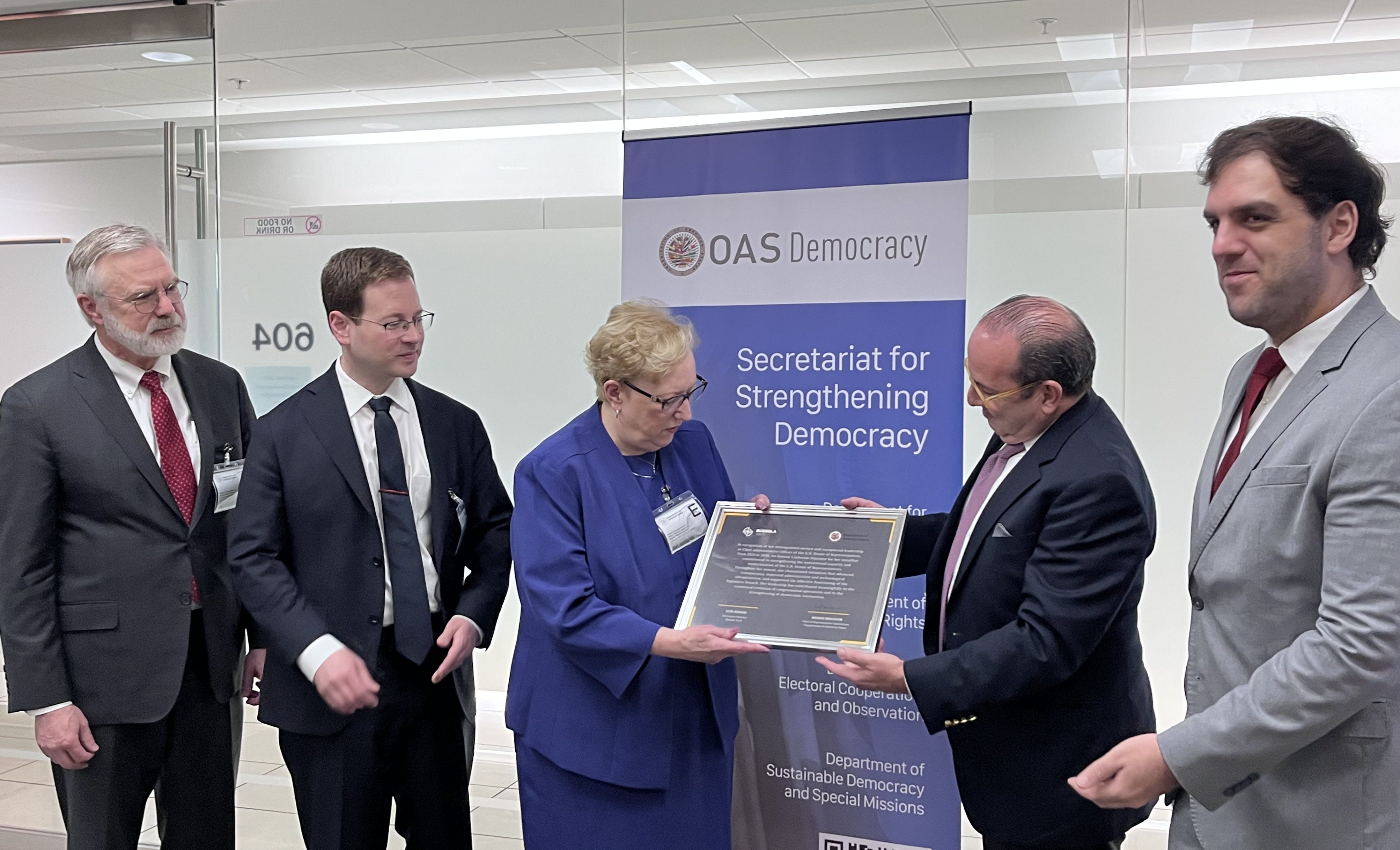
Bussola Tech has published a recap of the event, available here.
ODDS & ENDS
Daniel recently participated in the second annual Open Source Conference organized by George Washington University’s Open Source Program Office. We hope this community becomes more connected with congressional tech enthusiasts.
Security $$$. Members of Congress collectively used $1.3 million of MRA funds on security services in 2025, according to Legistorm. A total of 228 members reported one security-related expense. Spending actually peaked in 2023, with members using $2.16 million on security. This current figure is in line with recent averages. Nevertheless, it’s still another downward pressure on budgets for staff.
Don’t bet on it. Rep. Seth Moulton appears to be the first member to outlaw staffers from participating in prediction markets.
Great to read such an optimistic vision of technological integration in the legislative process and its records! Keep up the good work!