POWER OF THE PURSE
So-called “pocket rescissions” have returned. The White House announced Friday it intends not to obligate nearly $1 billion in appropriated funds, mostly within Department of Health and Human Services programs supporting refugees and asylum seekers. It also has not obligated $1.3 billion of funding appropriated in fiscal year 2025 for Global Health Programs that expire on September 30th.
Once again, Office of Management and Budget Director Russell Vought is following through with his explicit intent to claw federal spending power away from Congress when he or others in the administration object to programs on political grounds. Under the Impoundment Control Act, the White House must request the authority not to spend appropriated funds and provide Congress a 45-day working period to approve the request. The federal fiscal year ends Wednesday, and Congress is out of session.
The Supreme Court allowed the administration to continue withholding roughly $4 billion in foreign aid last year, but did not resolve the legality of the administration’s “pocket rescission” theory. A bipartisan group of former congressional appropriations and budget staffers, however, wrote to congressional appropriators recently that pocket rescissions have no basis in the ICA. The Government Accountability Office, which is empowered by the law to track potential violations, agrees.
As with practically all assaults on the congressional power of the purse, House leaders have been reticent on administration actions. Sens. Patty Murray and Brian Schatz were the first to raise alarms last week, noting Congress, “did not hand Trump a checkbook to spend on whatever he pleases while blocking funding for everything else.” Senate Appropriations Committee Chair Susan Collins subsequently requested a clarification on the fate of the Global Health Program funds in relation to a planned closeout of USAID funding. Friday, she complained about the “usurpation of Congress’s appropriations powers” by OMB through “unlawful cancellation of appropriations that were approved on a bipartisan basis and signed into law,” regarding the domestic spending rescissions.
We would expect Vought to stick to his plan even if Democrats seize the majority in the House in the next Congress. It is encouraging from the separation of powers perspective that potential House Appropriations Chair Rosa DeLauro, a vocal Vought opponent, says she plans to reassert congressional spending authority. “What they’re doing is to destroy the grant-making funding, and it’s a bipartisan process of the Appropriations Committee,” she told Punchbowl. “So, by God, I’m going after the issue of the power of the purse and make no bones about that.”
But if Vought persists, as the old adage goes, Congress doesn’t have an army. That doesn’t mean Congress is helpless to respond: it has a robust set of options that go beyond the considerable political pressure it can apply to the White House, from impeachment of Vought to zeroing out parts of the OMB budget and amending its authorization. Congress could refuse to approve appropriations for other parts or the whole of government until Vought is gone.
Most of the options, however, would upend the customary bipartisan comity and collaboration that has typified the appropriations process, which, as Rep. Steny Hoyer noted in his remarks at his final Legislative Branch Appropriations Subcommittee markup, was strained during this Congress. Members clearly value their own perception that the process is bipartisan and civil, even when White House actions require forceful political responses. The question hanging out there for the next Congress, therefore, is whether appropriators, many of whom have been part of the process for considerable lengths of time, will be willing to sacrifice this sense of tradition to pursue whatever means are necessary to defend congressional authorities.
NOTES FROM LEGISTECH
Daniel and I spent most of last week attending the sixth LegisTech Forum here in Washington, which the American Governance Institute co-hosted with the Brazilian think tank Bússola Tech, the Organization of American States, and the U.S. House of Representatives. Participants representing dozens of parliaments, technology firms, and international organizations met at OAS offices, its headquarters near the White House, and inside the U.S. Capitol with heavy focus on how AI was reshaping parliamentary operations and information environments, both internal and public-facing.
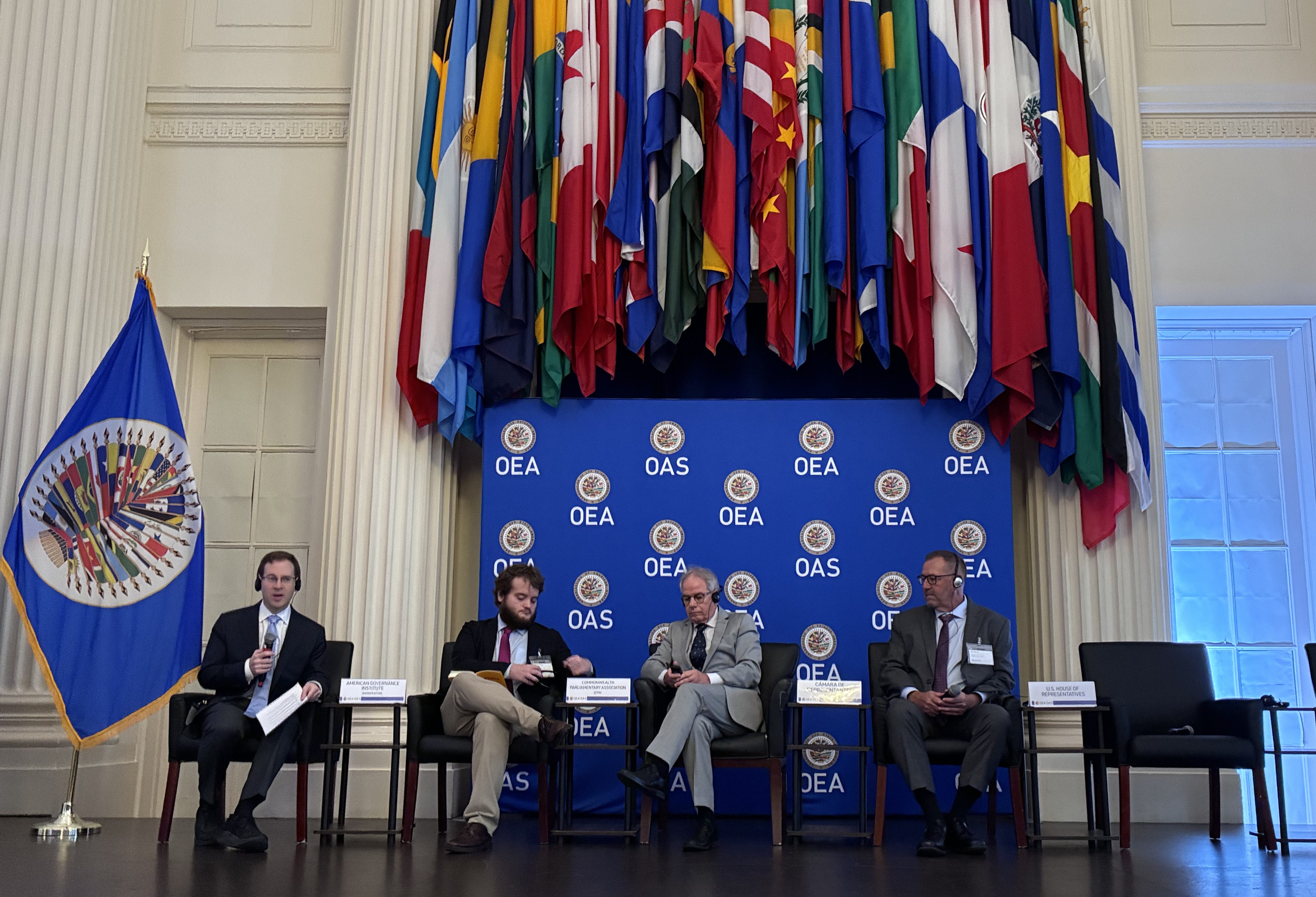
As it was a closed event I cannot attribute specific contributions to individual participants. Nevertheless, several themes stood out and I came away with some general observations to share. Daniel attended another Bússola Tech convening in Dublin in June and shared his thoughts on the Congressional Data Coalition blog if you’re looking for some continuity between events.
THE POSITION OF CONGRESS
We often hear about how technologically behind Congress is as a workplace and institution, with the implication that its lack of institutional tech savvy has consequential and negative downstream policy implications. This opinion often is advanced by members themselves. A decade ago, former Rep. Cathy McMorris Rodgers quipped that Congress is “a 19th-century institution often using 20th-century technology to respond to 21st-century problems,” which has been repeated often ever since.
It wasn’t entirely accurate then, and it’s neither useful nor correct to say so any more. While some participants related how some parliaments really are still operating in what we might consider the early 20th century in terms of recordkeeping, Congress adopted its first electronic bill status tracking system in 1973, the same year the House implemented electronic voting. (Back then, members had to call the office for the most timely updates.) Online access to the Congressional Record began in 1994. Work began on the XML schema undergirding all legislative data in 1997, the year Rep. Maxwell Frost was born.
Because these systems were designed to serve the exacting recordkeeping practices of the House Clerk that reach back to the 1st Congress, the informational architecture Congress has developed over the decades is comparatively robust. Furthermore, Congress has invested resources and organizational structures like the Congressional Data Task Force to make information about what it is doing discoverable. Some countries are still working on building up legislative information systems or getting members of parliament to adopt digital formats. At the conference, we heard from one country’s representatives whose lower and upper chambers had trouble tracking if bills have passed the other chamber or if bill drafts included regulations already in law. Another offers MPs digital tablets to read the day’s proceedings or bills on the floor, but finds that most still want documents printed out.
Artificial intelligence is proving to be a flexible resource, allowing some parliaments to close gaps rapidly in making legislative branch informational resources available and accessible. Those with such infrastructure already built out are adding layers of analysis to official sources. Some parliaments are doing both at the same time with exciting results, especially in making video of proceedings available and drafting legislation quickly. We were intrigued to see AI-enabled tools similar to the House Clerk’s Comparative Print Suite in use in other parliaments, as well as real-time changes to amendments.
If we take “respond” in McMorris Rodgers’ formulation to mean act on public sentiment gathered through modern tools, the U.S. Congress might be a bit behind. Presenters detailed sentiment analysis tools for various mass media formats, made more powerful by AI as well as projects inviting scholarly participation or pulling from academic resources directly in the bill-drafting or regulatory processes. Others were using AI to improve old open parliament concepts by putting forward only relevant or documented contributions from the public. The House has tinkered with some of these concepts over the last decade, but not pursued them at a programmatic level.
The structural differences between the U.S. Congress and other parliaments may be at play in this gap in public engagement experimentation. Most participants at the conference work for operational offices of parliaments, whose leadership often is separate from the political leadership of the chamber. In this role, they are gathering and pushing feedback from the public down to members of parliament and committees as they would legislative data.
In the Congress, member offices and, to a lesser degree, committees gather public sentiment. Americans can tell their individual representatives or the relevant committee what they think about an issue or perceive as a problem; but they can’t share them with the entire institution of Congress. It’s not a technology issue: no office has that role. Because the responsibility to engage with the public is distributed among political, rather than institutional actors, it is much more difficult for Congress to adopt the constructive public engagement techniques AI makes possible at any scale.
For that reason, AGI proposed creating a secretary general position in the House to provide administrative oversight and support to the nonpolitical functions of the chamber in our recommendations to the Committee on House Administration’s Modernization & Innovation Subcommittee’s open call for ideas.
BRANCH INDEPENDENCE
Another dominant theme among conference participants was the additional challenge artificial intelligence firms presented to the independence of their institutions. Some already faced strains because funding for legislative branch operations is determined by the executive. Those with a strong separation of powers like the United States’ constitutional system doggedly defended it. Repeatedly, participants rejected the idea that legislatures could hand data wholesale to technology firms without seriously risking its authoritativeness or accuracy.
One response to this concern is to limit the types of information, like constituent-related data or anything that could be subpoenaed by the executive branch, from AI vendors. Parliaments also are building their own AI systems, in some cases to structure parliamentary data systems.
MAKER SPACE
As more House personal offices encourage staff to develop workplace tools and the House CAO office provides direct support through the AI Center, staff will need additional resources for keeping tabs of interesting projects floating about the chamber. I launched this section of the newsletter in part to do my little part in helping to build such awareness and am pleased to offer the first recap of a project developed within a member office.
In Rep. August Pfluger’s office, legislative correspondent Zach Ramsey has created a custom browser extension for its Fireside21 constituent mail account that eliminates the pain and suffering involved in tagging and batching incoming email. It sorts each message through three progressive tiers beginning with office-specific keyword rules that catch the clear-cut cases, such as casework requests. If no match is made, Ramsey trained a machine learning model on the office’s own past sorting decisions to batch emails by issue topic. If those two fail to identify the proper place for a message, an OpenAI model assigns a batch based on the office’s batch list and past decisions. If no classification can be made, the system flags a message for a staff review.
Personally identifiable information is shielded from the AI as only the subject line and message are analyzed on a staffer’s computer.
Emails received by the office automatically become part of the machine learning training data, improving the responsiveness of the system over time. Staff corrections also are weighted three times more heavily in retraining. When a new issue comes up, staff can add a new batch, and the system starts recognizing that topic as more messages are sorted into it.
The office, Ramsey said, was able to cut down the time commitment involved in its current workflow by around 70% using the plug-in, freeing up that staff time for other duties. This innovation, dubbed the “Pflugerbot,” helped earn Rep. Pfluger the Congressional Management Foundation’s Democracy Award for “Best of Innovation & Modernization” in 2026.
CALENDAR
Several DC-based civic tech groups and gov tech professionals have put together a Google Meet event “Lightning Demos: Budget & Approps Edition!” with four demos of related projects on Friday, October 2 from 12:00 to 1:15 PM. Register here.
The next George Washington University Trachtenberg School fall Symposia on Government Oversight and Accountability series focusing on legislative oversight will be held on October 7 from 12:00 – 1:30 PM on GW campus with a virtual Zoom option available (register here for either). The event will include Former FDIC Inspector General Jay Lerner, Georgetown Law’s David Rapallo, GAO’s Nikki Clowers, Molly Reynolds of the Brookings Institution, and Kevin Kosar from the American Enterprise Institute – not too shabby!
Daniel will be speaking at the International Conference on Legislation and Law Reform (iLegis) taking place October 29-30 in Washington, D.C. The conference brings an international perspective on legislative drafting, the legislative process, and current legislative issues. For more information, visit the iLegis registration page.
ODDS & ENDS
The Senate launched the updated version of its website last Friday, with upgraded navigational design.
Protect Democracy, in partnership with R Street, published a report suggesting four methods by which the House of Representatives can reduce control over the chamber by the Speaker to provide members more say in the legislative process without undermining a unified party agenda. They include changes to the discharge petition, guaranteed up-or-down floor votes on germane amendments with significant co-sponsorship, floor votes on alternative budgets, and a standing committee on institutional reform. The report is part of a new Congressional Renewal Project.
The D.C. Circuit ruled last week that restrictions on protests on the Capitol steps violated the First Amendment, despite objections from the U.S. Capitol Police.
Has this Congress been productive? Should we measure productivity by bills passed or days in session? I’d argue for the 119th Congress, the degree to which it has handed over basic constitutional authorities and privileges is a more fundamental and important question.