Reaching the Breaking Point
Conventional political wisdom treats the relationship between House leadership and members as static. It isn't, and we desperately need a new vision of the speakership
TOP LINE

After a tumultuous week for Speaker Mike Johnson, Punchbowl sketched out the smooth path that Hakeem Jeffries may have in becoming the speaker of the 120th Congress.1 The piece cites the support Jeffries has across Democratic factions at the moment, which contrasts with the “torment” hardline conservatives have caused their top leaders for more than a decade. Jeffries does not appear even to have the turbulence ahead that Nancy Pelosi experienced after the 2018 elections.
The piece notes Jeffries’ softer political style inside the Democratic caucus in comparison to Pelosi, as well as his Brooklyn-infused attitude on display in his posture toward the second Trump Administration. Both certainly fit the current vibe of most House Democrats. He’s held Democrats both on message and in a fighting stance during his time as minority leader, including campaigning for redistricting in Virginia.
Serving as Speaker of the House entails more than leading your political party. Political insider accounts of what’s happening in the chambers rarely consider the enormous institutional power that leadership hoards, even though it’s causing members’ frustration to boil over inside the House. The institutional narrative is so focused on how well leadership forces votes through the procedural plumbing that it forgets that leadership laid the pipes and controls the pressure.
Take, for instance, veteran congressional observer Paul Kane’s account of vanishing institutional norms leading factions of the Republican House majority to break ranks and pass bills with Democrats or defeat rules votes leaders have arranged. The norms in question are the rank-and-file operating in lockstep with leadership. What the Republicans who halted the multiyear extension of Section 702 of FISA should have done, in Kane’s accounting, is shut up and vote for something they hated that was pushed upon them by leadership in the middle of the night. The institutional norm, in Kane’s view, is submission to leaders’ control even (and especially) when you disagree.
One problem with this conventional narrative frame is that it misapprehends the House of Representatives as a static institution, one where party leaders have always given orders and the rank-and-file have always saluted. Since Kane started covering Congress in 2000, the top-down model has largely been true. But over the longer sweep of the House of Representatives, it isn’t. When those with power have gone too far in locking out their colleagues and failing to factor in their political desires, the result has been rebellion and a new political order. Members reach a breaking point and reset the system.
The strength of the current speakership is a result of the last major reset in the late 1960s and early 1970s when liberals took it away from racist, seniority-privileged committee chairs and through a series of misadventures centralized it in a party—and then an office—that would be responsive to the majority of the majority. Reforms also spread opportunities to engage in the legislative process around both in the Democratic caucus and House and broke down barriers of secrecy surrounding legislative agenda setting.
As we explored when Speaker Emerita Nancy Pelosi announced her retirement, speakers began rewiring these reforms to consolidate their own power in the late 1980s and 1990s. They orchestrated the legislative process from the speakership through special rules and circumvention of committees on major bills. This was done in part to head-off the ability of the minority to offer amendments that could win majority support in the chamber. We also have to imagine that party leaders were not entirely disinterested actors, either.
Speaker Pelosi expanded upon what Newt Gingrich and Dennis Hastert had done to exert what congressional scholar Josh Huder described as “more unilateral control over the floor procedures than any contemporary Speaker—and arguably any Speaker in history.” Her successors retained the model. Pelosi and her approach is the gold standard against which other speakers are measured. The mental model most congressional observers hold of the norms of House procedure is barely 30 years old.
Rather than greater rank-and-file autonomy, the strong speaker model now prioritizes members’ compliance. In particular, it’s built off of compliance of members of the majority party. Legislation should not advance unless it can keep your party together, and it’s even better when it divides the other party.
Speakers reward and elevate loyal soldiers and deploy a variety of inducements and punishments against the non-compliant and the outliers. They also can control the schedule and flow of information to incentivize members to vote their way and to staunch any brewing rebellion. Their seeming omnipotence is their best inducement to get members to comply. Should they feel they are going to lose a vote, they retain vast powers, including the ability to dissolve the House unilaterally. Both party leaders knew this and at times had side-agreements to buttress one another. If you let the rabble rule, the two-party model’s over.
Members hate this system to the extent they sacrifice their autonomy, but face collective action challenges in changing it. As the most cohesive and organized faction in the chamber, the House Freedom Caucus has made the most serious recent attempts to do so. The Freedom Caucus utilized the leverage that exists at the start of a new Congress, when a majority of members have to agree to chamber rules, by withholding needed votes to reclaim some power through increased presence on the Rules Committee, retaining the ability to vacate the chair, and lowering the discharge petition barrier. There’s also a secret agreement that Kevin McCarthy reportedly agreed to, although we don’t know what it contained. He ultimately was tossed overboard for a Speaker more pliant to the preferences of the Freedom Caucus.
New Democrats and a few Progressives did something similar in 2018 when they withheld support for Pelosi to bring her to the bargaining table. What they got was not of the same magnitude, but it was notable nonetheless. The holdouts won concession of term limits for Democratic senior House positions. More significantly, the forced negotiation produced the Select Committee on the Modernization of Congress.
A better process than speaker election brinksmanship politically and institutionally would be for the incoming majority to work out the distribution of power within the caucus ahead of the organizing session of the next Congress. However, that type of collective decision making would require members to know what they want to improve their lot as legislators. But the vast majority of incumbents have only operated in the current system in which they are little more than voting cattle. Moreover, they generally don’t have the time and resources to figure out what they do want.
The HFC knows what it wants and is willing to fight for it. During speaker election fights and the removal of Speaker McCarthy, its members demanded to be treated like part of a governing coalition as if the faction were a small party. The HFC even prepared an orientation document for incoming Republican members for the 118th Congress that articulated a clear-eyed view of how power has moved into the hands of leadership and how they would use that power to control the chamber unless caucus members worked together to change the governing rules and structures. Here’s their topline bullet point: “The leaders of both political parties have consolidated so much power that most Members of Congress have no meaningful role in the legislative process beyond voting up or down.”
This declaration of relevancy for the rank-and-file struck most congressional observers as chaos and disorder, of a petulant minority breaking norms and rules. What it really represented was the start of a tectonic shift within the chamber back to a multi-factional system without domineering leadership control of the legislative process. We cannot judge whether the Freedom Caucus meant what they said. The result of their successful political maneuvers, however, was to swap leadership control with factional domination of the agenda, in this case, the minority-of-the-minority.
Freedom Caucus domination of the chamber wasn’t the only plausible result. They could also have created a circumstance where the stable equilibrium was a sharing of power among multiple factions—changing based upon the issue—but that would have required more traditional Republicans to band together and be willing to say “no” to rules. It also would have required Democrats to be willing to work in coalition with a subset of Republicans on various issues.
Jeffries seems to have understood the shift emerging. Writing in the Washington Post days after McCarthy’s removal, he urged the majority of Republicans to break from “MAGA extremism that has poisoned the House of Representatives” since the failed insurrection and form a bipartisan governing coalition. He laid out the following principles:
The House should be restructured to promote governance by consensus and facilitate up-or-down votes on bills that have strong bipartisan support. Under the current procedural landscape, a small handful of extreme members on the Rules Committee or in the House Republican conference can prevent common-sense legislation from ever seeing the light of day. That must change — perhaps in a manner consistent with bipartisan recommendations from the House Select Committee on the Modernization of Congress.
McCarthy had refused such a suggestion, but Jeffries envisioned Patrick McHenry’s interregnum as a chance to govern without leadership domination. Bills with strong bipartisan support should receive floor votes and the Rules Committee should not be able to 86 “common-sense legislation.” Obviously, this would have been a terrific outcome for a minority party still holding the White House, so we shouldn’t read solely institutionalist intent here. Nevertheless, it demonstrates an awareness that the House can operate in other ways, even radically different ones.
Democratic leadership has prided themselves over the last few years on the mantra that their unity is their strength in contrast to House Republicans. Unity, however, is a political tactic, not a goal. It narrows the set of acceptable ideas for the policy agenda down to those without any strong objections. It won’t offer voters anything new as a consequence. It keeps many policies off the table. If Jeffries is interested in holding the gavel for more than a term or two, we urge Democrats to reconsider their aversion to faction and allow for the competition of ideas within the caucus.
And, if Democratic members want to have and retain a say on Trump’s impeachment, foreign and domestic policy choices, and the operations of the House, they should avail themselves to more effective techniques than only appealing to Jeffries’ good nature. The willingness of an organized group to say “no” to the nomination of Jeffries or any possible Speaker in return for political concessions is how you get political concessions and a share of the power. Even the most mild-mannered party leader, once invested with power, will have little incentive to share it and every incentive to centralize it.
We are not asking Jeffries to eat his veggies here. Stronger factions – or more party disarray if you’re a pundit – actually would be to Jeffries’ benefit. Leaders have been most successful in leaving their imprint on the outcome of legislative processes, political scientist Ruth Bloch Rubin argues, at times in which there were several party factions that were evenly matched in competition with one another. Nancy Pelosi, for example, was able to assemble a robust infrastructure and renewable energy package during the Biden Administration because the Progressive faction she herself favored matched the organizational strength of moderates. During negotiations over the Affordable Care Act, Blue Dogs’ factional capacity held major advantages over Progressives and thus weakened Pelosi’s intentions for the bill. Moreover, the centralization of power in leadership reduces the internal friction across the factions that results in better policy outcomes and gives members something productive to do besides become TV stars.
Collaboration with non-MAGA Republicans also would be helpful to Jeffries. The scorched earth redistricting war now raging creates real peril that non-MAGA members in what were swing districts will face many more MAGA-aligned voters in redrawn maps. Indeed, it is the fact that non-MAGA members will struggle to survive the current moment that suggests they need a way out of the partisan primaries and gerrymandered districts that will eat them alive. More than legislative victories, they need to change the electoral system so they do not go extinct.
Over the longer term, we think allowing for more factional coalition-building will help the House transition into a new order. It’s important to recognize that members aren’t just frustrated with the current top-down agenda control system: so are voters. The strong speaker model has generated enough dysfunction and dissatisfaction that the electorate looks to the executive branch for all action. The policy agenda Speaker Johnson is working furiously to protect isn’t his, it’s that of the White House. Policy should come from Congress, and from the representatives wanting to put the ideas they campaigned on into action. A multi-faction, and perhaps eventual multi-party system in which the speaker is a facilitator and not a dictator would be more democratically stable and responsive.
APPROPRIATIONS
Senate Legislative Branch Subcommittee members will hear Acting Librarian of Congress Robert Newlen and Architect of the Capitol Thomas Austin’s budget requests for FY 2027 Tuesday at 10:00 AM in Dirksen 124. The hearing can be watched here.
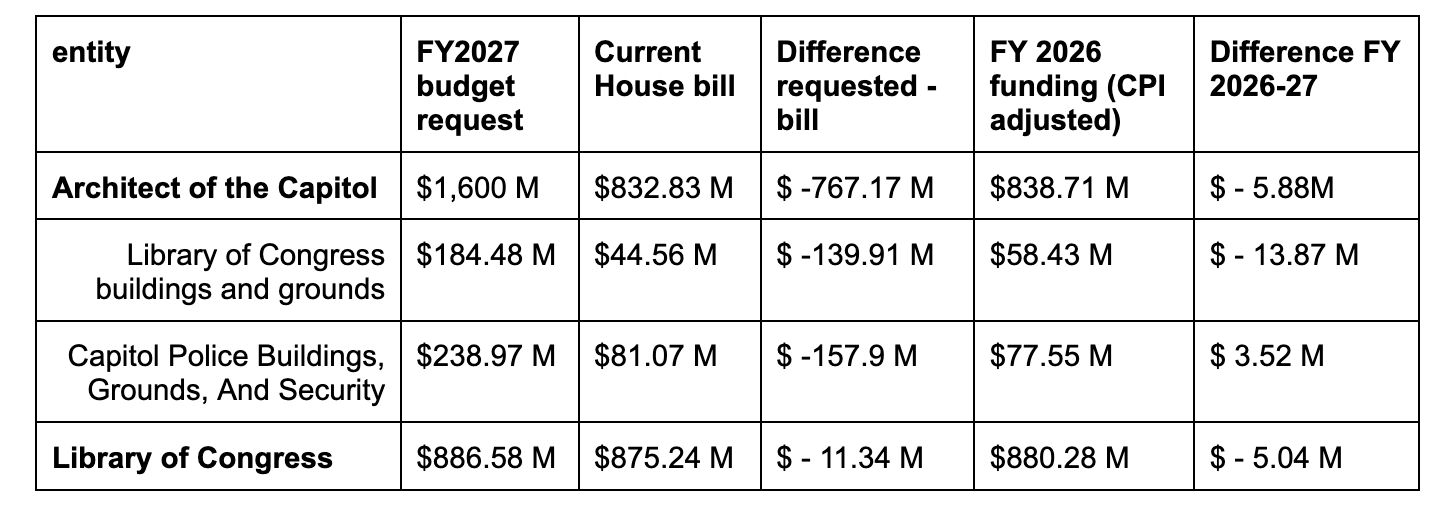
The subcommittee’s questions to Austin will be interesting because the House Appropriations Subcommittee markup of the Legislative Branch bill fell nearly $800 million short of the AOC’s request. Although requested funds for initiating emergency Rayburn House Office Building renovations that weren’t included account for about $280 million of that total, House appropriators also made significant cuts to requests for the Library of Congress buildings and grounds ($140 million) and Capitol Police buildings and security ($158 million).
We cannot help but note that the Architect’s Congressional Budget Justification, the plain-language explanation of how the AOC would spend the funds they request, is not publicly available and has not been for the last half-decade. The vast majority of CBJs for the executive branch are publicly available, as they are for a number of legislative branch entities. We were told a few years back the AOC’s CBJ is now being withheld for security reasons, but much of that document does not relate to security. The publicly available information regarding the proposed repairs to Rayburn are sparse, to say the least. We hope appropriators will do more to encourage the support offices and agencies to make them publicly available, and perhaps share the info themselves. The last AOC CBJ we found was in the House print from FY 2021, here.
Although the Library requested a $34.4 million increase over FY 2026 for new technology projects and to cover labor costs, the House subcommittee markup only provides a $23 million adjustment. Factoring in inflation, that’s actually equivalent to a $5 million cut to the Library’s budget. The House figure ($875.2 million) also brings the Library to its lowest inflation-adjusted funding level since 2015. The Library does publish their Congressional Budget Justification, which you can read here.
To put all of this information into order (and using data from the President’s Budget document for the AOC):
The full House Appropriations Committee has scheduled the markup of the Legislative Branch bill on May 20, beginning at 10:00 AM in Rayburn 2359. Look for a special edition of this newsletter when the report language accompanying the bill is released beforehand.
Public Service Announcement: We have collected all available documents for the FY 2027 Legislative Branch Appropriations package on the American Governance Institute website under the “Spotlight” section — the bill text and committee summaries, links to hearing videos, agency and witness testimonies, etc. It’s material we also have collected for the Legislative Branch bill since FY 2013 on the LegWiki GitHub page. I’ll eventually copy that information over to the AGI website, too.
We recently asked folks working on the Capitol Complex to report problems with buildings that they see. This can be done via this anonymous form.
MODERNIZATION
The Committee on House Administration made a formal request last Monday for Modernization Initiatives Account funding for a service academy nomination portal and dashboard. The tool would allow staff and constituent families to track steps along the process.
CHA is awaiting approval of its request for digital signage and wayfinding in House office buildings, too. Both projects fulfill Modernization Committee recommendations.
The MIA account is authorized at $10 million, but received only $4 million from appropriators last fiscal year. The legislative branch appropriations bill for FY 2027 once again pegs its budget at $4 million.
The Clerk’s office and Chief Administrative Officer also announced a new feature for the eHopper system providing an option for staff to confirm they also want to create a cosponsor form, adding interoperability with Quill.
ODDS AND ENDS
Spying attempt. Someone who was likely an officer of Chinese intelligence offered a staffer for the House Select Committee on the Chinese Communist Party $10,000 for regular briefings on the committee’s activities and related information. Instead, the New York Times reports, the staffer reported the contact.
Yet another reason to raise staff pay.
Member misconduct. The Office of Congressional Conduct released its report of activity for the first quarter of this year. It noted the referrals made to the Ethics Committee regarding the cases of Reps. Tony Gonzales and Sheila Cherfilus-McCormick, who have since resigned, and three referrals for further review involving Reps. Mike Collins and Nancy Mace and Collins’ staffer Brandon Phillips.
OCC reports receiving 3,357 communications from private citizens during the quarter, which include requests for information about the office and its procedures. We don’t have data on the number of submissions of allegations of misconduct.
During the first quarter of 2026, the office started five preliminary reviews, which makes for 18 reviews total during the 119th Congress. Six of those have been terminated and three dismissed.
Dear John. We’re not sure why Symphony Rojas would flush keeping her intel on the best bathrooms around the Capitol complex a secret, but it’s … ok, no more puns, it’s a fun story.
The Punchbowl newsletter in question was released before the Callais decision threw the next majority much more into question.
You know, in most parliamentary democracies, not voting with the party may be reason enough to be thrown out of said party. Whipping is a whole thing. Why are you so vehemently opposed to it?
The rank and file could reform the House Rules if they (a) worked together across party lines; and (b) had a clear vision of the way the House should be run. Here's how: BEFORE the midterms, when no one knows which party will be in the majority, write out fair House rules. Incumbents and challengers alike could then commit to supporting them on Organization Day, and opposing any other rules package, regardless of if they ended up in the majority or minority party.