Trading on Reform
Congress Arbitrages Its Power to Stay in Business


As the appropriations process has accelerated, members’ instincts for self-preservation have kicked in. By large margins, lawmakers have restored funding in five appropriations bills for FY2026 in a number of programs targeted by the Trump Administration that have importance in many districts. They rejected massive cuts this week to science funding at the National Science Foundation, NASA, and NOAA. The grants-heavy programs of the National Endowment for the Arts and National Endowment for Democracy received only slim reductions from congressional appropriators, who also rejected a proposed cancellation of $16.5 billion for the IRS in previously approved spending.
Members also reinvested in American soft power around the globe. Appropriators agreed to $9.4 billion for global health programs, more than double the administration’s request, and funding for the Voice of America, which Trump had ordered shuttered. A bipartisan Senate congressional delegation, meanwhile, engaged in some direct reassurance of American ally Denmark in the capital Copenhagen.
Although encouraging, these congressional actions to reassert some policy control come in areas far from the public eye or on issues, like Greenland, where the public is overwhelmingly against the president. They do little to shift the power dynamics between the branches, mainly because the Administration cares so little about political norms or relations with Congress, even though it is led by co-partisans. Moreover, they do little to dial back the statutory delegations of power to the Executive branch, rein in the agency heads the Senate foolishly confirmed, let alone tackle the administration’s assertion of unitary powers. Congress is living within the Trumpian framework.
If President Trump actually were to order the seizure of Greenland, impose punitive tariffs on European nations, or declare additional states of emergency to challenge domestic dissent, a recent piece by Georgetown Law professor Josh Chafetz explains that Congress has fewer methods with which to block Administration action because of the 1983 Supreme Court decision in INS v Chadha.
The majority decision written by Chief Justice Warren Burger held that legislative vetoes – provisions in hundreds of laws that allowed one or both chambers to vote to reject presidential decisions in areas in which Congress had delegated authority to act – were unconstitutional. Before Chadha, Congress could use its authorities under the War Powers Act to halt military intervention and terminate national emergencies with simple majorities approving a resolution in both chambers. Now, the president would have to sign such resolutions into law or Congress would need two-thirds votes to override what obviously would be vetoed.
The law could be changed, in theory. It was passed at Congress’s zenith in 1973 and mustering the supermajority required to override a presidential veto requires a constitutional crisis and a willingness of hawks in both parties to rein in the president, possible only in the wake of a Vietnam-level foreign policy disaster.
Congressional response to, say, ICE’s rampage over constitutional rights or military seizure of foreign territory effectively is limited to the appropriations and nominations processes. In that regard, Sen. Thom Tillis halted any talk of the administration removing Federal Reserve Chair Jerome Powell by pledging to block any new nomination to the position.
But as we’ve been saying since the start of this Congress, administration opponents’ adherence to the usual norms in the appropriations processes that make shutdowns taboo are a poor fit for extraordinary executive branch abuses of power, particularly as Trump threatens to improperly invoke the Insurrection Act in Minnesota. It’s only a question of when, not if the administration escalates the deployment of “police” and troops to use force against the American people. They appear to be trying to provoke a crisis to justify a further crackdown.
CONGRESSIONAL STONKS
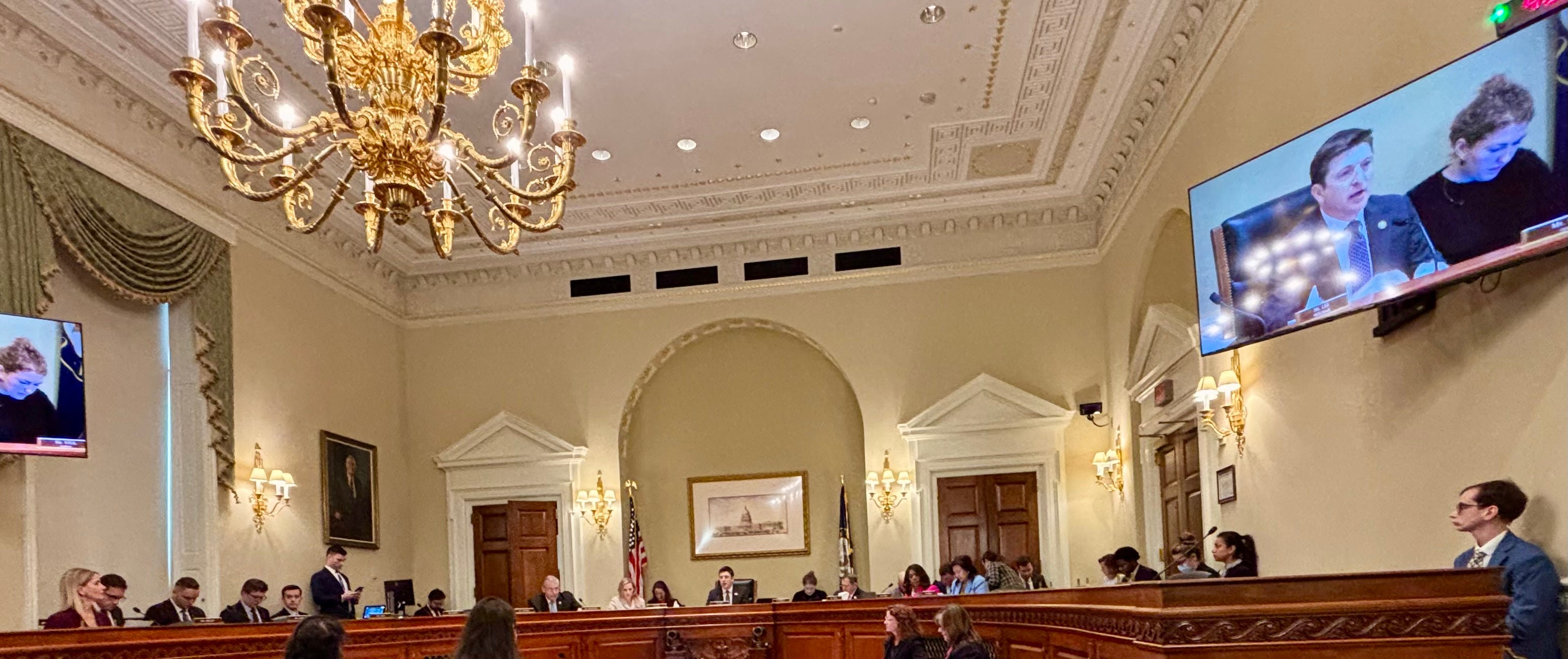
A bill blessed by Republican House leadership addressing members’ stock trading cleared its Committee on House Administration markup on Wednesday. The committee pushed aside amendments that took much harder lines to control members potentially profiting off of confidential information and did not consider the bipartisan legislation that is the subject of a discharge petition. A variety of nonprofit organizations wrote letters opposing the watered-down bill, including the Campaign Legal Center, P Street, Public Citizen, Democracy Defenders, CREW, Project on Government Oversight, and Citizens United.
Chair Bryan Steil’s legislation prohibits members from buying stock, but allows for the reinvestment of corporate dividends in additional shares. It also allows members to continue to sell stocks provided they give a seven-day notice to the House Clerk or Secretary of the Senate, maintaining the possibility of selling off based on privileged information. It also permits members to buy commodity futures, mutual funds, and cryptocurrencies.
Neither Republican nor Democratic leadership has been eager for this Congress to take up the more robust stock trade ban developed by a bipartisan group of members led by Reps. Chip Roy and Seth Magaziner. Their bill not only banned individual commodities trading but forced members to divest fully from holding individual stocks, futures, and other securities within 180 days (90 days for new members) or pay a penalty of 10% of the value of the asset plus any profit made. Rep. Anna Paulina Luna was organizing this discharge petition to advance H.R. 1908, which has 15 Republican co-sponsors (out of 80 total), which if joined by Democrats could reach the 218 threshold. Democrats say they will start their own discharge petition as soon as Monday.
During the markup, Democrats offered elements of their leadership’s substitute proposal that also added the president, vice president, and judiciary to persons covered by the trading ban, a poison pill for Republicans who routinely bend over backwards to please the White House. They also proposed amendments to tighten some aspects of Steil’s bill, like creating a carveout for family farmers to buy commodity futures in an overall ban on the practice. Democrats also complained the bill would allow a “grandma loophole” where spouses and children of members could buy stock and place them in a trust a member’s parents or grandparents control in anticipation of inheriting them.
Steil is not wrong when he says this bill is better than the legislation advanced by previous House Democratic leadership, particularly Speaker Nancy Pelosi, offered on this issue. As she was responsible for quietly blocking prior efforts, duh. But that overstates his case: neither (previous) Democratic nor (previously) Republican leadership had any real interest in advancing a meaningful ban on stock trading. We’re old enough to remember when Democrats and Republicans in both parties jointly sabotaged the STOCK Act, intended to provide transparency to stock trades. (My colleague Daniel notes it’s the only presidential bill signing he’s attended.) That law, per NPR, would also have “greatly expand[ed] financial disclosures and make all of the data searchable so insider trading and conflicts of interest would be easier to detect.” That’s a problem that still hasn’t been fixed.
Addressing conflicts of interest is popular with the American people, but it’s not particularly popular with party leaders. This in part is because they routinely recruit the wealthy and super-wealthy to run for Congress because they can self finance their own campaigns. It’s also because some leaders are quite wealthy, which is perhaps the inspiration behind the name of the PELOSI Act, which is intended to make that point. Ironically, Speaker Pelosi used the flurry of major Republican scandals, from the Jack Abramoff Affair and Duke Cunningham Scandal to the Mark Foley Imbroglio, as a major talking point in Democrats’ successful effort to recapture the House of Representatives. She campaigned on ethics reform, and once elected pushed through the Honest Leadership and Open Government Act, which established the independent Office of Congressional Ethics watchdog, required mandatory disclosure of earmarks, and strengthened public disclosure for lobbying. Even that legislation was subject to compromises that have come to create problems later on.
Ethics reform and transparency are often a plank of rising party leaders that is implemented to an extent once in office. John Boehner installed cameras in the House Rules Committee and instituted a provision requiring bills to be publicly available three legislative days in advance of a vote. Speaker Gingrich was responsible for passage of the Congressional Accountability Act, which required Congress to apply to itself many of the employment laws that applied to the private sector and the executive branch. Old hands who are readers of this newsletter can remind me of actions by Speakers Foley, McCarthy, and Ryan, but I’m sure they had their own signature measures. The only speaker in recent memory that did not is Speaker Johnson, but he did not rise in the usual way.
86% of Americans favor prohibiting stock-trading in individual companies by Members of Congress, the president, and Supreme Court Justices. If we take them at their word, Rep. Steil and Republican leadership want to advance their legislation because it is the best possible bill that can become law. The good should not be the enemy of the perfect. That’s a reasonable position. Similarly, Democrats want to pass strong legislation that applies to the president, the vice president, and the justices. Lord knows the federal courts, including the Supreme Court, have had more than their fair share of ethical problems where judges own stock in corporations whose cases they’re overseeing – at least 131 instances. Democrats pushing for a ban is reasonable as well.
Naturally, political leaders in both parties wish to be seen as proponents of reform. But if we were cynical, we might also acknowledge that not all of them would actually wish for a meaningful ban to advance. It could be why Rep. Steil’s bill is comparatively weak. It could also explain why the Democratic bill applies to the White House and the Supreme Court – its most likely path to enactment requires a trifecta, which provides a campaign issue for 2026 and 2028. We should be open to being persuaded by both parties that they’re serious, however. For example, many of the provisions to prohibit members from trading based on confidential information could be passed in the House right now by a resolution, which doesn’t require Senate agreement or a presidential signature. Why wait? You can do both a resolution and a bill.
Steil’s bill – really, Speaker Johnson’s bill – assuming it is enforced, would address half of the confidential information trading issue for members, like Rep. Lisa McClain’s husband’s purchase of several hundreds of thousands of dollars in stock in Elon Musk’s artificial intelligence firm right before the Department of Defense announced it would start using Grok. But members still can navigate their congressional careers to the benefit of stocks they already hold, like committee seats, without a divestment requirement. Permitting cryptocurrency holding, the corruption vehicle of choice for the Trump family, simply reeks.
The major reason any of this is a live issue in this Congress is because of the bipartisan effort by the rank-and-file to keep the issue in the spotlight and move the legislation forward. Sooner or later, they could reach the threshold to hold a vote on the House floor, at which point it would pass overwhelmingly. Republican leadership presumably would be unhappy both with the strong bill and also with the further undermining of Speaker Johnson’s ability to control the floor.
Accordingly, Republican leadership may be trying to prevent the loss of control and to claim a win by advancing their bill, hoping the nuance about all the carve-outs won’t matter when they try to sell it to voters. Democratic leadership also may be trying to claim a win by advancing their discharge petition, hoping to show voters that Republicans aren’t serious because they exclude the White House, federal judges, and the legislation is made of Swiss cheese. It also would further illustrate Johnson’s loss of control of the floor.
It is possible that Republican and Democratic brinksmanship could result in the enactment of legislation preventing members of Congress from buying and selling individual stocks and other securities based upon non-public or confidential information. The most likely result is House Republican passage of their leadership’s bill in that chamber. It’s hard to see how it would play out in the Senate.
Ironically, if we really wanted to address corruption in Congress, the better thing we could do is increase the pay for members of Congress. Their pay would be $100,000 higher if members had not consistently blocked cost of living increases for themselves since 2009. Going another, say, at least $100k beyond that figure would alleviate the need to trade individual stocks and other securities for many members and more importantly, allow Americans who are not independently wealthy to run for and hold congressional office. Members fear that such a move would be politically unpopular with voters.
The original ban on members of Congress earning outside income was paired with having their pay tied to a COLA formula. That worked for a while, until Rahm Emanuel decided to use it for political purposes. A wise policy move could be to pair a stock trading limitation with an increase in member pay. But politically, I don’t see how either party would ever make that trade.
GAO’S FUTURE
The Foundation for American Innovation has released the full report by Dan Lips and Soren Dayton on improving GAO’s performance in both cost savings and promoting bureaucratic efficiency, both of which they note have been sagging recently. At least a quarter of GAO recommendations, they note, are routinely ignored and more than 5,000 remain unaddressed. They also mention that the typical GAO report conclusion on agency progress in adopting recommendations of “progress made, challenges remain,” buried under a hill of detail, has become something of a running joke on the Hill and illustrates the tremendous amount of work GAO produces is not fulfilling congressional users’ needs.
We asked outgoing Comptroller General Gene Dodaro about improving the user experience for GAO products – in our recent interview with him. Specifically, we asked if legislative branch agencies ever discuss together what they hear back from congressional audiences about their products. The answer was pretty illuminating about legislative branch support agencies writ large.
Lips and Dayton’s suggestions for refocusing and renewing GAO’s priorities and collaborative capacity are well timed for the start of the search for a new comptroller general, a process that likely will be colored by the White House Office of Management and Budget’s dismissive attitude toward GAO on impoundments. They call for a reset, removing GAO from enforcement of the Impoundment Control Act and insisting on strict neutrality with regard to the Congressional Review Act to extricate it from messy political situations so it can focus on better performance. To further reinforce bipartisan trust, they urge Congress to work with the new CG to reduce lower-impact mandates and allow the agency to prioritize work with the highest potential for fiscal or managerial effectiveness returns. Some improvement, they argue, can be made by detailing at least one GAO employee into each congressional committee and codifying the requirement of federal agencies to cooperate with GAO information and oversight requests.
We are still working through their recommendations and are not necessarily on the same page for everything. But, it’s a serious effort and worth serious consideration.
ODDS & ENDS
ByrdBathBot. The Republican Study Committee says it trained an AI tool on thousands of Byrd Rule documents “to generate compliant legislative text and preempt Democrat[ic] challenges” in preparation for another reconciliation bill. The Senate Parliamentarian, recall, shot holes in the first reconciliation bill. We might not get the computer chess moment for Senate procedure as other Republicans aren’t as sold on legislative priorities as the RSC.
We have seen other parliaments train AI tools to provide support with interpreting the rules of the chamber and we think it can be helpful in certain instances. We’ve also seen the use of AI to draft legislation, although that’s largely to show how text would execute against a law, not to draft the law itself. It’s good that folks are working on these technological approaches. We would not recommend that anyone rely on such tools for work that goes into production, however, and would urge the chambers to use their professional staff to explore what approaches to use.
Next week, Daniel will attend a conference in Brazil on LegisTech: AI in Parliaments for Enhanced Accountability that will address these and other knotty issues, hosted by Bussola Tech and the Organization of American States. More to come.
10,000 mark. The Government Publishing Office reached the milestone of digitizing and releasing its 10,000th volume in the U.S. Congressional Serial Set, the paper record of committee reports and documents from each Congress stretching back to 1817 – 185,000 documents in all. Call your dad: the most recent updates include the entire official records of the Union and Confederate armies. Also included: committee testimony from a 1912 hearing on women’s suffrage and records of how federal agencies joined the nation’s centennial celebration.
Freedom and information. The PRESS Act, which Daniel has advocated for over the years and remains stalled, may have protected Washington Post reporter Hannah Natanson from the FBI’s seizure of personal items from her home as they investigate a classified information leak.
Congrats to Daniel, by the way, for being named to the FOIA Hall of Fame, which is a project of the Freedom Forum and Society of Professional Journalists.
Cell phone heist. The Justice Department charged a House Transportation and Infrastructure systems administrator with ordering and then stealing 240 cell phones he ordered for the committee. He sold most to a pawn shop.
What’s troubling is the committee only has about 80 staff members and, according to the DoJ, the theft was discovered when someone who bought one of the phones on eBay booted it up and called the House Technology Service Desk in confusion. In other words, the committee and House didn’t detect an irregularity in an order of $150,000 in product and 160 extra phones.
Faction. The Congressional Black Caucus endorsed Congressional Hispanic Caucus chair Adriano Espaillat, whom it denied membership to in 2017 after he defeated Charlie Rangel’s hand-picked successor, over an Afro-Latina democratic socialist primary challenger who criticized Israel’s military campaign in Gaza. A lot to unpack in that sentence, but the CBC’s PAC under its chair Rep. Gregory Meeks has a record of opposing more progressive candidates and has strong fundraising ties to AIPAC. In the House, the CBC has supported traditional liberal and moderate Democratic leadership.
How the factional composition and role of the CBC changes in coming Congresses will be interesting to watch. 19 of its 61 members are over the age of 70 (two are 69). Eight of those are 80 and older. Six, nevertheless, either are running or are considering running for re-election. Redistricting, meanwhile, will squeeze some incumbents out of seats.
ICE+Insurrection. The Department of Homeland Security secretly restored a policy that blocked unannounced oversight visits by members of Congress, which a federal court had struck down in December as a violation of federal law. The dozen congressional plaintiffs in that case have returned to court. DHS, meanwhile, is working to deport two witnesses of a death of another inmate in a chokehold in early January at a Texas detention center.
House Judiciary Committee Ranking Member Jamie Raskin sent a letter to DHS and DoJ requesting information on congressional insurrectionists pardoned by the administration joining ICE.
Hidden majorities. Protect Democracy authors Max Spitzer and Alex Tausanovitch take the rise of the discharge petition in the House this Congress as a sign that working majority coalitions already exist in Congress, but the rules submerge them. They call for a more decentralized system for floor action to enable factional competition – which we agree would be a good thing for the institution – and different mechanisms for coalitions to bring their bills to the floor.
Expand the Senate. Should cities receive the sort of delegates in the Senate that American territories and the District of Columbia have in the House to improve urban representation in the chamber? It’s an idea.
Robed warriors. Stanford Law fellow Duncan Hosie explores how the judicial branch has conducted a campaign to assert its supremacy over the legislative branch, with dire consequences. “When the Court claims exclusive authority over constitutional meaning while systematically weakening the federal institution most responsive to the people, it does not preserve the constitutional order,” he writes. “It ends it.”
In the committees. Committee proceedings we’re watching this week include House Admin’s oversight hearing of GPO, House Oversight’s vote on holding Bill and Hillary Clinton in contempt, and oversight of the Office of Special Counsel Jack Smith.