When Interns Become Infrastructure: How the Congressional Workforce Is Changing
Guest analysis from HillClimbers founder Omar Awan
This guest post by former CAO director of strategy and HillClimbers Founder Omar Awan meaningful shifts in how congressional managers are trying to stretch their employment budgets. They are drawn from Awan’s analysis of HillClimbers data. This piece explains how offices are shifting the traditional entry-level congressional job market in ways that will have long-term institutional ramifications to manage flat budgets. Given the downward pressure on the legislative branch budget from big-ticket items like building renovations and security for FY 2027, this is important context for coming appropriations decisions. - Chris Nehls
Staffing levels in the House reflect budget decisions for the legislative branch. When Member Representational Allowances increased in legislative year 2023, staffing levels rose quickly across the House. Since then budgets have remained flat and staffing levels began to decline again during legislative year 2025.
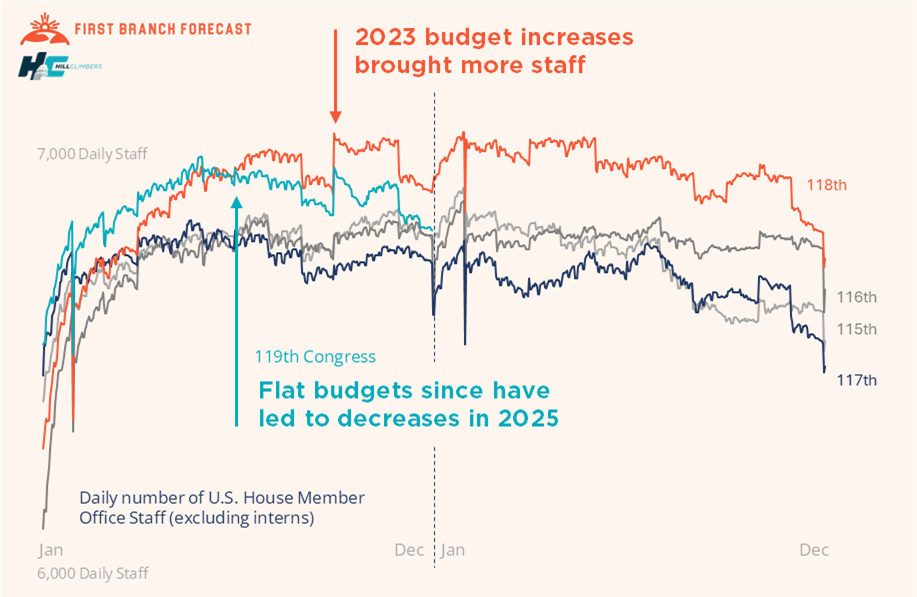
These recent budget constraints are accelerating changing workforce strategies inside congressional offices. Looking across nearly a decade of data from House statements of disbursement, permanent entry-level roles are gradually declining while the hiring of interns and other non-permanent staff has surged. These shifts have significant implications for workforce development over the long term in House offices.
This pattern began in 2019, when Congress created a fund to allow every personal office to pay interns. In the House, member offices soon created many new non-permanent positions while keeping the rest of the workforce relatively steady. By 2021, there were more non-permanent staff than members of constituent service teams. By 2023, interns and temporary staff surpassed the number of permanent administrative staff. Over the same period, only communications staff grew overall, but at a much slower rate and in lower overall numbers.
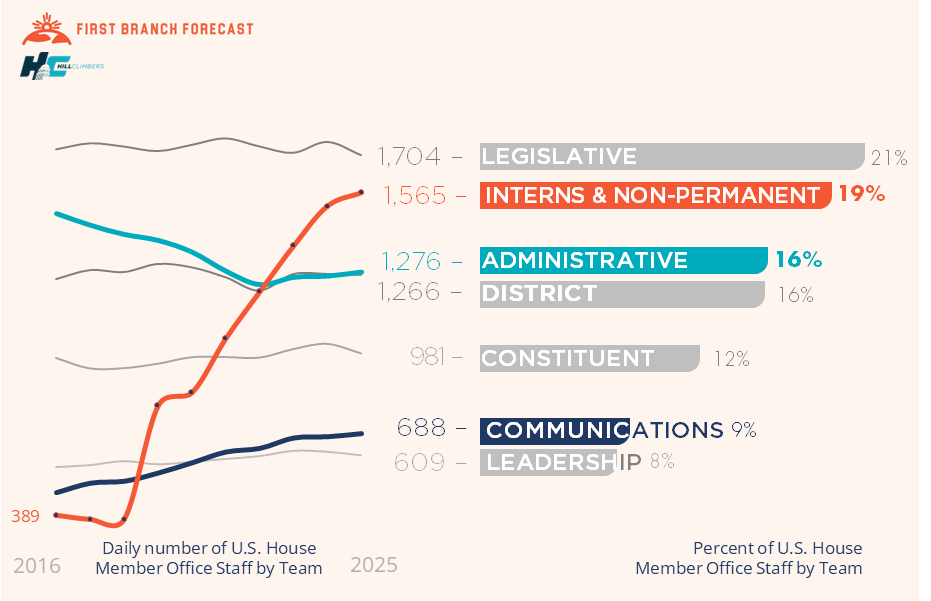
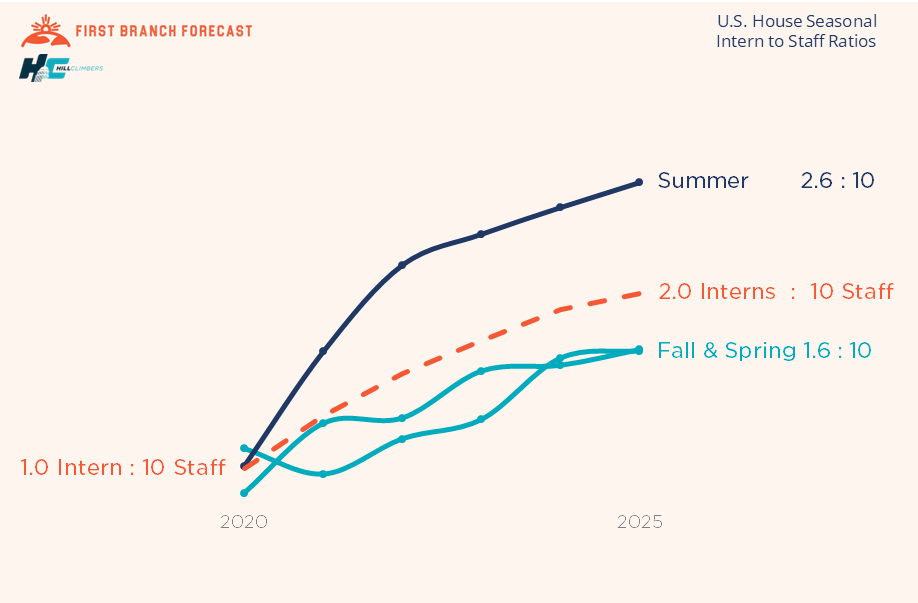
Today, non-permanent staff represent one of the largest sources of capacity inside the House as over 5,750 interns worked in member offices in 2025. In 2020, congressional offices averaged roughly one intern for every ten staff members. By 2025, that ratio had doubled to two interns for every ten staff members. Interns and other non-permanent staff currently account for about 19 percent of total workforce capacity, second only to Legislative staff at about 21 percent.
The HillClimbers platform can track these changes because our dataset standardizes thousands of job titles into functional teams such as legislative, district, communications, administrative, leadership, and interns. Because some staff hold multiple roles, the counts use a “single role plus” method. Staff with a single role count fully, while staff with multiple roles are divided between their assignments. This prevents double counting while still capturing how offices distribute work. HillClimbers also can track when people holding these roles are assigned to an office on a daily basis. That data is revealing how the use of internships has shifted.
The Intern Workforce Is Now Continuous
Internship cycles once followed a predictable academic rhythm. Numbers rose in the summer and dropped sharply in the fall and spring. Summer internships still represent the largest share of the intern workforce and the largest-growing cohort of seasonal workers. However, fall and spring internship programs have expanded significantly as well.
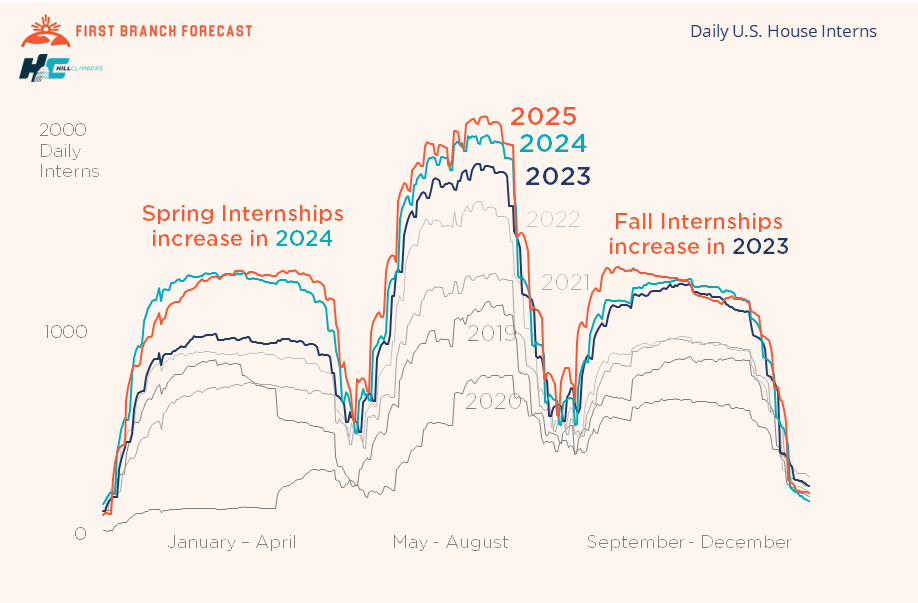
Interns are increasingly present throughout the entire year rather than concentrated only during the summer months. In practical terms, nearly one out of every five people working in a congressional office is a House-paid intern on any given day.
Job postings reflect the same shift. Instead of generic summer internship positions, offices increasingly advertise specific roles such as spring legal intern, fall press intern, or summer district intern. These titles closely resemble the functions traditionally performed by permanent entry level staff.
A Workforce Substitution
Looking more closely at entry-level roles reveals where much of the change is occurring. The number of staff assistants, one of the most common entry points into congressional careers, has declined steadily over the past decade. Legislative correspondent and aide roles have also declined. Field representatives and constituent services staff have remained relatively stable but show gradual downward pressure. At the same time, communications roles have expanded.
These changes are visible when entry-level roles are tracked daily across the House workforce
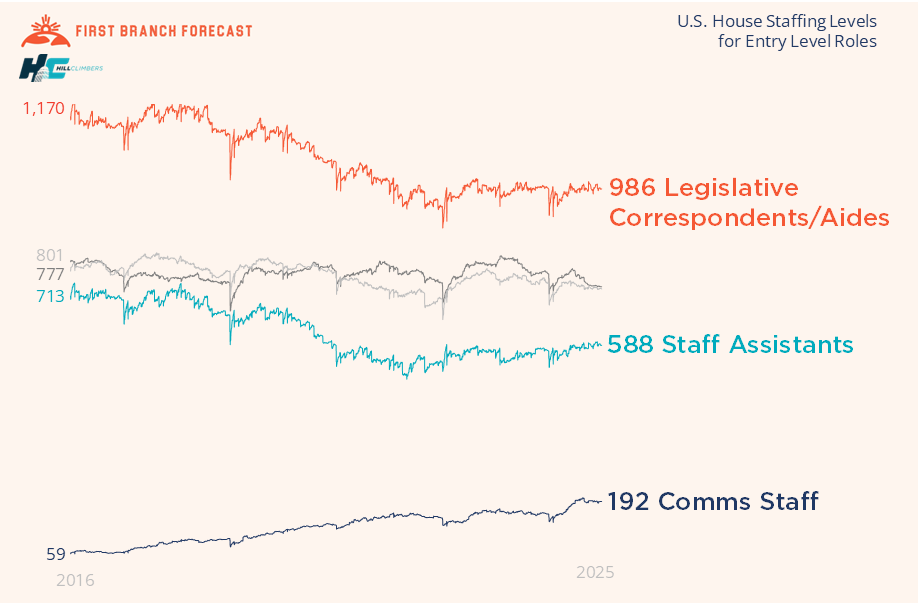
Taken together, staff assistants and legislative correspondents or aides declined from about 1,883 positions in 2016 to 1,574 in 2025, a reduction of roughly 16 percent in these core entry-level roles.
The pattern suggests that the traditional first rung of congressional careers is narrowing. Fewer permanent entry-level positions exist than a decade ago, even as offices continue to face the same workload demands.
Intern programs, meanwhile, have expanded dramatically during the same period. Interns now represent a growing share of office capacity and increasingly fill roles that resemble the responsibilities traditionally associated with early career staff. Offices still need people to answer constituent requests, support legislative work, manage communications, and assist with research. But the workforce fulfilling those tasks appears to be shifting toward more temporary roles.
Budget constraints likely play an important role. Member office budgets have not kept pace with inflation or the rising costs of operating offices in Washington and in districts. When resources remain fixed but workloads continue to grow, offices may rely more heavily on temporary labor.
Why This Matters for Congress
Is Congress gradually replacing the first rung of its career ladder with a rotating internship workforce? If more daily staff capacity relies on positions that reset every academic term, offices may face growing challenges maintaining continuity, training, and institutional memory. Internships are temporary by design. Most interns remain in offices for only a few months, and relatively few continue working on Capitol Hill long term. Since 2009, only 13% of Interns have remained or returned to the House.
Internships play an important role in congressional offices. They provide valuable opportunities for students and help offices manage demanding workloads. But the shift toward a larger non-permanent workforce may also have broader institutional consequences.
 | A guest post by
|
Interns and fellows have been an important to member staffing for over 50 years. Senator Brock in 1972 instituted his own fellows program supplemented by researchers and interns. Looking at cases studies across time would be helpful for understanding full impact to office staffing roles, activities, and office organizational stiles.