Congressional Modernization Reaches a Point of Maturity
More platform demos than data discussion at a key task force meeting benchmarks legislative branch progress
The Congressional Data Task Force reconvened in a beautiful new location in the Jefferson Building at the Library of Congress on Thursday. For those not familiar, the CDTF started out a dozen years ago as a working group to evaluate whether information on what became Congress.gov should be made available to the public as structured data. It then continued to meet quarterly with internal and public stakeholders to improve sharing of legislative branch data, establish data standards, and develop tools for internal and external stakeholders to improve their ability to engage with congressional activities.
We at the American Governance Institute manage the Congressional Data Coalition, a group of external stakeholders that have engaged with and documented this process—and helped set it in motion. This internal-external coordination has made this data useful to internal and external website and application developers building tools to keep Congress and the public better informed.
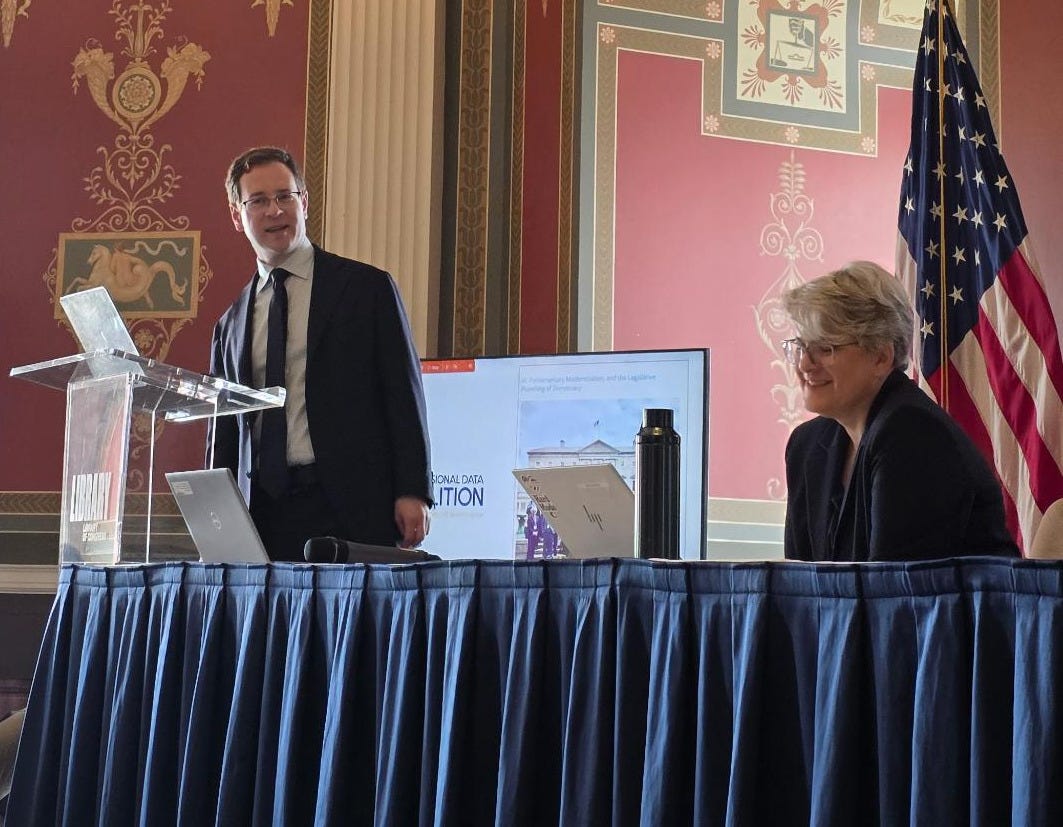
Thursday demonstrated how far CDTF has grown into a collaborative forum that facilitates legislative branch modernization. Most participating legislative branch support offices used their meeting slot to demo powerful platforms they’ve built for congressional users or preview coming attractions. We in civil society, working on the other side of the congressional firewall, were excited and appreciative that staff gave us a peek at their accomplishments through the demos, some of which were shared publicly for the first time.
There was one major data project unveiled at the meeting: the presentation by the Government Publishing Office has added the Legislative Branch Data Map compiled by the Congressional Data Coalition and the House Office of the CAO in an easy-to-read format on the Legislative Branch Innovation Hub for all to explore. It is a catalog of datasets across the legislative branch that stakeholders can use to build their tools and solve their problems, something that heretofore has not existed. It grew out of a project demoed at the 2025 Congressional Hackathon and seeded by our 2023 “biased yet reliable guide to sources of information and data about Congress.”
The map includes the title, description, and link to the publisher source of data produced by legislative branch offices and civil society organizations as well as their DCAT, or standardized metadata. Like other GitHub pages, people can contribute new entries through this link. This resource centralizes dozens of data sources on a single reference and should be a great help to developers supporting legislative branch modernization. Veneice Smith in the Clerk’s office, who is managing the project, worked hard (in collaboration with others) to get the project to the point where the data is published online on the Innovation Hub.
We will have a longer write-up of information shared and tools demonstrated at the meeting, but here are a few highlights, including the text amendment project, Senate modernization, House modernization projects, and tracking congressionally mandated reports.
BILL TEXT ANALYSIS
Comparative Print Suite. New tools built on top of data standardization have made it possible for Hill staff to perform sophisticated bill text analysis with greater efficiency. The House Clerk’s Office demoed the completed full version of its comparative print suite platform, which CDTF coordinator Kirsten Gullickson noted is likely the first (but not only) artificial intelligence-enabled tool developed within the House. It cleanly shows inline text how a bill would change existing law and allows users to upload bill drafts. We’ve been tracking this complex, multi-year project and congratulate all involved. (We’ve written about this tool, also known as the Posey project, previously.)
It is available to all members of the House and is also used by CRS. A pilot group of about 80 Senate staff is using the comparative print suite as well, with interest growing from offices for more access. They have been working for a while to resolve licensing and administrative issues to allow for expanded usage in the Senate. (The comparative print suite we should note is not available to the public, although we have advocated for its availability.)
Text Analysis Program. Barbara Perkins from the Congressional Research Service provided a demo of its Text Analysis Program, which finds bills with similar text that may have been introduced in previous Congresses or have been tucked inside longer legislation. This is incredibly powerful, because it allows for the tracking of legislative ideas as they propagate across the current Congress or over multiple Congresses. This is version 2 of TAP, and it is very sophisticated indeed. (We had built a prototype of this approach, called BillMap, a few years back to demonstrate that it was possible to do.) TAP 1.0 was described by CRS in 2011 as a tool to identify similarities in congressional bills covering the 103rd Congress to date. Modernization efforts kicked off around FY 2022, according to the Library.
TAP 2.0 can help support resolving a recommendation by the House Modernization Committee (no. 120) to provide information resources that can show members’ activity on issues over time. In theory, it makes it possible for a member of Congress to receive credit for legislation they introduced even if that bill passes as part of a larger bill, or in an amended form. For that to work, the output of TAP must be shown on Congress.gov, identifying various kinds of relatedness of legislation.
Identifying related legislation is a tricky concept. How do you identify bills that are identical, near identical, and similar? Do you identify similarity in text, and if so, how similar do they need to be? Do you identify bills that have similar outcomes? We were comfortable with revealing how we identified similarity and having the user decide whether we made the right connection. CRS has some wariness about this approach, and so its analysis requires a lot more intervention by human experts who make the determination.
It is our view that combining the relatedness of legislation over multiple Congresses with information about those related bills, such as committee reports, votes, GAO reports, statements of administrative policy, and the like, could provide congressional users with a wealth of information to help them analyze legislation quickly by looking at how it has been responded to previously.
TAP 2.0 contains legislation going back to the 113th Congress and offers side-by-side views. We aren’t 100% sure, but we think that it is only available inside CRS, at least for now. Correction: TAP is available in the House.
SENATE PROGRESS
Webster. Arin Shapiro of the Office of the Secretary of the Senate announced it will begin a revamp of the widely-used internal website called Webster. The technology behind the resource is becoming obsolete and the update will continue to help staff discover information useful in their work.1 An update involves several Senate stakeholders so it may be complex, but Shapiro said it should be completed in nine to 18 months. It is unclear whether it will be made available to House staff, but there is a growing effort to create greater federation of authentication between the two chambers to allow for better data and tool sharing.
The Bells. The secretary’s office also is finishing up development of a Senate version of an app that can keep users informed of open votes, quorum calls, and when the Senate is in session. For decades, this information has been displayed via lights on the clocks inside congressional office buildings and with alarms, transmitted through radio signals. It’s been a complicated technical challenge to convert this system to modern mobile devices, but the new app will work on and off the Hill via a VPN. The Senate team learned from a similar effort on the House side for its bells system. The data will be available internally through an API, but there are no plans as of yet to make it publicly available. There will be an app for internal users as well. Readers of this newsletter may remember Capitol Bells, an app developed by Ted Henderson that let the public know for whom the bells tolled, and had wide usage on the hill, too.
As we wrote about previously, the Secretary of the Senate’s office has updated the internal technology—the Amendment Tracking System—used to track senate bills and amendments as they’re considered on the Senate floor. As things stand, at times the Senate will vote on bills that have not yet been made publicly available.
Congress.gov data is far downstream from the Senate process, and unlike the House, which first publishes its legislation on docs.house.gov as uses it to measure online availability of legislation, there is no Senate equivalent. We have written letters and submitted testimony calling for legislation and amendments to be made publicly available as they are considered by the Senate. For its part, the Senate’s new technology is capable of providing public access, a testament to the robust design process for the new ATS, but leadership direction is required to provide transparency to the public.
MODERNIZATION FUND PROJECTS
CAO House Digital Service Director Ken Ward presented four projects that House appropriators recently approved to receive Modernization Initiative Account funding.
Constituent Engagement Innovation Project. This project will define a common format for information coming into member offices from constituent emails, phone calls, letters, etc. that go into offices’ constituent management systems software. The House Modernization Committee described the goal as “to provide Members with the option to select from a broad range of providers for the unique services that best meet their needs.” Starting this year, the HDS will engage in initial discovery and proof of concept work with the ultimate goal of producing a data lake so that members are not locked into a particular Constituent Management System, but can control their own data and move between platforms.
FlagTrack 2.0. Building on the successful flag tracking system, FlagTrack 2.0 will further streamline the process by allowing checks and refunds to be processed through the portal, providing an option for a flag to be sent to member offices or shipped directly to the constituent, and give constituents the ability to track their flag requests. This should take nine-18 months to complete.
Digital Signage and Wayfinding Initiative. Visiting the Capitol complex can be very confusing, and this project will improve the visitor experience in the House side of the complex. There will be nine new digital displays at entrances to the main House buildings that list member and public office locations as well as real time information about committee, floor, and public events. In addition, there will be a newly created House Visitors App that provides a 3D digital map, the ability to look up Member and public office locations, and turn-by-turn directions. You can scan a QR code and get directions. Think of it as Waze for Congress (well, the House side). The data to make all this work will be drawn from the CAO’s newish LegiDex directory, which provides up-to-date information about locations on the campus, as well as HouseCal, which keeps track of what events are occurring. This project should be complete in 18-24 months.
Service Academy Nomination Portal and Dashboard. Members of Congress annually nominate constituents to Service Academy positions, but the way member offices handle the process of collecting applications and processing recommendations varies widely. This tool will replace the spreadsheet and email-based systems used by most offices and replace it with a streamlined, online system. It will include an applicant portal, a public-facing web application for submitting applications and supporting documents and tracking application progress, and a staff dashboard, which allows staff to track and manage the applications. This is expected to be completed in nine-18 months.
Altogether, these projects should significantly improve the efficiency of office constituent services and the user experience for people interacting directly with Congress. This is a great validation of the process by which the Modernization Committee at House Administration recommends projects, appropriators provide the funds, and various stakeholders inside the House build the technology.
We are hopeful that once members can see their benefits, appropriators will restore the $10 million authorization for the Member Initiative Account so HDS can do even more. We also would be pleased to see more House-Senate and legislative branch-wide collaborations on modernizing technology, including seeing progress on implementing appropriators’ direction for the House and Senate to co-develop technology and sign a MOU to facilitate tool building. The House FY 2027 Legislative Branch Appropriations bill funds the account at $4 million for a second consecutive year.
ONGOING PROJECTS
There are a number of ongoing projects, including the joint House-Senate effort to provide unique IDs for lobbyists, the House’s building of a committee activity portal, and updates to USLM. More information about those projects will be published on the House Modernization Reports website in July.
MATCHING MANDATED REPORTS
Daniel shared a project the American Governance Institute has started with the help of government data and tech leader Dave Zvenyach to identify missing records of congressionally mandated reports that agencies are required to submit to GPO. It draws from a list of more than 3,000 required reports drawn up by the House Clerk’s Office and attempts to match it up with the more than 1,000 records on govinfo.gov. There is not a common data standard for what the legislative branch is ingesting and executive branch agencies are providing, which made the effort challenging.
Here are the key findings. First, most congressional mandates for reports to be provided to Congress do not have matching reports in the GPO repository. Second, 395 reports in the GPO repository are not identified in the House’s list of reports due to Congress. Finally, in light of metadata limitations arising from looking at the list of reports due against the list of reports received, the next step is to look at the transmission letters to Congress and match that against the reports themselves.
This is one of four technology projects undertaken by the American Governance Institute this year with the support of Zvenyach. Expect to see presentations on identifying absent House committee video data, transforming appropriations bills and reports into data, and tracking changes in appropriations report language.
At the meeting, Daniel also shared a few observations from a recent convening in Dublin of parliamentary officials from dozens of countries on data management and modernization efforts. He wrote a longer summary of the event on the Congressional Data Coalition blog.
The next CDTF meeting is scheduled for December 3, again in the Library of Congress. The next Congress.gov public forum will be on September 24. Several other events are in the works for September as well—this is when the Hackathon is usually scheduled—so stay tuned.
In addition, if you’re a staffer and interested in earning an ethics-approved professional certificate on ‘data skills for Congress,’ go here to learn more about the virtual class.
We will share a more in-depth summary of the quarterly meeting on the Congressional Data Coalition website, where we have a repository of summaries of past meetings.
REINFORCING ARTICLE 1
The House passed a bill last week that would give a council of congressional leaders control of the selection process for the next Librarian of Congress and director of the Government Publishing Office. H.R. 6028, which the Committee on House Administration hammered out over the last year, removes presidential nomination from the process. The bill is similar to a recent law changing the selection and removal of the Architect of the Capitol.
These changes would strengthen legislative branch independence in the wake of President Trump’s firing of Librarian of Congress Carla Hayden and effort to remove Register of Copyrights Shira Perlmutter and his attempt to install then-Deputy Attorney General (and his former defense attorney) Todd Blanche as Librarian. Trump also tried to name a new Deputy Librarian and Register, but none of these individuals were allowed in the building. (Perlmutter eventually won her job back via lawsuit.) Having Administration lackeys in charge of the Congressional Research Service and other resources would have undermined members’ ability to gather reliable and independent information about public policy and undermined the independence of copyright processes.
H.R. 6028 changes the selection of the Register of Copyrights as well, allowing the majority and minority leadership of CHA, the Senate Rules and Administration Committee, and the Judiciary Committees of both chambers to recommend jointly three nominees for the president to choose from to fill the role, with the Senate approving the appointment. Rep. Morgan Griffith, the bill’s primary sponsor, noted that the Register has some executive-type functions even though it is a legislative branch office, so keeping the president in the process was warranted. (Interestingly, Griffith also wants the Office of the U.S. Trade Representative transferred to Congress.)
The addition of CHA and Senate Rules to the process was one of the substantive changes that emerged from the bill’s markup. The text agreed to by the House unanimously under suspension on Tuesday was the first we’ve seen of this version of the bill. The original bill struck a section of existing law that required the Register to consult with the Librarian when establishing new regulations. The version the House passed restores this consultative role. It also stands up a completely independent inspector general’s office in the Copyright Office. We note these changes as evidence of how the committee worked through the specifics of these reforms.
These reforms are important for preserving the separation of powers and independence of the legislative branch. They also make a set of congressional leaders responsible and therefore accountable for making successful choices for these positions, incentivizing them to take the process seriously. A similar change to the selection of Architect of the Capitol appears to be a success with the performance of Thomas Austin. CHA members were on the whole complimentary and appreciative of Austin’s efforts in his first year in the role during the committee’s recent oversight hearing with the AOC.
We note that House Appropriators included a different approach regarding appointments of the Librarian of Congress and Director of the GPO in the bill recently reported by that committee.
We remain concerned about the presidential role retained under current law for the president to nominate the next Comptroller General. Jurisdictional challenges and policy disagreements may have made addressing GAO in the CHA bill challenging, as the House Oversight Committee has jurisdiction over the legislative branch’s watchdog. We have trouble imagining the Senate would be willing to move the House’s legislation absent a GAO fix.
Speaking of GAO, it is being stonewalled regularly by the Trump Administration on requests for information from a number of federal agencies, according to NOTUS. At times, requests were denied if issued by committee ranking members, whereas in other cases GAO was denied records and data it had received routinely in the past. Sometimes, “agencies have not responded to GAO’s emailed questions or even acknowledged that an audit is taking place,” Jose Pagliery reports. GAO and its legislative branch masters may need more tools to force executive branch compliance.
It’s also worth exploring common data layers for the executive and legislative branches so some data can be delivered to the legislative branch automatically.
SNAPSHOT OF PARLIAMENT’S STAFF
The British House of Commons recently published a granular survey of the growth of full-time employees from 2014 to 2025. Unlike their American congressional cousins, House of Commons FTEs have increased over that ten years by 90% with about two-thirds of those undertaking new activities for the Parliament. The House of Commons now has about 3,400 full-time employees serving in roles akin to congressional legislative branch support offices. More than half serve both houses of Parliament on teams like a new Parliamentary Security Department and the Parliamentary Digital Service.
What do those new hires do? The report offers down-to-the-FTE detail (we would love to see something similar from Congress). The Parliamentary Digital Service added 285 staff, more than doubling in size. Dozens of new FTEs work on digital democracy implementation, the Parliament’s web and broadcast teams, digital infrastructure, and what we would call member services: digital tools for MPs’ procedural needs like remote voting and the digital hubs they use to help answer constituent questions. The security team added about 575 staff over that time.
Like the U.S. Congress, MPs are authorized to hire their own personal staff with public funds. The current allowance, however, only supports five FTEs for the 650 MPs. British elected officials, therefore, receive more direct support from parliamentary services staff in research and analysis than personal staff.
The House of Representatives and the Senate should conduct and publicly release a similar longitudinal survey of staff FTEs across the legislative branch.
ODDS AND ENDS
Tribute. We congratulate the Project on Government Oversight for 45 years of operation and raise a glass to Executive Director Danielle Brian, a giant in the field, for her 35 years with the organization.
Blocked grants training. Lawyers for Good Government, legal experts and other civil society groups will offer a free virtual training for congressional caseworkers on assisting constituents with disrupted federal grants on June 17 at 1:00PM EST. Sign up to attend here.
Unblocking threats. A change in Meta’s algorithm led to a tripling in threats to lawmakers in both parties, according to the Center for Countering Digital Hate.
Minority powers. Georgetown University Law Center’s David Rapallo has updated his recent paper on the options minority parties in the Senate have to check the executive branch through investigative powers.
This version of Webster is 8 years old, but Daniel remembers using a version of Webster in 2001.