Interview: Wade Ballou
The former House Legislative Counsel explains the curiosity-driven process of drafting legislation, how the courts are unmooring the process, and how tech-driven efficiency can be a double-edged sword
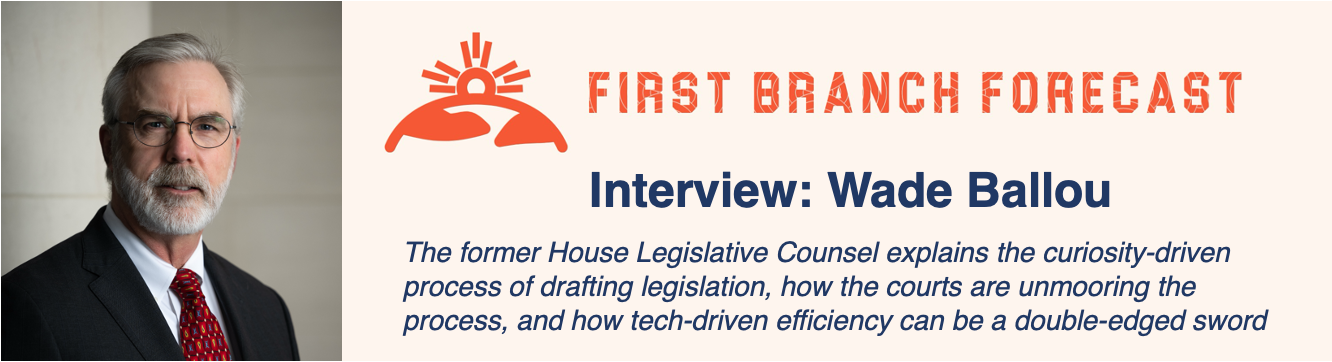
Daniel and I spoke this week with Wade Ballou, the recently-retired Legislative Counsel of the House of Representatives. In that role, he lead the House Office of Legislative Counsel, the 70-attorney team that drafts legislation, amendments, and other bill text, from 2016 to 2024. He enjoyed a 40-year-plus career at HOLC, joining the office in 1983 when bill drafting was still done on legal pads. Through an interest in software development, Wade was instrumental in HOLC’s contributing to the development of the United States Legislative Markup data standard that underpins cutting-edge applications like the House Comparative Print Suite. He received the Democracy Award for Lifetime Achievement from the Congressional Management Foundation in 2024.
This free-ranging conversation is a unique window into this little-known but essential (and very busy) part of the legislative branch and how separation of powers issues trickle down into the gears of the institution. It’s been lightly edited for clarity and length.
Chris Nehls: Mr. Ballou, why don’t you just start out by explaining what the Office of Legislative Counsel is because I think most of our audience think that members of Congress write bills and or their staff write bills. There’s actually much more to it. Can you explain what the office is and what your role was.
Wade Ballou: At a high level, the office was established to advise and assist members in the performance of the legislative part of their constitutional duties. It was established formally in 1919 and received a charter in the Legislative Reorganization Act of 1970. The office to begin with is nonpartisan and maintains confidentiality with respect to each member for whom it prepares a draft or provides advice.
Within that, we then assist the members at conference. So when they’re having a formal conference with the Senate or having the informal ping pong back and forth, we assist in preparing whatever the version of the bill is required at that point.
We assist as well in the committee process, working with the chair and, if desired, the ranking members in preparing the substitute for the bill. I say substitute because that’s the way that the committees have been proceeding for a few years. We also are assisting each member of the committee, that’s majority and minority, in preparing their amendments to the substitute and then assisting the members. After the markup is completed, if the bill is ordered reported, then we prepare the report materials to include any Ramseyer if needed – the document that shows how the law is actually changed by the reported version of the bill. The committee itself does their report which explains what the committee did, then they include all the elements required by the House rules.
Moving to the floor, we will prepare member amendments to the bill. The rules committee is pretty much acting as a de facto floor where members are able to be seen. All of those amendments are prepared and the members submit them to the rules committee.
And then finally, in terms of the general drafting area, we assist members in the preparation of their bills and resolutions that they are working on that they might introduce or they might use to further negotiations either among themselves or with the executive branch.
The final part of our charter in terms of what our functions are has that wonderful clause that says, oh, by the way, anything else that the Speaker asks or approves, you can do that, too. Under that rubric is, at least in my mind, where we’ve done most of our software development work.
Some of the value that we bring as we assist members is we bring a curiosity – why are you doing what you want to do? What’s your motivation? What’s the problem you’re trying to solve? – and really seek to understand for the benefit of us then asking questions of the member to help the member think through what they’re doing. Our secret juice, as it were, is curiosity, and our method is asking questions. Because ultimately, what legislation does not only changes law or makes law, but in doing so it draws lines. Where does the member want to draw lines? We are seeking to understand that so that we can then faithfully give them a draft where we represent to them that in our opinion, this draft, if enacted, will actually carry out your desired policy.
Daniel Schuman: How many people are in your office?
Ballou: Well, I left a year ago or a little bit more, so I’m not sure where they are right now. When I left, we had 71 or so attorneys. I think they’re up to about 75 or so, and about 20 support staff.
Schuman: And what’s the volume of bills and amendments that you might, that your office might be called upon to help draft?
Ballou: Individual numbers lately, the bills run anywhere from 10,000 to 15,000, maybe even up to 20,000 drafts. Not every draft is actually introduced. And then it’s a like number of amendments that we are preparing. So it’s a busy place. The context frequently is short deadlines, and a lot of pressure to get it right – and I’ll put that in air quotes here – many times without full information provided to us.
Nehls: This, it seems like a tremendous work pace, but also very different from what attorneys usually are doing, which is dealing with case law or laws that exist. Can you explain what the different skill sets that somebody at the Office of Legal Counsel would need that might be different from the average attorney out there.
Ballou: As you mentioned, coming out of law school, you have been steeped in figuring out what the law is relating to a particular set of facts that are presented by your client and then applying the law to those facts or perhaps arguing from the facts, which law should apply. If you are a litigator, if you are in a transactional practice, then you want to understand what the law is so that you can structure the transaction so that it will be upheld in a court and achieve the goals of the parties involved in that transaction.
Law schools typically don’t teach anything about the legislative process. They’ll get to section eight with the enumerated powers, but they don’t really get into how the process works and how laws are made. So that would be one difference right off the bat. You are going to be dropped into a foreign process in terms of what you were training for.
Our goal is twofold: to train you to think legislatively. That is, you are presented with a policy from a member and that policy ought to be based on a desire to solve a particular problem. So it’s helpful to find the facts. And then the question is, what do you do with that policy? Rather than applying the law, you’re changing the law. So you need to learn to think, how do I change law?
And then relating to that, you typically in the role of Congress are directing the president to do something or a secretary to do something. Getting yourself into that mindset of, Mr. President, with all due respect, here’s what we are requiring you to do, and here’s when you have to report back, et cetera, et cetera. That’s the basic change that needs to happen, which is why being curious is really important. What’s going on on the ground with the real facts, what’s going on in the law? Because typically it’s not just one place where you need to fix law.
But law is complex and there are a lot of moving parts. You need to be able to identify all the parts that need to be modified in order to carry out the policy, and then the questions. It’s not ours in terms of legislative counsel to figure out what the right answer is in terms of modifying all those parts. Rather, they become questions that you ask the member or the member’s office. Your policy impacts law (A), here’s how it impacts it. Here’s what would happen if you do not change it. Here’s what happens if you do change it. And oh, by the way, here are a variety of ways that it could be changed. What do you, the member, want to do with this? So the member is always in charge of the policy. In terms of the draft, as far as the member is willing to go, that basically means that if the member doesn’t go very far, the draft doesn’t go very far either. So a caveat emptor for everybody who reads bills, uses bills that you really need to do your independent analysis of what the bill does and how well it works.
Schuman: Okay, just two quick questions on that. We talked about this a little bit before. You can’t just show up at your office and be able to do this. It takes time to develop the skill set. Could you talk about just how long it takes for someone to be able to be a competent drafter, to be able to assist members to do this.
Ballou: Back in the good old days, we used to say it took about seven years. The reason I say the good old days I was in the office for a little over 41 years. I began in 1983., and everything of course, was done without computer technology. Nowadays, I would say it takes roughly about five years.
The reason is we are able to take advantage of the technology to speed up the training. But more importantly, we have moved from the solo practitioner model that was in place when I joined to a team model. We have a two year formal training program and out of that, we put you onto a team. And then you are mentored as a member of that team really forever. At some point, we all mentor each other and we all assist each other. So, after about five years, you have seen the variety of kinds of situations that arise and you either know how to solve them or address them or you know where to find the answer or who to ask.
Schuman: The other question I had is that it seems like the nature and pace case of law itself is changing. So the principles of interpretation that you would see from the courts are in significant flux, right? Chevron [deference] being knocked down is one example. The major questions doctrine is another. I would not necessarily be confident that one canon of interpretation that we would have relied on last week will necessarily be around next week. And your job is to write for the ages.
There are some people that say the way to solve this is by having Congress write in greater detail, right? Have the laws be much, much more detailed. Although, if you’re dealing with a court that is not so interested in the detail, then that might be challenging. I just wonder, how do you think about it? How do you think about writing in what seem like very fluid circumstances with legal interpretation?
So how in the world do we think about it now? Because when I draft, I draft under assumptions being the typical rules of statutory interpretation, the long standing precedents of the Supreme Court the, typical agency interpretations of their regulations. When that gets in flux, then you’re losing your anchor points from which you can advise and provide any level of certainty that your draft, if enacted, will carry out the intended policy. So it’s becoming much harder, and it’s because of the Supreme Court decisions and how they are rippling through the rest of government. - Wade Ballou
Ballou: I recall saying to the ranking member a number of years ago of House Administration kind of when he asked a similar question about how we’re doing and I said, well, I’m not sure I know how to do my job anymore. And of course, he looked at me like I’d lost my head. And then I explained, so let me talk a bit more about that. Our training involves not only just the basic structure of drafts: how to put them together, how to think about that, and just the very close, careful attention to words and word choice, but it also involves a lot of work in the Constitution and therefore Supreme Court decisions as you move on to a team in areas of law.
The complexity involved there is the procedure of the House and to some degree of the Senate, because you have to be aware of what your draft might do if and when it lands in the Senate and how it can unintentionally upend the Senate process. It’s not that when we make a draft that it’s all of these things. Rather they are prompts for questions to the member. If we do it this way, this is what we think the result will be in the Senate. Do you want to proceed anyway? It’s kind of again, up to the member.
So how in the world do we think about it now? Because when I draft, I draft under assumptions being the typical rules of statutory interpretation, the long standing precedents of the Supreme Court the, typical agency interpretations of their regulations. When that gets in flux, then you’re losing your anchor points from which you can advise and provide any level of certainty that your draft, if enacted, will carry out the intended policy. So it’s becoming much harder, and it’s because of the Supreme Court decisions and how they are rippling through the rest of government.
Schuman: So, for things like Humphrey’s Executor [v. U.S.], right? Where it seems like the federal courts are saying that the establishment of independent executive agencies is no longer a thing. We don’t quite know how far that goes, but it seems like it’s going pretty far. If you were back at your desk trying to draft around that problem, it becomes significantly more difficult.
Ballou: It’s a real problem. At its core, the question for the member is, is this supposed to be independent or is this supposed to be clearly within the executive branch? In the past we would do one approach or the other. They’re established in the Department of the Treasury X office or whatever, or we would direct the Secretary of the Treasury to do something if we wanted something independent. Well, we’ll set up this agency and we will provide perhaps for five heads in terms of directors or commissioners or whatever you want to call them.
Nowadays, it’s a bit unclear as to just how far the court will go in upending the understanding of how American law worked for the entire 20th century. I think it is really important to understand what the law was addressing and that is the complexity of problems that were facing the American people. It was the Congresses at the time working with the presidents at the time to come up with a solution that worked for the people. And over time, as they found what worked and what the Supreme Court would say met the constitutional requirements – that’s kind of what the 1930s was all about. From a legal perspective you had a pretty stable system. It would be a little iffy on the edges perhaps, but in the middle, everybody knew pretty much what the rules were. Now, the system is no longer very stable and it’s unclear what the rules are going to be, which is really bad for the people because one of the key principles in law is providing certainty so that people can then make their decisions and go about their daily life.
Schuman: When I started as a staffer, I had the idea that staff write the bills and it’s not unusual for people to try to cobble together their own legislative text and send it to leg. counsel. But that’s not necessarily the best process, is it? Could you talk about what you think an ideal process would look like?
Ballou: Yeah, but let me address whether or not a staffer ought to write legislation. It depends! Do you know what you’re doing? I learned a lot from staffers who have a lot of experience. They taught me much about the law. There are some really, really good staffers who continue to work for members and for committees. So, I would not discourage them from writing legislation.The kind of conversation that I would end up having with them would be very different from one who was uncertain about how to proceed and really wanted our full assistance.
For the one who wants the full assistance, the place that they need to begin is with their member. What’s the problem? And what does the member want to do to address that problem? And until they get a good understanding of that, it is really hard for them to proceed any further. Let’s assume that they get past that point or they’re almost past that point. We then come to a place where there’s actually a difference of opinion in [OLC], at least at the time I was over there. I like for that staffer to contact me and say, hey, we’re thinking about a bill. Here’s the problem that we want to solve. What do you think? So no drafting at that point, but kind of are we hitting in a good direction? Are there things we ought to think about? So it’s the kind of function that we do.
The Congressional Research Service will do that as well. A lot of outside groups will also do that. It’s really important for them as they work their policy to get that early check, to make sure they’re moving in a direction that is ultimately going to be fruitful, unless they’re simply trying to poke the bear – and that, too, is a valid thing that they might want to do.
At the end of that process, they need to then provide drafting instructions or specifications – that concept is used interchangeably. That includes a description of the problem and what their proposed policy solution is, and then as much guidance as they can provide on what they would like to see. They then submit that to the office. The office would assign that to the appropriate team based on subject matter.
And, lo and behold, I would get it. The ideal thing is I would have thought about it for a bit and contact them and say, hey, I’ve got some clarifying questions, and then I would just run through what my questions are. That takes us all the way back to that curiosity thing I mentioned. If I’m curious about it, I’m going to want to know what’s going on around the problem and around their solution, and have they thought about some other alternatives that seem to be similar and perhaps, in my mind, may actually be more effective.
Once I get enough answers, at some point, I’m going to actually begin trying to write out that policy and express it in a draft. Almost always in the writing process, I will think about things I did not initially think about with my first set of questions. And here’s where part of the skill of drafting comes in – is finding out when I’ve asked enough questions to get the basic outline of a draft, finding out how that member’s office would like to work.
Some member offices like to work with that basic outline and then begin to fill in what’s not said yet in terms of more policy directions. Others prefer to have a more complete draft, so finding out what they want and then completing a draft up to the desired point and providing that back to the office of the member so they can work with it.
And sometimes I never hear from them again. What they needed was enough of an expression of the idea to begin to shop it and find out, okay, this idea doesn’t have any legs, it’s not going anywhere. Sometimes they’ll come back. In fact, more often they come back with revisions, and so we’ll begin that modification process. And it can take as long as a member wants. I can think of some drafts I’ve done that I think I had 70 versions by the time it was completed. Now, to me, that’s actually a member’s office that’s not willing or able to make a final decision. So the ideal average, for me, usually was somewhere between three and five drafts expressing a policy.
Schuman: They provide you with the nucleus of an idea or legislative text and then you have to manage it and you’ve got other things that you’re doing. Like how long does that take?
Ballou: Virtually everybody wants to know the answer to that. And the answer is, it depends. How complex is the idea? How important is it to the member? So, when I get back to the member, are they working on it because they’re really on top of it, want to move it and will answer questions, or is it just one of a number of things and it’s kind of on the back burner? I might hear back in a month. I’ve had some where we might begin in the first session of a Congress, say early on, and I might not hear from them until the middle of the second session of that Congress, or if they get reelected in the following Congress.
Schuman: When I first came to the Hill, it was try to cobble together texts. The more that I talk to you and think about it, it almost seems like the staffer should write a summary of what they’re trying to do or even not law, but like pseudo-law like – this should work sort of in this way. Don’t worry about this amends that or whatever, but worry about having the concepts be coherent so that you can look at the gestalt, you can look at the whole of what they’re trying to do because you can always turn it into, into the legal language. Spelling out the idea is what’s most useful, but I don’t think most people think about it that way. How, how would you think about it?
Ballou: Yeah, I’ve done enough software development now to compare it to developing software. I remember there were actually several of us in the office who were interested in software, etc. and, and worked with our developers. And I can’t tell you how many times they came back to us and said, don’t give us your solution: Tell us what you want to do. We are the software experts, and we will then engage with that and provide you software that you can then work with and we can improve. It’s the same way with legislation. If I get a draft prepared by somebody else assuming you want me to engage my full effort on it, I’m basically going to have to begin over again. And I will treat that draft as instructions, but I want to rethink the problem from the beginning.
This is yet another reason that it takes a long time to actually train somebody. I will ask the new attorney to walk me through their draft. Not because I’m being mean: I want to find out. Do they understand it? What gaps are in there that they see or in that discussion process I can ask about? Well, how was your interaction with the members and staff, what else did they say that you haven’t included yet? And as they get good at that and walking me through their draft, what they’re really learning is not only how to relate to the member client, but then to sit in a drafting session and to, with confidence, walk everybody in that room through the draft, how it works, what the law is. And to do that with confidence so that they can manage a good drafting session.
Nehls: So you mentioned software development. I’m curious how the office was using technology given the huge workload and if it could punch it down with some technology, and what you think could be done to help staff even more, maybe in the future now that we have generative AI and things like that? I don’t know if you want to unleash gen AI on writing law or, or interpreting it, but there are things that are finding efficiencies out there.
Ballou: Well, it’s there and like any other technology, the Congress is going to need to address it, understand what it does, what it does not do, what the limitations are, and then figure out how best to employ it.
But to answer your question a little bit better, it might be useful to recognize what the office practice was when I arrived in 1983. I had a couple of pens, a couple of pencils, a pad of paper and I would write out my drafts in longhand. I would then hand it to a clerk typist who would type it up. And eventually, that would be the draft that was provided to the member’s office. That is the form it would be introduced in and the member might make handwritten changes on it. And then the Clerk of the House would send it all over to the Government Printing Office, which is what it was called at the time. They would typeset it with a hot metal typesetting process. None of that happens anymore as far as I know, although it’s important to retain the ability to write out longhand.
Nehls: I would’ve been fired with my handwriting.
Ballou: There are stories about how drafts didn’t quite get to where they needed to be because of handwriting problems. So that’s where we began. About the time I was coming into the office was when the big publishers were using the mainframe computers, a system called Atex and our office actually acquired one. We had a few dumb terminals that we would put on the desk of our clerk typists. As I recall it had a lot of memory, like 20MB. And that was huge, right? [we laugh] So that’s where we began in terms of computer technology.
As the PC came on the scene, a few people, as I understand it, left the Atex company and formed another company to write software for the PC. And that’s the software that we used in the PC called XyWrite. It was actually wonderful software. It was a form of a word processor, but not like WordPerfect or Microsoft Word. We used the GPO locator codes they had developed as a process for typesetting. The fateful decision was made for our software to include locator codes that provided a wonderful efficiency in the printing process and began what turned out to be an early form of legislative data.
The downside of that from the office point of view is we began taking on a type setting function. So in addition to the legal work, we became the typesetters over time for more and more legislation and now our function began to get blurred. What are we doing? Are we typesetting? Are we a law office advising and assisting members? That confusion in my view has continued up to the present time. Software in the future would be very helpful to address what the role is. Are we going ahead in the future, advising and assisting, or are we going to continue to be the typesetters? But now, it’s not just typesetting to make the page look right: It is inserting useful XML tagging to help the downstream user, which is a very important thing to transparency and open government. But you’ve got the legal office who’s under time pressure to focus on the legal result and get out a draft doing software work, and that is providing a significant tension.
Schuman: I want to pick up two points for that. One, is it also allowing you to generate version control for the Ramseyer. It allows you to show this is what it was before; this is how it’s changed or here is how it went into the committee; this is what’s been reported out. And that function is challenging. But, one could imagine that some of those features may be automatable, or some of them may be automatable in the future where that work can be decreased perhaps for alleged counsel.
Ballou: Yes, and that is exactly the line that we attempted to take and continue to maintain as far as I know as we move from XyWrite and the GPO locator codes into the XML world and the tagging. The line that we really tried to hold was how much of this can be automated? If I don’t have to insert tags and you can automate it, go for it, let’s do that because information is best captured at the source. The further you remove yourself from the source, then the more work is required to look back and insert useful information.
The example that I like to use is the short title [for bills.] The original reason for a short title was exactly that: Rather than require the lawyer to write out this long title – An Act to amend the Internal Revenue Code of 1954 to provide a tax credit for whatever – you could simply cite the short title. So it saves time, it saves space, particularly when you’re in a context where time is important. Early in that GPO process when you were using a typewriter, making changes was hard. It was time consuming, so you wanted to be careful with your original draft, and you want it to be really careful about making changes forward.
Schuman: When we’re talking about automation, one is the actual drafting, the tools that one can use to add structured data. One could also imagine there might be an automated or semi-automated process for intake, right? As a staffer, I’ve got this idea and [OLC] have virtual Wade, and it’s asking well, have you, have you thought through what this bill is? Can you create an intake process to help them shape it before it comes to you? Is that something that you have explored as well?
Ballou: I began exploring it, I don’t know, six, seven years ago. And I ran into an interesting fact about just how our office works. As I’ve asked others around how I think all offices work, which is, “Our system works fine for my purposes. I don’t need to change. And therefore, we’re not going to.” So, it became really hard to introduce something new and a different way of getting at things like referral once it hits our office, or what would be helpful for the staffer as they interacted with [OLC]to help them make a better request.
The useful thing about the fact that I failed in making a change five or six years ago is that the technology continues to get better. You know, we mentioned AI: I suspect that using AI, you can have a pretty good, quick query process where the staffer can engage with, let’s call it a leg council bot or something that will guide them in making a better request that will also then have a way of pretty accurately making a referral to the right team. I think that would improve the process in terms of requests.
The hidden challenge I’ve run into over the years as we’ve tried to improve how we function and function more efficiently is that the combination of our efficiency gains ultimately get lost because it has the effect of speeding up the legislative process, at least as far as interaction with our clients are concerned. It’s not intentional, but what happens is the last minute changes are, oh, I need to make this change – can you do it in five minutes or two minutes or one minute? And, they find out that, yeah, actually you can at least occasionally: And that occasional becomes the norm.
Schuman: I’m hesitating whether to open up a can of worms, but I want to be respectful of your time. The legislation that you write is technically complex and it’s difficult for many people to understand what it means. And you’ve helped develop the comparative print project and other tools that explain how an amendment would change a bill and a bill would change the law. So it’s more difficult to have obscurity around hidden references to knock out a single word someplace else.
But most people look at the bill summaries, and those bill summaries are generated at various points later on in the process. The Library of Congress generates one, CBO generates one, committee staff may generate one if it goes through the committee process. But all of these folks are trying to capture a conceptual framework that you, in partnership with the member office, have established. The two of you are probably the ones who best understand what this is and what it’s trying to do.
Ballou: That’s right.
Schuman: Where should this function live of trying to summarize what a bill does?
Ballou: I think to that question for me, the legislative attorney working with the member’s office, I owe that office and that member complete confidentiality as to why they’re attempting to do what they’re doing. I see it difficult at best for me to write a summary of what it was. At what point have I crossed the line and unintentionally revealed some aspect about the bill that the member either wanted to reveal himself or doesn’t want revealed and just hope others haven’t figured out. So there’s that problem. That’s not insurmountable. I can think of a variety of ways to work around that, but it’s there.
A more significant challenge for me if I were to do [the summary] would be the amount of time that it takes. So I suspect we could develop a way where the summary comes along with the draft and the additional time isn’t significant, but if we’re not careful, then that number of bills and amendments that we talked about, which requires a lot of time, now I’ve got a like number of summaries that I’m also working on. That will increase the amount of time that I need to devote to any particular project.
The thing that concerns me more about relying on summaries produced by a member or a member in combination with us is that members are always coming from something from a partisan point of view. Can you really trust that summary? Is there a twist in there? Have they intentionally not said something? And let’s imagine that we find that one of the above is actually true. Will there be any kind of a sanction that the House rules apply in terms of procedure or process, a point of order or something against that summary? Because it’s not the bill itself: It simply says the bill does the following five things. Maybe it does five and a half, and the most significant change is the half. And it didn’t say anything about the half. Was that intentional? An oversight? I don’t know.
But you’re right that most people don’t read the bill. From what I can tell, they read a statement of facts, some kind of a summary of what the bill does, or in the worst case, they look to their leadership and leadership says, here’s how our party is going to vote on the bill. Well, if that’s really what’s happening, why do I need to read the bill at all?
Now, most members that I talk with say, “I originally came to Congress because I thought I could make a difference. I thought I could represent my people and do something for them and then represent them as I engaged my other members from around the country for something that’s for the good of the country,” only to find out that they fall into a bucket which is a party. There’s a lot of behind the scenes that happens in the development of ideas. If you’re not engaged in that particular part, then except at the caucus level, why should I read the bill?
Now, there are important reasons that you should and there are contributions that you can make if you really want to be a legislator and engage in the process. If you want to grandstand, you don’t need to read the bill. You find out a couple things about it, and then you can make up whatever story you want to make up and you’re off to the races.
In my view, as I watch some of the committee markups, that seems to be what happens in terms of how the bills are described or amendments are described. I remember the very first time that happened with something I had written. I went to the markup and the bill was open for amendment. A member offers an amendment and then describes it, and as I’m listening to it, I turn to my mentor who had taken me over to the markup and I said, “that’s not what I wrote! He’s not describing it right.” And he said, “that’s okay. It’ll be okay. Don’t worry about it. I had no idea how these guys interact at markups.
Schuman: Some of the work that you’ve done has made it harder for people to hide some of the games that get played with legislation. But the sheer volume and the change in nature of the process can also make it harder for members and staff and the public to understand what’s happening as well. But this is the process we have, right?
Ballou: Well, not only is it the process that we have but it’s the process, at least at the high constitutional level that’s set out in the Constitution. And the Constitution assumes that each member of the House, member of the Senate will show up and will engage in the process and be responsible and actually do their duty, not delegate it to somebody else, which is what we’ve seen in this last year of simply the House not acting.
The legislative output – not that this is a great measure just numbers by itself – but it’s the fact that members are not engaging in the issues that concern their constituents, from what I can tell. That becomes really important because the public doesn’t see that there’s a functioning legislative process. And so if there’s an incursion on the legislature from one of the other branches, they’re not upset about it because people want – and I use air quotes again – they want something done. And if the Congress isn’t going to do it, maybe the president will. Or maybe the president needs the help of the court in order to get there. And in that process, the fact that one of the branches isn’t carrying out its function allows the others to really make inroads into that function. That upsets what the Constitution is actually all about, which is dividing power out, so that power is not consolidated in one place. Ultimately, that’s my concern as a legislative attorney. The appropriate exercise of power ends up representing the people fairly well. Is it ideal? Of course not. Is it better than alternatives? I personally think so.
Schuman: And on that note, that’s a perfect ending. Thank you. Thank you so much for your generosity with your time. Thank you for your service.
Ballou: You’re welcome.