
This transcript has been lightly edited for readability.
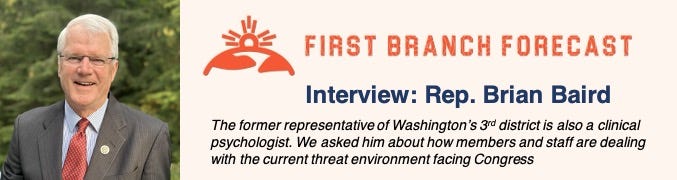
Daniel Schuman: So, we’re here today with Brian Baird, former member of Congress from 1999 to 2011, and as far as I know, the only clinical psychologist to serve in Congress in modern times.
Rep. Brian Baird: Well, actually, Ted Strickland served as well. He was a psychologist as well, but think he had a slightly different degree.
Schuman: We’re focusing on member security and the way that members relate to each other. There have been a number of mass attacks on members of Congress in the last handful of years. There was the attack recently at the Hilton Hotel, where, of course, President Trump and his Cabinet were -- but there were also journalists in attendance and many members of Congress. And while the executive branch officials were sort of whisked away, many members of Congress were sort of left to fend for themselves in light of an uncertain environment.
And of course, we had the January 6th attack just a handful of years ago, where, again, members of Congress were the subject of a mass attack that presumably could leave significantly different attitudes towards their colleagues or how they felt about the institution.
And I’m hoping that you could talk a little bit about how members of Congress view their own safety and how these repeated attacks may have changed the way that members, view and relate to one another.
Baird: I’m really glad to have a chance to talk about this. I think it’s a hugely important topic that, I think is worth doing.
First of all, is just talk about the security situation. And, sadly, there’s grim news on that front, and every member of Congress needs to understand this, as do their spouses, and families. And it’s not pretty: If someone really wants to kill a member of Congress, it’s not hard to do so. All the security measures that have been proposed -- let’s get more Capitol Police on the Capitol grounds, maybe an individual guard when you’re about your official duties. They may make some difference. Certainly, we need to secure the Capitol and the Congressional Office Buildings. But when you’re going about your daily life as a member of Congress, and as a human being, set aside the member of Congress, you still have to go grocery shopping. You still have to come in and out of your house. If you’re doing, parades or town halls or things like that, you’re in the public, and if a person really wants to hunt you down, they can do it.
I don’t say that to be alarmist. But the question is then how do we deal with that? Even just the walk to a vote, if somebody’s hanging out outside the Capitol Grounds and they’re not in that narrow perimeter where you’ve got the magnetometers, just walking up the steps somebody can approach you and shoot you.
My experience talking to members of Congress, there is a paradoxical, logical inconsistency. On the one hand, everybody talks about how we have to be more secure, but then they don’t necessarily take the individual precautions or the institutional precautions to deal with that.
As you know, one of the things that I firmly believe is we need to take measures to ensure the continuity of representation of members of Congress. The first thing we need to do, not for our individual sakes initially, but for the sake of the representative democracy, is provide mechanisms by which you can replace House members if they die through natural causes, accidents, or assassinations. We’ve done nothing to deal with that since September 11th, which is now almost 25 years ago, and the problems remain the same.
Why do I start with that? Because it’s one thing to say somebody just doesn’t like me as a person or as a representative and they want to kill me. That’s a challenge and it’s unpleasant. But it’s another thing to say, “If I kill enough of these guys, I could change the balance of power in the House or Senate.”
As I’ve said before, right now you could fit more bullets into the magazine of a single semi-automatic pistol than it would take to change the balance of power in both the House and the Senate. In one pistol, it’d be so easy to do. The first thing I would do is assure representation and secondly, I would reduce the incentive, the political incentive for assassination. If there were a way to replace members of Congress with like-minded temporary replacements who could fill the role until a special election occurred, then you could kill 30 of us and they would be replaced promptly by people who probably vote about the same way, and there’s no political gain, no chaos, no disruption, no breakage of representation.
So that’s the first point. The second point though is, okay, if you understand that, why are people not acting? And I think there’s this kind of unconscious, if you will, sense that on the one hand I’m cavalier about it -- “Well, that could happen” -- and then on the other hand, that absolves me from taking responsible measures to correct the situation.
You still have to do your job, and your staff have to do their job, and your families have to live with the unpleasantness that you could be harmed or they could be harmed even worse. But that doesn’t mean you do nothing. So, step one is take care of the institutional continuity and then remove the political incentive for harming. Step two then is what are the practical measures that you can take to protect yourself and your family and your staff and the constituents?
Really we began to see a dramatic turnaround in threats to members, just the general attitude, back in the early rise of the Tea Party and in the days of the assault weapons ban votes and some other controversies, and Obamacare.
We went from having town halls -- I had, by the way, more than 350 town halls when I was in office, I think more than almost anybody I know, and they were usually very informal affairs. We’d meet at a fire station in a rural town or at a library or a high school auditorium or something. Anybody’d show up. There were no magnetometers. There were no crazy crowds. People respected one another. Yes, they sometimes criticized me. It’s their right. I have to honor that right, but there were not massive crowds of people pushing one another to try to get in.
Back in that era, believe it or not, there were actually websites created dedicated to telling people how to disrupt town halls. You could log online and search that, and a website would come up that would say, “Get there early. Try to occupy all the spaces. Scatter your supporters around the room. If the member tries to speak, interrupt them. Shout them down. Don’t let there be a rational conversation. Call them liar. Insult...” These were strategic publicized mechanisms for creating a dangerous and threatening environment and disrupting legitimate and essential dialogue between members of Congress and their constituents. It’s only gotten worse.
To give you a sense of how significant it was at the time, during the Obamacare, debates and public discussion, the crowds were so large, we actually held one town hall in an outdoor rock amphitheater and we had 3,500 people in attendance. It was totally different, and there were some pretty hostile folks there. So one of the things that has happened now is members of Congress are getting oftentimes plainclothes police officers at their town halls, and they’re getting more security. We actually had town halls in my era of Obamacare where ambulances were parked at the back of the stage in case I got shot. That’s a true story. So, we have to take those kinds of precautions.
But somewhere along the line, and this is step three, we’ve got to restore the civility of dialogue and have members of Congress, and the President of the United States and his appointees or designees, stop demonizing people on the other side and stop endorsing hatred. When you have a president of the United States, as we have in the case of Trump, essentially, endorsing people being bullied or beaten up from the podium, when he’s saying things like that, that creates that environment.
There’s also a potential hypocrisy here and duplicity that people can say, “Well, if you criticize the president for making those remarks, then you yourself are somehow inciting violence against the president,” that’s duplicitous. I mean, the fact is if you have people who are knowingly and willfully inciting violence through their rhetoric, and condoning violence and you point that out, you are not equal in culpability. So, the first step is to acknowledge the threat, try to reduce the threat through safety mechanisms.
By the way, there’s a whole list of things members of Congress can and should do to secure their offices, to make sure that they know who’s coming in, when they’re coming in, that there is an exit strategy. Every member of Congress should do a safety audit with themselves, their staff, and their families. There should be code words that are used if we need to evacuate. There should be designated routes for evacuation. There should be precautions for your family members to take if they see anything coming. There should be ways in which you can contact them if there’s an emergency, et cetera.
And every member of Congress should make sure their local law enforcement, at all levels, sheriff, police, state patrol, they all know where the member of Congress lives. They should all have a photo of the member of Congress. I hate to say it, but it’s true, especially members of Congress of color, because there may be a default assumption that the members of Congress are going to be white, or if somebody’s not white, they’re not a member of Congress. They need to really say, “this is who I am. This is what my family looks like. Here’s where we live. If you get a call from 417 North Rogers Street, by God, get there fast. And when you get there, this is what the good guys look like.”
There should be safety audits, there should be great contact with your local law enforcement, et cetera, et cetera. I don’t know if that is being done. I’m not hearing of it being done at an organized institutional level, but I think it should be done.
I can speak to there has been progress on those lines. There’s more funding available for coordination, between, Congress, and the Capitol Police, and the local law enforcement. Whether it’s sufficient, whether it’s being done properly, we don’t have visibility into that. But there have been a lot more resources put into trying to address at least that particular concern through reimbursing local law enforcement to be incentivized to provide that kind of support. That’s great, and I encourage every member of Congress to reach out proactively to some members of their law enforcement to do just this. Don’t leave it up to the Capitol Police. That’s, that’s a key message, hardening the targets, if you will. I hate to say it that way, but that’s what you have to do.
Then there’s the issue which you contacted me with, and that is how do we cope with this risk of assault? The first is acknowledge that it’s there, try to reduce it, but don’t imagine that, that you’re going to be 100% safe.
What we found post-September 11th, when I led initiatives to try to help staff and, to some degree, members of Congress cope with the reality of being targets now, and with the massive loss of human life that was unprecedented on civilian targets at the time, we found that one of the essential ingredients was a deep sense of purpose to help people get through this. Why are we doing this? Why are we exposing ourselves to potential risk when there’s a thousand other jobs we could do that are probably less stressful, pay more, and have less risk?
It’s a tragedy that public officials at all levels now, not just members of Congress -- school board members, library officials, elections officials, almost all public officers are, both elected and hired, employed -- are now denigrated and criticized and potential targets for not only opprobrium but attacks. That’s been a concerted rhetorical effort and consequence. When people despise their own government and say that their own employees are worthless, lazy, criminal, dishonest, as frankly, the President of the United States did during COVID, implying that medical doctors and nurses were stealing or misappropriating protective equipment, well, that conduct on his part was reprehensible, but it’s also damn dangerous. And it’s destructive to the fabric of the society.
So back to the sense of calling, members of Congress ideally should be called to serve. They shouldn’t be there to become famous or to make a lot of money, or to pave the way to their next job as a YouTube influencer or something. They should be there to serve, and, that’s a service with humility, I believe. But it’s also a service that carries with it some risk. Nobody said the job would be easy. It shouldn’t, carry mortal risk, but it is a degree of risk that one faces. So, getting at peace with that, yes, I understand there’s a risk, but I’m willing to take that risk to do my job responsibly.
One important element about that is that you not be cowed into either changing your policy judgment out of fear. And, interestingly enough, whether that’s fear of reelection or fear of assassination, at some point you have to say, “What do I think is the right thing for the good of this country, even if it means I get unelected?” It’s funny, I think I’ve talked to members who probably are more afraid of losing an election than they are about losing their lives. But neither should be the governing factor in a democratic republic. You should be able to say, “this is what I believe. Here’s why I believe it. Here’s why I’m voting this way,” and certainly be willing to risk a defeat in an election, but possibly willing to risk even your own life for it if you think it’s that important.
Schuman: can I hone in on that for a second? I think a lot of members -- and you would know better than I do -- have the sense of calling. They have the sense of responsibility.
Baird: Members don’t pass legislation on their own. There is a collaboration that happens. You often hear people talking about the need for bipartisan collaboration. The January 6th attacks… I call it the Trump insurrection. President Trump incited a mob to go and sack the Capitol. Previously, there had been a crazy person who went and tried to kill Majority Leader Scalise and a number of other Republican members who was also motivated by ideology.
Certainly, as I talk to different folks, both members and staffers, they say that something has changed, that the willingness or ability to collaborate across the aisle for members has changed, because they view the other side as not just being the loyal opposition, but some of them as aiding and abetting, efforts to kill them. On one hand in Congress, you have to find ways to work together. On the other hand, you are afraid that some folks are inciting your death.
Schuman: Can you talk about how a member’s perspective changes in those circumstances? How do you cope with that in a body that’s supposed to be collegial but clearly is not?
Baird: Well, it doesn’t work easily. I’ve talked to so many, current members and former members as well, and their staff, and especially as you were saying, Daniel, post January 6th, things really changed. Since the Civil War, there had never been that kind of an insurrection. Prior to the Civil War there were beatings, there were duels, there were people carrying swords and guns onto the floor. But that hadn’t happened to that magnitude since the Civil War.
Post-January 6th, you now had people who condoned, and actually who encouraged the insurrection, who perpetrated the lies upon which the insurrection was based and refused to sanction the president or the would-be assassins who entered the building calling for the execution of the Vice President of the United States and the Speaker of the House, and possibly would’ve done so if they’d have had the opportunity. So now you’re working with people who have condoned a crime, have excused people who conducted violent and destructive acts, and that’s really difficult.
In fact, I’ll be speaking at a conference in two days on how to reduce polarization, and my first point is we have to understand that not everybody wants to reduce polarization. Not everybody believes collaboration and compromise and mutual respect are not values they adhere to. They see those as weaknesses and causes for scorn and disdain. Well, that changes the calculus and the rules about how we normally interact and collaborate.
Even then, there are still often possibilities, however, where we can find common ground. Even in the presence of that vitriol and that level of animosity, we could still try to find areas of common ground. My own belief is without diminishing or denying this very problematic exculpation of threats and enticements and encouragement for threats and acts, we could still try to say, “where are some areas where we agree,” and try to start there.
It doesn’t mean you excuse the conduct that led to January 6th or followed January 6th: But it does mean you still try to function in a positive way where you can. What it should not mean is that you get on the bandwagon of the people who call for insurrections. It should not mean that you join the chorus of people who excuse such things. That’s partly where it’s a problem, when you say to yourself, “this person who is doing that is doing things that are antithetical to the foundations of this country, and I don’t respect their values, and I don’t respect their thinking, and I don’t respect how they view this country.” Those folks you have to try to defeat in election. But that’s the key word. You have to try to defeat them in election, not try to condone violence against them.
Again, when it came to January 6th, one of the things that’s been very difficult for people is the false equivalency. I have spoken to people and said -- and many members, sitting members have had the same experience -- “how do you possibly excuse what happened on January 6th,” and the answer is this false equivalency. “Well, you condone Antifa.” They’re completely different, vastly different. But cognitively, the dissonance reduction is, “we haven’t done anything bad. You do bad things as well. We’re equal,” this false equivalency. There’s a vast difference between the two events and the two organizations. Antifa is not a major political party. It is not the Democratic Party. It is a bunch of ruffians in black outfits. But even then, they never did anything approximating what January 6th has done. That false equivalency becomes a problem and, and it’s very difficult to reason with folks.
I’ve got good friends on the Republican side who say, “Well, on the Democratic side, they’re inciting violence when they use words like fascist.” Well, okay, take out the word fascist, but ask yourself what is the conduct of certain members of the administration or members of Congress? What are their actions, and what does that remind you of? It’s frightening to people.
The hard part is as a psychologist, there’s a temptation to say, “Okay, a traumatic event has happened. How do you deal with that trauma?” I’ve worked with people who’ve been in combat in the military. I’ve worked with people who have been police officers. I’ve worked with people who’ve been in severe car accidents, victims of crimes, et cetera. In all of those cases, there was, there was an end point. In, in other words, the person who assaulted you is not assaulting you today. The war that you were fighting in in Fallujah, you’re not in that combat zone today. Yes, you had this terrible car wreck, but you’re, but that’s a thing of the past. There’s always an awareness after such events of our own fragility. There’s a break in the assumption of normalcy, the assumption of security, but we can begin to heal that wound as psychologists and as human beings by recognizing that those threats or those events were improbable and in the past and I can now move forward in a secure new way.
The challenge with what we’re dealing with and the risk that the members of Congress are facing is it’s not a past event. January 6th still lingers. We still have the people who promoted January 6th in power, in fact, more empowered than ever before. The people who committed the crimes of January 6th have been liberated. So now the dynamic that we usually deal with in terms of trying to help people deal with trauma, the keyword is post-traumatic stress syndrome. if it’s not post-trauma because it can still emerge and is actually being condoned and expanded, that changes how you have to deal with it.
The word that comes to my mind is resolve. It is you’re not going to become the kind of person who incites or condones violence towards the other side, but you are going to resolve yourself steadfastly to not pretend there is not a threat and to use that to channel the energy to make a difference.
In the congressional context, the trauma is not over. Members of Congress and their staff have to work with each other. Legislation passes by a majority. The Republicans, many of them are themselves in a bind where they may abhor what happened. Politically, they separate their personal views from their performative behaviors because it’s to their advantage to do so, or because they know that if they don’t it, the machine of animosity will get aimed at them either politically or personally where they themselves might be subject to threat.
Schuman: Knowing that the situation is ongoing, you talked about perseverance, what else can members and staff do to be able to do their jobs even in the wake of this ongoing trauma that they’re continuing to experience?
Baird: Well, it’s a great question. The first thing, Daniel, is every totalitarian regime in history has depended on the ability to coerce people to shut up and to not speak out, to take the side of the abuser, take the side of the aggressor out of fear of themselves. They may in private lament the choice, but justify it nevertheless. That’s not just fascists on the right, it includes Stalinists on the left. It includes dictators in Latin America on the left and the right and in Africa. The point is, people have to recognize that if you condone totalitarianism and autocracies and cults of personality, eventually you’ll become the victim of that yourself.
The first thing we need is for the people who are in the side of those condoning violence to step up and to their own side, “stop this.” Not to say, “oh, the other side does it too, so therefore,” whatever. Not to think it’s funny, not to think it’s manly, not to think it’s necessary, not to condone it, but to say, “no, this is wrong. The rhetoric is wrong, the policy is wrong, the attitude is wrong, the conduct is wrong, and I insist that you change that.”
Now, some courageous people have done that, and some have been defeated: but there are worse things in life than be defeated in election. To really deserve the job, you have to be willing to lose the job. And if you’re willing to see a rational, deliberative, collaborative democratic republic turn into an autocratic cult of personality so you can get reelected, you don’t deserve to be reelected. You don’t deserve to have violence sent your way, but you don’t deserve to hold the seat.
Schuman: Can, can I push you on that? One of the rationalizations is if I’m not here, worse things will happen. And it’s better for me to be here to stop some of these terrible things that might otherwise emerge so that when there’s an opportunity to do the right thing, I’m the person that’s here to be able to do that. But if they replace me with some zombie, some true-eyed believer, then it’s going to be even worse. What would you say to someone who has that perspective?
Baird: Well, the nature of politics is you sometimes have to make some compromises: but you also have to draw red lines. You have to say, “this one I’m not going to cross. There are certain things I won’t, I won’t condone.” You know, my dear friend Bob Inglis from South Carolina, who was willing to lose his congressional seat because he recognized the dangerous threat to the world of climate change, has told me many times he’s talked to Republicans behind the scenes who say, “Bob, I’ve seen the droughts. I’ve seen the floods. I’ve seen the sea level rise. I’ve, I’ve lost my crops. I understand that something is happening to the climate, and I’ll give you that it’s probably human-caused. But if I say that, I’ll lose my election.” And Bob and I have both marveled at that: so you’re saying that the potential fate of the planet, you’re willing to sacrifice that for the sake of getting reelected on the belief that somehow then you can do something more important. Yeah. I mean, that’s pretty crazy. Well, there, there’s a, a phrase, “Man’s not a rational animal, he’s a rationalizing animal.” At some point you’ve got to look yourself in the mirror and say, “what do I stand for? Why am I here?” The problem is silence is condoning in many cases.
I’ve been in town halls, where folks are getting up and shouting at each other, and I’ve seen a courageous person stand up and say, “Hey, friends, I don’t agree with this man, but can’t we treat each other with respect? This is not helping. can’t we tone the rhetoric down just a little bit?” Now, sometimes they get shouted at, et cetera, but oftentimes there’s that voice of conscience that reminds us of who we need to be, and that voice is really important.
When that voice is silenced, then where are the breaks? Where are the constraints? What can we do to empower those people in this environment, because the congressional environment is a team environment. How do we empower people to act as a check, to break away from this Manichean type of dialogue.
Well, you and I have talked a lot about house rules and how important they are. You work so hard as an individual to get elected to what you think is the great deliberative body, and it turns out leadership on both sides of the aisle -- and here’s where it is not a false equivalence -- leadership in both sides of the aisle just wants you to vote the way you’re told and be a good puppy.
Now, that doesn’t mean you should be a bomb thrower demagogue yourself and a grandstander and say, “hey, look at me. I’m, I’m louder in my criticism of the other side than the other side is of me.” That’s not what I’m talking about. I’m talking about willingness to stand up for a functional, collaborative, representative, deliberative body for rules that allow the legislative process to move forward as it was intended with real debate, time to study legislation, the opportunity to introduce and have amendments on what we would call in the business regular order, which hasn’t been regular for at least three decades almost. We need institutionalists. We need people who say, “we’ve got to make this organization work.” And yes, even if the person on the other side is going to have a policy or that I disagree with, I must have a process by which they do that and by which they can succeed.
I personally think there needs to be a significant movement before the next election to get well-intentioned people from both sides to really think about the House rules and what kind of institution they want to serve in, and put forward some reforms, that can do that.
Chris Nehls: We had the same kind of conversation with Steny Hoyer actually, where he challenged us on if changing the rules would change the culture. He was very much on the you need better people to run for office side. It sounds like you think if you have it more open, regular set of rules and processes, more members can participate, you do create an environment where the bad actors are going to get shut out. Nobody’s going to want to work with the jerks, right? They’re going to be less successful legislators, so maybe it’s a self-healing culture. What do you think about that?
Baird: Well, the great paradox of our constitutional democratic republic today and in the modern era is that the skills and behaviors that it takes to achieve the office are not the skills and behaviors that are required to function well in the office. In fact, they’re often antithetical. So right now, it’s raising money, bombast, demagoguery, grandstanding, extremism. But those skills that it takes to get elected are antithetical to what it takes to govern well. Too much of the debate has been issue-related debate and not character-related debate, and I think we really need profoundly to change that.
I’ve talked to the local paper awhile back and said, “Look, instead of asking, where do you stand on guns, abortion, you know, gay and lesbian rights, blah, blah, blah, pick your topics, right, because, frankly, anybody of any character and capacity can tell you where they stand. That’s not what gets you good representation.” I said to the paper, “ask people this question: Name a time when you had a strongly held position but information changed your opinion, and why did it do so? Give me an example of where you have dedicated yourself to serving others at some significant personal sacrifice. Give me some examples of people you admire on the other side who you think you could work with. how do you feel about collaboration and compromise, and give us example. Tangible examples in your life, not just rhetorical flourish or promises on issues.” Because at the end of the day, it’s the character of the person, it’s how they conduct themselves, it’s their capacity to listen, to understand, and it’s most importantly of all, their commitment to service.
One way we change this is by changing what people look for when they vote for people, by really putting that forward. What have you done with your life that tells us you’re willing to play well in the sandbox and you’re willing to put somebody else’s needs over your own? Then I guess the other question is, how do you make decisions? Does somebody just tell you what to do, or do you study issues and reach rational decisions?
All of that, from how we select people to begin with, how we prepare people, how we prepare the institution through our rules package, how we conduct ourselves once we’re in there, how we relate to one another in our rhetoric and in our conduct, all of that makes a difference. So, I think all that package has to be there.
Nehls: It seems right now censure is the main way to try to bring some kind of discipline or better behavior from some members, and there’s been a big rise in the number of censure votes. What do you make of that? Some members are pushing back like this is just a waste of time. What do you think about it?
Baird: Well, if institutional norms mattered, censure matters. but the problem is that if you’re from the extremes, censure is a badge of honor. You know, it’s a it’s a campaign tactic. “I’m proud to have been censured because you’re censuring a man who tells the truth or a woman who tells the truth, blah, blah, blah, blah, blah.”
When you achieve office by denigrating the institution you’re seeking to become a participant in, you create a vicious and destructive cycle. Now, it’s fine to say, “Congress doesn’t work, and I want to fix it,” in a sincere manner, but that’s different than saying, “it’s a corrupt and horrible institution, and everybody in it is bad,” or, “only people who agree with me are telling the truth.”
There’s some epistemology -- what does it mean to know something? How do we know? What is a fact? How do we reason together? So, you know, you still have to be able to say you are conducting yourself contrary to the norms of this institution.
But frankly, that has to come from leadership. It has to mean something. I mean, for God’s sakes, we’re in a situation with the margins so close that we have people who’ve done pretty damn bad things: breaking the law, dishonesty, misappropriation of funds, abuse of staff, et cetera, and people [in leadership are not saying, “is this the kind of person we want in the United States Congress,” they’re saying, “gee, what’s the vote count?” I get it that the margins are close, but you know what? The tragedy is the public smells that. They say, “you guys aren’t interested in integrity. You’re not interested in solving the problems. You’re just interested in who’s got the most votes.”
Censure’s important, but if somebody says, “the election was stolen,”how do you censor someone for a belief that they believe is true, but is actually inflammatory, false, and destructive, and dangerous? That’s the challenge.
Schuman: It seems like there’s two different types of credibility gaps and you’ve described them both well. One is the credibility gap between, what people campaign on and how they act behind the scenes. I still think that most members of Congress and most staff are there trying to do the right thing.
Baird: Totally agree. And they feel this obligation to play in the bombastic space. Trump is always right or Harris is, whatever, that is their public face. But then their private face is, “no, we can reason together. We can still do deals.” And a lot of, I think, where Republicans feel unhappy is they feel like Democrats are judging them by their actions and not by their intent.
Everybody wants to be judged by, of course, by what you mean to do, but the way we really judge people is by what they actually do. And the same thing is happening with voters. Most members of Congress want to do the right thing, but we see the outliers, at least what I hope are the outliers. Because the other members are not censuring them, are not punishing them in some way, separating themselves, from our perspective, they all look the same because we can’t tell that most of these people mean to do the right thing, but they’re only tolerating Congressman X because the vote margin is thin or some other functional purpose.
Awhile back, many years ago, after I left Congress, I thought it’d be fun to have a dialogue. Actually, Bob Inglis and I worked on this. We had a briefly lived podcast called A Reasonable Conversation. That was an easy domain name to buy because nobody wanted a reasonable conversation.
Everything we’ve just said about politicians is, exponentially greater among influencers and streamers. They get their bread buttered by being extreme, by not saying, “hey, here’s a different perspective that I’ve had on my show before. I realized something I said last week is inaccurate. The other people had a good case to make, and I think we should listen to that.” That’d be an almost an Onion episode.
I do believe that most members of Congress are well-intentioned. I especially believe most staff members are. And, but again, if your leadership is out there spewing hate, and you’re not there saying, “no, that’s not right,” or “well, I agree with his policies, just not the things he says,” I’m sorry, words have consequences, and it gets people killed sometimes. What’s wrong with saying, “I disagree with what he says. I don’t hate the other side. I don’t want to see people harmed”? Nobody whose conduct is detrimental to the wellbeing of the institution and the society should be exempt from, from criticism or correction. It could be respectful, but to say, “I respectfully think the President of the United States should not talk this way, or the speaker, or the minority leader, or et cetera.” If, if they’re conducting themselves in ways that are damaging, we got to call out on that. And, and if we do it ourselves, we need to say, “I sincerely regret that I...”
So now to it back to where we started, the key point I think is there was a time when people looked up to the president and to members of Congress as not just elected officials, but ideally role models, exemplars of what a constitutional democratic republic can be when we elect good people. To the extent that our conduct and our rhetoric and our attitudes deviate from that and appeal to the lowest and most base and vitriolic desires, we create an environment that raises the threat profile. So yes, we can help people cope with that threat profile, but the most important thing we should do is reduce the threat profile itself, is reduce the factors that that are leading to that. The issue of affective polarization in Congress -- affective polarization means we don’t just disagree on policy, we think the other side is evil and bad and in some way deserving of harm -- that’s the danger. We need both sides to say we got to bring that back together.
Now as you know, I really believe service is a way to do that. I believe that when people serve together, truly serve together, they can set aside their differences and find common ground because that motive of service transcends our divisions. I think trying to restore that motive of service in the general public, not necessarily through some big national program, but honoring local -- I don’t want to use the word heroes -- just local people who through their character and kindness make a difference.
I think a lot of the changes have to come at the local level, Daniel and Chris. I really think we need to start looking in our own communities and finding examples of people who are engaging in kindness and making a difference and make that the preeminent sense of who we are as people. And then from that emerge better candidates and better parties.
One last thing, I also think there are a whole package of reforms in how we conduct elections, how we redistrict or do districts, et cetera. I personally have come to believe that the response to the gerrymandering decisions of the court is a multi-member congressional district, first two pass the post because right now, one out of three voters in this country never gets to vote for somebody who is from their same party who actually gets elected. One out of three. It’s probably 30, 40 million Americans. Historically it was blocked by civil rights activists who were believing that it was diffusing minority votes. Well, that argument’s gone. But if you had multi-member districts, you could conceivably elect persons of color in the second position possibly. You would have people from different parties representing the same district with some common interests. They both need the water treatment plant, they both need the overpass, et cetera, et cetera. I think some reforms like that might help us get there in surprising ways. I think putting forward packages like that -- progressive, constructive changes to the rules package, et cetera -- can get us there.
Schuman: Well, I, on behalf of Chris, thank you so much, Congressman Baird. Incredibly helpful, really thoughtful. Thank you.
Baird: The last thing I would say, Daniel, would be we’ve got to make sure that this message gets down to the staff level. We have to help the staff say, “look, regardless of what the big public rhetoric is, you have an opportunity every single day you work in this institution to conduct yourself with kindness and respect and professionalism.” The staff can. They’re not on TV, they’re not running for election. You mentioned earlier it’s a collaborative team. They can say, “I am going to conduct myself with dignity and courtesy and respect because that’s the kind of person I want to be.” Now, not all are going to do that, but if enough do that, it makes a big difference in how the institution works.


